Commentary & Analysis
Two Kingdoms, One Vision: Saudi-Danish Cooperation in Regional Security
While direct bilateral cooperation between Saudi Arabia and Denmark in enhancing regional security in the Middle East has historically been limited, recent developments in the Middle East’s increasingly complex geopolitical landscape have necessitated collaborative security efforts among regional and international actors. Generally, over the past several years, the EU and Denmark have increased their focus on the Gulf region and promoting regional security, recognizing its global implications. The release of the European Commission’s Joint Communication on “A Strategic Partnership with the Gulf” in May 2022 is an excellent example of this. The document was received favorably by the GCC countries and has since served as a framework in which the close interests of both sides are reflected and acted upon. The document explicitly states that “the security and stability of the Gulf region bear direct consequences for the EU.” Therefore, it is necessary to evaluate the current state of ties not only within the context of EU-GCC relations but also more specifically at the level of individual bilateral relations.
Saudi Arabia, as a central nation in the region, has been at the forefront of various diplomatic and security initiatives, ranging from mediation efforts in Ukraine, such as Saudi Arabia’s hosting of the Ukraine peace talks among senior officials from 40 countries in Jeddah in August 2023 after the Copenhagen talks two months prior, and leading the Global Alliance for Implementation of the Two-State Solution. On the other hand, Denmark’s involvement in Middle Eastern security has primarily been through multilateral platforms and alliances. Denmark has participated in various international coalitions and initiatives aimed at countering terrorism and promoting stability in the region. Notably, Denmark plays a significant role in maritime security in the region by being an active contributor to the European naval operation EMASoH/AGENOR in the Strait of Hormuz, which aims to ensure the free movement of ships in the Strait of Hormuz, the Arabian Sea, the Arabian Gulf, and the Gulf of Oman.
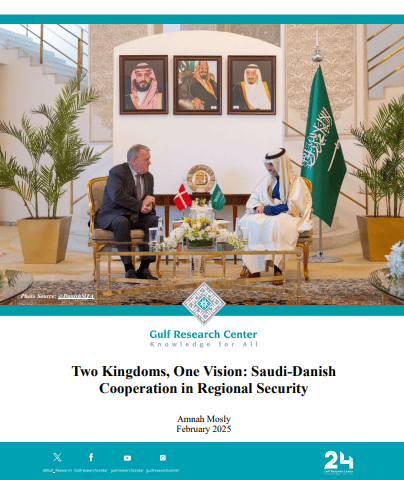
In February 2025, HE Lars Løkke Rasmussen, Denmark’s Foreign Minister, visited Saudi Arabia, marking the first official visit by a Danish foreign minister in over nine years, where he had various meetings, including with HH Prince Faisal bin Farhan, Saudi Arabia’s Minister of Foreign Affairs. The ministers reviewed various ways to strengthen relations between the two countries. The two officials also met on the sidelines of the 79th United Nations General Assembly in New York City in September 2024 and on the sidelines of the first-ever EU-GCC High-Level Forum on Regional Security and Cooperation in Luxembourg in April 2024. In addition, Saudi Arabia’s Foreign Minister received a phone call from his Danish counterpart in October 2023, where they discussed the “importance of intensifying communication with the international community to find a just solution that meets the aspirations of the Palestinian people, mitigates the repercussions of the current crisis in a way that contributes to protecting civilians, and enables the delivery of relief aid and medical equipment.”
During his visit, Foreign Minister Rasmussen acknowledged Saudi Arabia’s crucial role in regional peace efforts in Palestine, Lebanon, and Syria and expressed Denmark’s interest in strengthening bilateral ties across various sectors. The Danish Foreign Minister noted “the very crucial … and constructive role Saudi Arabia is playing in the entire region” as a ceasefire is being established in Gaza, a new president is elected in Lebanon, and Syria sees the transition to a new regime. The Foreign Minister added, “There is a real possibility that we could have peace in Syria, but also (to) a large extent a more … peaceful region.”
On Syria, the Danish Foreign Minister asserted that Denmark intends to engage with the new Syrian government and has introduced humanitarian assistance packages. Denmark has also scaled up its funding for Syria, fully supported the Commission of Inquiry, the Independent Institution on Missing Persons, and the International, Impartial, and Independent Mechanism (IIIM), and has been committed to combatting ISIL since the group’s emergence. On January 8, 2025, HE Christina Markus Lassen, Permanent Representative of Denmark to the UN, asserted in her statement at the United Nations Security Council Meeting on Syria that “Denmark is fully committed to working to this end. To support a Syrian-led political process that includes all parts of Syrian society that paves the way to a peaceful and stable future for all Syrians.”
On Palestine, Foreign Minister Rasmussen stressed that a two-state solution is the “only solution” to the reconstruction of Gaza and assured that the two-state solution is “a consensus decision in the Danish parliament and has been our position for many, many years,” which is why Denmark joined the Saudi-led Global Alliance for the Implementation of the Two-State Solution. The Danish official also explained that the two-state solution would serve Israel’s best interest, explaining that “you can’t solve that problem without creating a sovereign Palestine state, and any idea of just exporting the Palestinian problem to neighboring countries … It’s not doable.” Foreign Minister Rasmussen further proposed that the EU aid the Palestinian Authority “in order to give them the needed competencies to take upon themselves this task” as they must be involved in the solution.
As Saudi Arabia and Denmark continue to navigate the evolving security landscape of the Middle East, several key areas of potential collaboration can be strengthened. Despite operating from different geopolitical contexts, their shared interests in counterterrorism, stability, and international law offer promising avenues for deeper cooperation. Joint efforts should focus on continuing political dialogue, maritime security, and humanitarian aid. Already, there has been an increase in political dialogue on many areas of mutual concern and diplomatic visits between Denmark and Saudi Arabia, as evidenced by the Foreign Minister’s visit to the Kingdom. Denmark’s participation in EU and NATO maritime security initiatives aligns with Saudi Arabia’s regional security efforts, creating a broader framework for safeguarding maritime routes.
NATO itself has undertaken a review of its policies in the Southern Neighbourhood, thus acknowledging the need for an adjustment in its approach. NATO’s decision to increase its regional cooperation began at the NATO Vilnius Summit in July 2023. In May 2024, an independent group of experts appointed by the NATO Secretary General led the first phase of this reflection process and produced a report that stated, “Overall, NATO must listen harder, better and more actively to partners, and invest in skills and people to do this” through “strengthening of NATO’s political dialogue about and with the region, through the language of partnerships, concrete cooperative solutions to shared interests and concerns, and a sustainable long-term commitment.”
Consequently, NATO’s Southern Neighbourhood Action Plan for a more substantial, more strategic, and results-oriented approach to the region was adopted at the NATO Washington Summit in July 2024. The Secretary-General appointed Javier Colomina as his Special Representative for the Southern Neighbourhood, making it the first time that NATO dedicated a focal point for its work on and with the South.
In conclusion, the evolving geopolitical landscape necessitates a strengthened partnership between the two kingdoms, especially in light of global challenges that require collaborative responses. Looking ahead, prioritizing regular high-level exchanges and joint initiatives will be crucial in realizing the shared aspirations of Saudi Arabia and Denmark, ultimately fostering a resilient and prosperous partnership that can address contemporary challenges and promote mutual benefits for both regions.
*Amnah Mosly is a Researcher at the Gulf Research Center (GRC)