Commentary & Analysis
US-Gulf Relations Under Trump 2.0
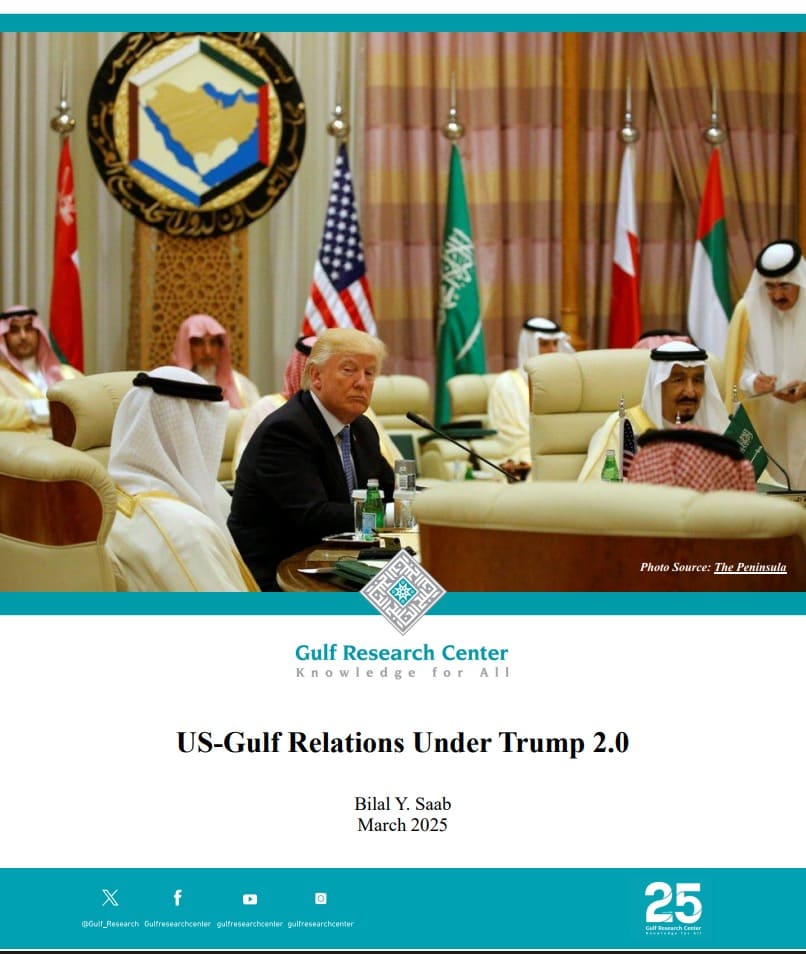
US President Donald Trump’s warmer personal relationships with several Gulf Arab leaders, along with his penchant for big deals in foreign policy, should, in theory, serve US-GCC relations. In the current strategic environment, there is much that the two sides can work on including enhanced economic cooperation, technological collaboration, and coordination on the issues of Iran and regional stability.
But an opportunity without a plan is just that – an opportunity. The key is to find areas of common ground, issue a strategic dialogue (or dialogues with individual GCC countries), and devise strategies that promote collective interests.
A good start for Washington would be to get a better understanding of its Gulf Arab partners’ strategic positions, preferences, and concerns. Not all of them will be met, of course, but core ones, once identified, should be considered to avoid disappointments and frustrations, as experienced in the lead-up to the signing of the Iran nuclear deal in 2015.
On the issue of Iran, for example, countries including Saudi Arabia, the United Arab Emirates, and Qatar have no interest in seeking any confrontation with their larger neighbor. The opportunity to further weaken Iran exists, and they can see it, but they won’t take the lead. They never have and probably never will.
The days of lobbying Washington for a more aggressive approach towards Iran—especially on the issue of the Islamic Revolutionary Guard Corps’ sponsorship of political violence across the region—are over for the foreseeable future. Riyadh, Abu Dhabi, and others have chosen the path of accommodation and normalization with Tehran so they can focus on their top priority: economic development. They want a calm and stable region that can attract the foreign direct investment they need to fulfill the goals they laid out in their long-term economic visions.
Even when the UAE and Bahrain signed the Abraham Accords with Israel in 2020, they deliberately underemphasized security cooperation to avoid alienating or provoking Iran. Four years have passed since the signing of those Arab-Israeli normalization deals, and we have yet to hear of any joint security initiative between its members. Even to this day, when Gulf Arab leaders meet with their US counterparts in Washington or the region, the discussions center on economics, technological innovation, and investments. There is hardly any talk of joint security. Gulf leaders also continue to refuse to let the US military launch attacks against Iran’s regional allies—be it the Houthis in Yemen or the militias in Iraq—from their own territories.
None of this suggests that the Arab partners suddenly trust Iran or do not worry about their security. But it means that whatever opportunity Iran’s current relative weakness presents, the Arab partners have a ceiling in terms of security cooperation with Washington and Israel.
In his statements on Iran, Trump seems to have prioritized the issue of reaching a nuclear settlement. His general preference, like that of the Arab partners, is to stop all wars in the Middle East and promote economic development.
Although Trump did not say much on Iran’s regional conduct, and his strategy for Iran has yet to mature, it is possible he is more interested in focusing on the nuclear issue, which appears to be moving quickly. The gist of his approach towards Tehran is likely to be fairly simple: reach a deal or risk getting bombed, either by the United States or jointly with Israel, which already has its finger on the trigger.
However, this doesn’t mean that Trump will totally ignore Iran’s destabilizing activities in the region. In his first term, he ordered the killing of Quds Force commander Qasem Soleimani in January 2020. It was a debilitating blow to Iran’s military power in the region. Soleimani was the glue that kept Tehran’s regional network together, and the Iranians have had a very hard time finding a capable replacement. Trump might view such aggressive US tactics against Iran as a means to compel Tehran to make concessions on its nuclear program.
But beyond the general dispositions of Trump and the Arab partners, there is no question that there is plenty of room for further security cooperation. Indeed, there is no philosophical clash or major disagreement on Iran between the two sides. Each will pursue its national interest, as always, but it would be foolish not to take advantage of this historic moment in the region—one where Iran is not on the ascendancy and wreaking havoc across the region but on the decline.
Should that come to pass, it could considerably influence how Saudi Arabia (and again, possibly others) decides to treat its cooperation with the United States on regional security. With a robust US defense pact, Riyadh could accept greater risk than before, knowing that if a conflict with Iran erupts or if Iran attacks the Kingdom again as it did in September 2019, the United States will be legally obligated to intervene militarily on its behalf. Under such a framework and the US security umbrella, various forms of security cooperation between the two countries could be entertained and instituted, especially on integrated air and missile defense, which could benefit the whole region.
Short of a US defense pact, the Arab partners will continue to shy away from any anti-Iran coalition and focus instead on upgrading their own defenses by lobbying Trump for equipment that has been off the table for years, including fifth-generation aircraft, communications systems, autonomous weapons, and various munitions.
Trump will ask for the Gulf Arab states’ cooperation on post-conflict reconstruction in Gaza and Lebanon, and on regional security should a contingency with Iran arise, similar to what happened last year when Iran and Israel traded direct blows twice. The Gulf Arab partners may oblige but only if the US plans serve their interests and long-term visions for their economies and societies.
*Bilal Y. Saab is the Senior Managing Director of TRENDS US in Washington, DC.