Commentary & Analysis
Strategic Alliances: The Gulf States and Africa in a Multilateral World
Gulf states, notably Saudi Arabia, Qatar, and the UAE, are redefining their global standing by pursuing ambitious national visions aimed at reducing oil dependence and expanding their influence. A vital component of this transformation is the Gulf Cooperation Council’s (GCC) deepening engagement with African nations through multilateral organizations. Their participation in groupings such as the G20, the Organization of Petroleum Exporting Countries (OPEC), and the Organization of Islamic Cooperation (OIC) provides pathways for political cooperation, economic investment, and security collaboration. By leveraging these institutions, the GCC strengthens its ties with various partners, including Africa, enhancing its diplomatic reach and asserting itself as a key player in shaping the emerging global order.
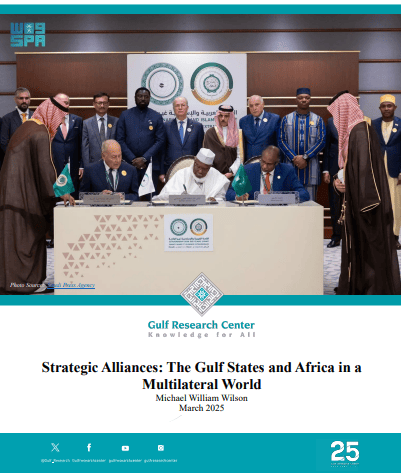
Multilateral institutions have played a key role in strengthening political relations between the Gulf and Africa. The OIC, one of the earliest multilateral platforms linking the two regions, includes the six GCC states and 26 African nations, such as Nigeria and Mali. As “the voice of the Muslim world,” the OIC promotes international peace and unity.1 The GCC states actively leverage the OIC to shape pan-Islamic positions on key geopolitical issues. For example, Saudi Arabia hosted the Arab-Islamic Summit with the Arab League and the OIC in 2024, responding to the Israeli aggression against Palestinians in Gaza. The summit condemned the violence in Gaza and tasked foreign ministers of Nigeria, Saudi Arabia, and Qatar, amongst others, to form an international coalition to halt the hostilities. The summit’s resolution mobilized support for Palestine, underscoring the trend of multilateral cooperation between African and Gulf nations working together within the OIC framework to advance shared interests. By leveraging such institutions, the GCC ensures that its policies resonate across the wider Muslim world, strengthening its leadership role in global Islamic affairs.2
As a result of action taken by the OIC, the African Union (AU) has reinforced this solidarity by supporting the Palestinian cause, demonstrating how multilateralism fosters consensus and policy alignment between the Gulf and Africa.3 South Africa, a G20 and AU member, further championed the Palestinian cause by leading a case at the International Court of Justice, accusing Israel of violating international law and committing genocide against the people of Gaza. Gulf states, including Bahrain and Saudi Arabia, have echoed this support through their foreign ministries and UN representatives. At the UN Security Council’s open debate on the Middle East, Bahrain’s Permanent Representative, Ambassador Jamal Fares Al Rowaiei, chaired the Arab Group and reaffirmed its backing for South Africa’s case, underscoring the role of multilateralism in deepening cooperation and demonstrating solidarity.
Gulf states have also used their influence in multilateral organizations to advocate for African interests. For instance, during Saudi Arabia’s G20 presidency, it proposed suspending African debt payments to ease economic strain during the COVID-19 pandemic.4 The Kingdom also pushed for the AU to gain permanent membership in the G20, further demonstrating its commitment to amplifying Africa’s position in the global order. During South Africa’s G20 presidency, its ambassador to Saudi Arabia, Mogobo David Magabe, praised the Kingdom’s leadership in addressing global challenges and its role as a geopolitical mediator.5
Economic cooperation extends to the energy sector, where OPEC facilitates coordination among petroleum-producing nations to stabilize oil markets. Saudi Arabia, the UAE, Kuwait, Nigeria, the Republic of Congo, Equatorial Guinea, and Gabon are all OPEC members, leveraging their partnership to align energy policies for mutual benefit. Through strategic agreements, OPEC also steers investment in Africa’s oil and gas infrastructure, supporting exploration, refinement, and distribution projects. At the annual OPEC Africa Energy Dialogue in 2024, African leaders secured financing for energy initiatives. The OPEC Secretary-General has urged African countries to tap into their hydrocarbon potential, boosting energy access across the continent. For instance, Nigeria’s Dangote oil refinery will be the first of its kind in West Africa and reflects the materialization of the shared vision between OPEC and African members. Secretary-General of OPEC, Haitham Al Ghais, further commented that Nigeria’s contributions to “OPEC’s successes” have underscored the benefits of working with the nation and demonstrated how multilateral institutions can foster economic and commercial synergies. 6
The BRICS (Brazil, Russia, India, China, and South Africa) has, in the meantime, emerged as a pivotal platform for Gulf-Africa cooperation, aiming to establish an economic system independent of Western-dominated markets. The bloc has expanded to include African and Gulf states, with the UAE formally joining in 2024 and Saudi Arabia considering becoming a full member. Nigeria became the fourth African “partner” member in 2025, alongside Uganda.7 These developments have created a more conducive environment for South-South economic collaboration, strengthening the Gulf’s role as a strategic partner for Africa.
Multilateral summits have provided another area of collaboration. At COP 28, the UAE announced a 4.5 billion USD fund for energy transition efforts in Africa through renewable energy and carbon capture technologies. The Saudi Africa Summit in 2023 hosted 43 African Heads of State in Riyadh to identify mutual interests in energy, mining, agriculture, and aviation sectors. Both summits brought regional leaders together and heightened their diplomatic rapport while servicing economic agendas.
Security collaboration between the Gulf and Africa has also expanded through multilateral efforts. In 2018, the UAE and Saudi Arabia contributed $130 million to the Joint Task Force combating violent extremism in the Sahel region, supporting Burkina Faso, Chad, Mali, Mauritania, and Equatorial Guinea. Additionally, the Islamic Military Counter Terrorism Coalition, comprising 43 African and Gulf states, has played a vital role in counter terrorism efforts.
Gulf states have actively mediated African conflicts and fostered multilateral peace proceedings. Notably, Saudi Arabia’s role in mediating the peace between Eritrea and Ethiopia in 2018 and Qatar easing the rapport between Kenya and Somalia in 2021. Qatar has been instrumental in facilitating peace talks between the Democratic Republic of Congo’s President Félix Tshisekedi and Rwanda’s President Paul Kagame—an effort that had previously failed under other mediators. This success highlights Qatar’s growing influence as a diplomatic broker.
Following a series of coups in the Sahel, ECOWAS suspended Mali, Burkina Faso, and Niger from the regional economic bloc. In contrast, Saudi Arabia took a more pragmatic approach, inviting coup leaders to the 2023 Saudi-Africa Summit, where it secured cooperation agreements across several sectors. This underscores the Gulf’s ability to maintain ties even in times of political instability, distinguishing its approach from Western and African counterparts who opted for sanctions or diplomatic isolation.
Multilateralism can, therefore, be seen as a key vehicle to strengthen Gulf-Africa relations, facilitating economic partnerships, security collaboration, and diplomatic alignment. Institutions like the G20, OIC, OPEC, and BRICS have provided platforms for both regions to align their interests and show their solidarity. This approach enabled the Gulf to also play a growing role in conflict mediation across Africa.
----------------------------------
1 Organization of Islamic Cooperation
2 “Saudi Arabia to Host Arab-Islamic Summit to Halt Israeli Aggression on Palestinian, Lebanese Territories.” 10 November 2023 Saudi Press Agency
3 “OIC, Arab League, African Union Commission Sign Tripartite Document on Palestine.” 12 November 2024 Saudi Press Agency
4 “Riyadh Declaration of Saudi-African Summit Issued.” 10 November 2023 Saudi Press Agency
5 Lama Alhamawi February 13 2025. “‘Lessons to Be Learned from Saudi Arabia’s G20’ Says South African Envoy.” Arab News
6 “OPEC Bulletin February 2024.” 1st February 2024. Organization of Petroleum Exporting Countries.
7 “Nigeria Joins BRICS as a Partner Country.” January 17, 2025. Ministério Das Relações Exteriores.