
Commentary & Analysis
Realism and Transactionalism: Afghanistan Experiences Neighbors’ Embrace
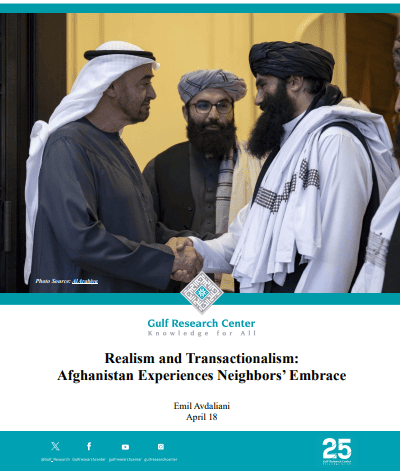
Since the return of the Taliban to power in Afghanistan in 2021, outright hesitancy among the country’s neighbors to build rapport with the new Afghan authorities has given way to active attempts to develop closer ties with Kabul. Natural resources of Afghanistan as well as the country’s strategic location push its neighbors to seek understanding with the Taliban. Moreover, there is the issue of shifting connectivity in Eurasia, with Afghanistan poised to play an important role in connecting Central Asia with South Asia, as well as China with West Asia. Afghanistan has gradually become more integrated in various regional projects and its political rehabilitation is now in full swing with countries such as Iran, Russia, and the Central Asian states inching closer to official recognition of the Taliban.
Political Dimension
Iran’s shifting position is a good example of how Afghanistan’s neighbors have started to perceive the country and its leadership. Although Iran has not yet formally acknowledged the Taliban as Afghanistan’s legitimate governing body, recent developments in bilateral trade, investments, and political engagement suggest a major shift in bilateral relations is forthcoming.
On January 26, Iranian Deputy Foreign Minister Abbas Araghchi made a notable trip to Kabul, marking the first high-level diplomatic engagement of its kind in nearly a decade. In October 2023, a joint Afghan-Iranian chamber of commerce was created to facilitate trade and transit via Iran’s Chabahar Port. A month later, Tehran approved unrestricted Afghan access to the port – a strategic gateway that enables Afghanistan to bypass Pakistan in reaching Indian markets. The two also agreed to activate the Khaf-Herat railway link. Kabul has further expressed interest in involving Iranian firms in Afghanistan’s mineral extraction efforts, particularly in the western regions close to the Iranian border. Afghanistan, with its estimated $1 trillion worth of minerals including lithium and rare earth elements, remains largely untapped due to logistical, financial, and security challenges.
Barter trade and cross-border transactions in local currencies have grown and Tehran and Kabul agreed to create a free trade zone in Iran’s Khorasan region. Both sides have argued that their annual trade volume could reach up to $10 billion.
However, challenges persist. A major concern is the extensive and largely unsecured 900-kilometer border between the two countries, which remains a hotspot for drug trafficking and extremist group activity. Water-sharing has also become a point of contention. The Helmand River, which flows from Afghanistan into Iran, has seen reduced flow due to dam construction upstream. And another ongoing issue is the presence of millions of Afghan refugees in Iran, a source of domestic tension amid economic strains and security concerns.
Outside bilateral dynamics, there are broader regional developments that push the two countries closer. Over the course of 2024, Iran’s geopolitical standing declined, particularly as its network of proxy groups – such as Hezbollah and Hamas – suffered major setbacks. These losses coincide with an emboldened Israeli posture and renewed U.S. pressure under Donald Trump’s reinstated “maximum pressure” policy. Normalizing ties with the Taliban now aligns with Tehran’s broader diplomatic efforts to reduce tensions with neighbors such as Azerbaijan, Gulf states like the UAE and Saudi Arabia, and even Tajikistan.
This fits into a much wider shift in how countries approach the Taliban. For instance, Russia’s approach toward Afghanistan likewise has seen major changes. In late March, the Russian Prosecutor General’s Office as well as the country’s Ministry of Foreign Affairs effectively signaled that Moscow was inching closer to removing the Taliban from the list of terrorist organizations. In July 2024, the Russian president even called the Islamist group “a trusted ally,” while in November that year Russian Secretary of the National Security Council, Sergey Shoigu paid a visit to Kabul where the two sides discussed security and trade issues. Moscow is especially concerned about potential strengthening of the jihadist group Islamic State – Khorasan Province (ISIS-K).
For Russia, establishing formal ties with Kabul is about recognizing a fait accompli – the Taliban is unavoidable risk factor that would be unwise to ignore. In fact, Moscow wants closer cooperation with Afghanistan on such issues as security (especially in light of potential spillover into Central Asia), raw material extraction, and more importantly, development of connectivity. For Russia, this approach is part of its pivot to Asia which began following the annexation of Crimea in 2014 and ensuing Western sanctions, and accelerated after the full-scale invasion of Ukraine in 2022.
As for the Taliban, formal ties with Russia are all about garnering international recognition via Moscow’s help in various global platforms. Potential Russian investment in extraction industry and agriculture is also something that the Taliban seeks. Yet, geographic distance, lack of infrastructure as well as competition from more powerful countries such as China, will likely constrain Moscow’s potential.
Closer engagement is likewise observed in Afghanistan’s relations with the Gulf Cooperation Council (GCC). In early 2022, the GCC held its first meeting with the Taliban and discussed humanitarian issues confronting Afghanistan. Among the GCC countries, Qatar stands out most as reflected in a meeting between Qatari Prime Minister and Foreign Minister Mohammed bin Abdulrahman Al Thani and the Taliban supreme leader, Hibatullah Akhunzada, in 2023. Earlier this year, a high-level meeting took place between the UAE and the Taliban leadership – the second such meeting in a year. Afghan representation in the UAE was elevated to a general consulate and the Gulf country also accepted Badruddin Haqqani as a Taliban ambassador. Active meetings were also held with Omani leadership, while Saudi Arabia seems to be more hesitant. However, even then, several meetings between the Kingdom and Taliban officials have taken place. The GCC countries have thus gradually moved beyond caution and strictly humanitarian aid policy, into a more politically cooperative mode with the Afghan leadership.
Then there are Central Asian states which are very much interested in closer cooperation with Afghanistan. In 2024, Kazakh President Kassym-Jomart Tokayev announced that Kazakhstan had officially removed the Taliban from its national list of terrorist organizations – a designation that had been in place since 2005. This move is a part of Astana’s broader strategy to strengthen economic and trade ties with Afghanistan. Tokayev emphasized the need for pragmatic engagement and in August 2024, Kazakhstan also accredited a Taliban-appointed chargé d’affaires similar to what China did when it accepted Taliban-appointed diplomats and indicated a readiness to pursue joint projects.
There are economic incentives behind Kazakhstan’s moves. The country’s trade with Afghanistan approached $1 billion in 2022, with Afghan imports consisting largely of Kazakh flour— accounting for around 70% of total imports. Both sides expect bilateral trade to reach $3 billion in the coming years. This economic strategy is supported by ongoing humanitarian efforts. In 2023, Kazakhstan allocated $2.6 million in food aid to Afghanistan and has raised the issue of Afghanistan in multilateral settings such as the one in July 2024 when a special session of the C5+1 platform in Astana was held.
From Kazakhstan’s perspective, economic engagement is a means of both stabilizing Afghanistan and insulating the broader region from extremist threats. This includes tackling the narcotics trade, which remains a destabilizing factor. One of the options to reduce security instability from Kazakhstan relates to fostering reliable overland routes from Central Asia to Afghanistan.
It has been Kazakhstan’s long-standing goal to diversify its connectivity with major economic centers of Eurasia. New commercial lines could indeed serve as a powerful incentive for Afghanistan to integrate into the Central Asian market. In sum, Kazakhstan’s removal of the Taliban from its terrorist list marks a shift dictated by regional pragmatism and aims to address the drivers of instability in Afghanistan through economic development and multilateral cooperation.
A similar approach to engagement is evident in other Central Asian countries. Tajikistan and Kyrgyzstan have signaled their willingness to cooperate with the Afghan government. In terms of Uzbekistan’s approach, if before the Taliban takeover and in its immediate aftermath, Uzbekistan’s policy was more security-driven, it has now become clear that an economic engagement has prevailed. For instance, in August 2024, the Uzbek side signed an agreement worth $2.5 billion in trade and investment deals with Afghanistan. Then in September, both countries opened the Airitom Free Zone on the Afghan border. The initiative covers 36 hectares, cost $70 million and is expected to serve as a major economic zone to facilitate trade between the two countries. Bilateral trade levels have also become promising, with the $3 billion mark reached in 2024.
Overall, Uzbekistan is interested in investing in Afghanistan’s mining and agriculture sectors as well as in selling electricity to its southern neighbor. Surely, security issues have not disappeared from the agenda altogether. Potential trans-border threats still constitute a major concern for Tashkent. This growing engagement also translated into political ties such as the October decision by Tashkent to accept an ambassador from Afghanistan’s Taliban authorities.
Shifting Eurasian Connectivity
As part of Afghanistan’s growing engagement with the region, the country’s efforts to develop efficient links with the surrounding regions have been especially noteworthy. Moscow is particularly interested in building new trade corridors and expanding existing ones throughout Central Asia to Afghanistan. Its pivot to Asia as a result of the war in Ukraine and the Western sanctions boosted this vision. For instance, in late 2024, Kyrgyzstan and Russia launched an ambitious project for a new transport corridor that is planned to pass through Turkmenistan and bypass Kazakhstan. The corridor – “Russia-Caspian Sea-Turkmenistan-Uzbekistan-Kyrgyzstan” will allow goods to be delivered from Kyrgyzstan to the ports of Astrakhan and Makhachkala.
Russia also continues its work on the International North-South Transport Corridor (INSTC) which stretches from the country’s heartland, especially the Caspian region, to Iran and the latter’s ports in the Gulf. One of the branches of the INSTC runs through Central Asia—and Russia has been particularly interested in activating this line as it would allow the country to reach out to mineralrich Afghanistan. When Russian Secretary of the National Security Council, Sergey Shoigu, visited Kabul one of the issues he discussed with Afghan counterparts was the latter’s willingness to play a more active role within INSTC. Moscow also expressed its interest in participating in the implementation of the trans-Afghan railway project.
Following the return of the Taliban, Afghanistan is indeed a focal point of the larger Central Asian region, especially as it aims to establish smoother links with the neighbors. For instance, the initiative to build the Termez-Naybabad-Logar-Kharlachi railway route, which provides for a direct connection to the Pakistani seaports of Karachi and Qasem, represents an important step in the integration of the Eurasian and South Asian railway networks through Afghanistan. This project will land the region on what historically was the Great Silk Road and will offer the shortest land route between several regions of Eurasia by reducing the time and cost of cargo transportation by some 30-40%. Estimated transportation volumes may increase to 3 million tons in the first years of operation, and to more than 20 million tons per year by 2030.
Additionally, the 1,468-kilometer Mazar-i-Sharif-Herat-Kandahar railway line project was unveiled by Afghan officials in May 2023. Later, plans for the building of the Spin BoldakKandahar railway were announced. Alternatively, Turkmenistan suggested a different TransAfghan Corridor that would run via the Torghundi-Herat-Kandahar-Spin Boldak corridor. Kazakhstan later joined the project, and in September 2024, the groundwork for a 22-kilometer railway line linking Sanobar and the border station of Torghundi was built.
Likewise in 2023, representatives of Uzbekistan, Pakistan, and Afghanistan announced they would work toward linking South and Central Asia through a railroad to boost commercial ties in the region. This has now evolved into the Trans-Afghan Multimodal Transport Corridor and in 2024 the first pilot project was successfully completed, shipping cargo via the corridor from Kazakhstan to Dubai.
Looking Ahead
Big and small, actors in Eurasia have grown increasingly close to recognizing the Taliban and developing transactional type of relationships. At the heart of this shifting attitude lies the growing interest in building new commercial and transit links between Afghanistan itself and its neighbors. In short, Afghanistan and its surrounding regions are gradually opening up to each other through expanding connectivity. Indeed, trade and transit routes through Afghanistan have always been central to Eurasian connectivity both in medieval and modern times.
Surely, not all is as going as smoothly as presented by involved parties. For instance, insecurity in Afghanistan coupled with caution on the part of its neighbors limits the scope of potential cooperation. Much will also depend on how long-term Russia’s pivot to Asia will be given its ongoing negotiations with the US and the potential for reconciliation. Should the Western markets re-open to Russian businesses, the urgency in Moscow to look eastward and invest into the INSTC could decline. Nevertheless, there is a clear geopolitical trajectory of Afghanistan becoming more integrated into Central Asia and wider Eurasian connectivity and commerce.
Emil Avdaliani is a professor of international relations at the European University in Tbilisi, Georgia, and a scholar of Silk Roads. He can be reached on Twitter/X at @emilavdaliani.