Commentary & Analysis
Forging a New Arc: Enhancing GCC–Central Asia Relations in a Shifting Global Order
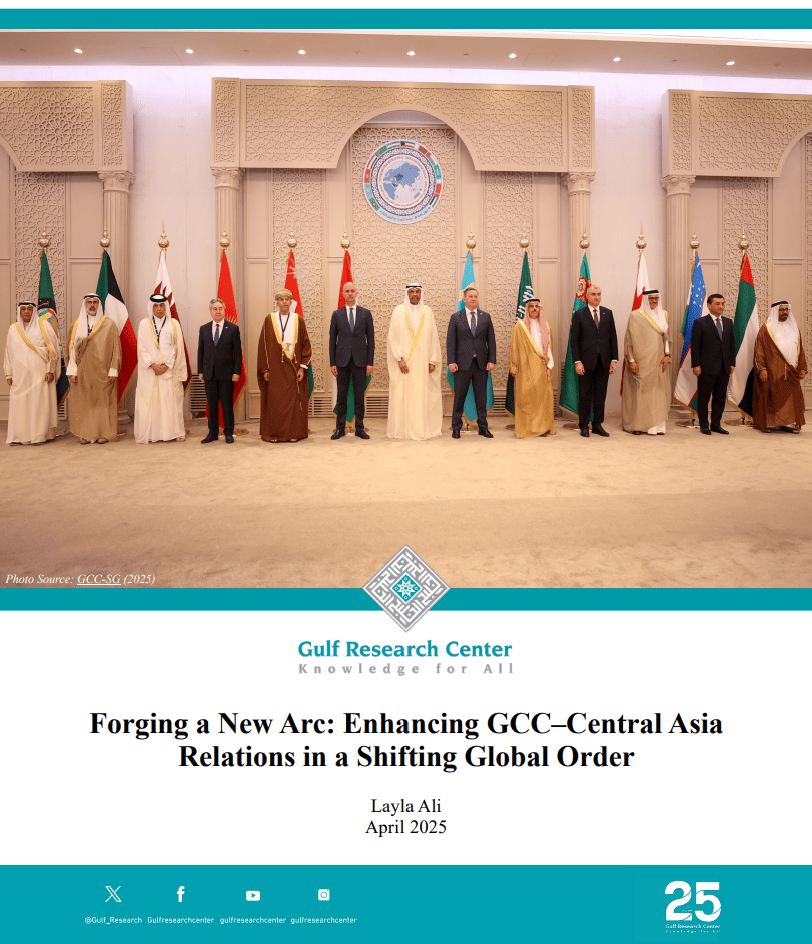
As the global order undergoes significant transformation, marked by the return of great power competition, regional multipolarity, and the rise of middle powers, new avenues are opening up for strengthened relations between the Gulf Cooperation Council (GCC) countries and Central Asia. Both regions, strategically located at the crossroads of Asia, the Middle East, and Europe, are recalibrating their foreign policies to align with emerging global dynamics. This commentary examines what to expect from GCC–Central Asia relations in the near future and outlines strategies to enhance cooperation across key sectors.
Shared Strategic Interests in a Fragmented World
The fragmentation of the global order has prompted middle powers to seek diversified partnerships beyond traditional alignments. For GCC states, Central Asia offers a relatively untapped strategic corridor that complements their eastward diversification efforts and aligns with their growing interests in Eurasian connectivity, trade facilitation, and regional security frameworks. As competition intensifies among global powers, GCC states—particularly Saudi Arabia and the United Arab Emirates—are seeking to expand their influence by leveraging economic diplomacy and cultivating new geostrategic relationships.
Conversely, Central Asian states view the GCC as a stable and resource-rich region that can offer investment, technology, and political partnerships beyond Russia and China. The ongoing conflict in Ukraine and increasing economic sanctions on Russia have underscored the importance of economic diversification and political hedging for Central Asian republics. In this context, ties with the GCC offer not only alternative funding sources but also access to global markets and innovation ecosystems in the Gulf.
Both regions are increasingly drawn to non-aligned strategies, emphasizing pragmatism, development, and economic sovereignty. These common principles serve as the foundation for future diplomatic convergence, particularly in international forums such as the United Nations, the Shanghai Cooperation Organization (SCO), and the Organization of the Islamic Cooperation (OIC). Here, we can expect closer coordination on themes such as multilateralism, noninterference in domestic affairs, sustainable development, and pressing global issues like food and energy security, climate change, and conflict resolution.
Economic Cooperation and Investment Opportunities
One of the most promising areas for GCC–Central Asia cooperation lies in economic development. Central Asia, with its vast natural resources, young population, agricultural potential, and infrastructure ambitions, is actively seeking foreign direct investment. Meanwhile, GCC countries—particularly Saudi Arabia, the UAE, and Qatar—are utilizing their sovereign wealth and technical expertise to establish long-term economic partnerships through national strategies such as Vision 2030 (Saudi Arabia), Vision 2035 (Kuwait), and the UAE Centennial 2071. This economic growth potential is a source of optimism for the future of GCC-Central Asia relations. In recent years, there has been a rise in high-level investment forums and trade delegations between the two regions. For example, the Saudi-Central Asia Investment Forum has highlighted potential sectors for collaboration, including renewable energy, transport corridors, fintech, logistics, and agro-processing. Kazakhstan, Uzbekistan, and Turkmenistan stand out as desirable markets due to their mineral wealth, liberalizing economic reforms, and integration into regional corridors such as the Belt and Road Initiative (BRI), the Middle Corridor, and the International North-South Transport Corridor (INSTC).
GCC sovereign wealth funds—such as Saudi Arabia’s Public Investment Fund (PIF), the UAE’s Mubadala and ADQ, and Qatar Investment Authority (QIA)—are increasingly eyeing Central Asia as a long-term strategic investment destination. For instance, ADQ and Mubadala have explored renewable energy and agritech projects in Uzbekistan, while the QIA has held discussions about co-investing in logistics and mining ventures in Kazakhstan. The PIF is also reportedly assessing opportunities in transport infrastructure and data centers in the region as part of its global diversification strategy.
Simultaneously, Central Asian states could explore reciprocal investments in Gulf ports, logistics zones, and digital infrastructure projects to expand their global connectivity and access. Kazakhstan’s national railway company, KTZ, has expressed interest in Gulf port partnerships to connect to the Indian Ocean through UAE logistics hubs. Uzbekistan’s IT Park has also been in talks with Gulf-based tech accelerators to create digital corridors between Tashkent and Dubai, aiming to link Central Asian startups with Gulf venture capital and AI infrastructure.
Energy Transition and Strategic Resource Collaboration
Energy remains a foundational component in GCC–Central Asia cooperation, but the nature of this cooperation is evolving. Both regions are investing heavily in clean energy initiatives, including solar, wind, and hydrogen technologies, as they strive to meet their emissions targets and reduce their dependence on fossil fuels.
Gulf countries, with their advanced expertise in project financing and energy infrastructure, can support Central Asian countries, particularly Kazakhstan and Uzbekistan, in achieving their decarbonization goals. For example, Masdar, the UAE’s renewable energy giant, signed a deal with Uzbekistan to develop over 2 GW of solar and wind energy projects. Saudi Arabia’s ACWA Power is similarly involved in building wind and gas-to-power projects in Uzbekistan, showcasing the growing Gulf footprint in the region’s clean energy transition.
These partnerships can also extend to green hydrogen development, carbon capture and storage (CCS) projects, as well as sustainable water and energy management solutions. There is increasing interest in developing a green hydrogen corridor from Kazakhstan to the Gulf, facilitated by logistics networks through the Caspian and Arabian Seas. Meanwhile, both Qatar and the UAE are exploring water-saving agricultural technologies that could be piloted in Central Asia’s arid regions.
Furthermore, Central Asia’s wealth in strategic minerals—including rare earth elements, lithium, and uranium—is of growing interest to GCC states. Kazakhstan, one of the world’s leading uranium producers, has already signed nuclear energy cooperation agreements with the United Arab Emirates (UAE), reflecting the region’s broader strategic value. This aligns closely with Saudi Arabia’s ambitions under its national strategy for mineral development, which seeks to position the Kingdom as a global hub for critical minerals by diversifying supply sources, attracting foreign investment, and developing domestic downstream industries. Strengthening ties with Central Asian countries could therefore play a key role in advancing Saudi Arabia’s goals in the mining and energy sectors.
As Gulf economies build out their nuclear energy programs and high-tech manufacturing capabilities, securing access to these critical resources will become a shared priority. Tajikistan and Kyrgyzstan, with growing interest in hydropower and untapped mineral reserves, are also emerging on the radars of Gulf investors.
Security and Counterterrorism Coordination
Security cooperation between the GCC and Central Asia is an underexplored yet crucial area. Both regions face similar threats, including extremism, border insecurity, trafficking networks, and growing cyber threats. The withdrawal of U.S. forces from Afghanistan and the evolving situation there have amplified the need for regional coordination on security.
Joint security mechanisms—such as regular dialogues between national security councils, military-to-military cooperation, and intelligence-sharing agreements—can help both sides anticipate and manage emerging risks. Establishing working groups on counterterrorism, border management, and cybersecurity could be explored through regional forums such as the Conference on Interaction and Confidence Building Measures in Asia (CICA) or the Arab League’s coordination platforms.
People-to-People Ties and Cultural Exchange
Despite progress at the governmental level, cultural and social engagement remains limited. Strengthening people-to-people ties through education, tourism, arts, and media can lay the foundation for more resilient bilateral relations. The potential for stronger bilateral relations through cultural exchange is significant and should not be underestimated.
GCC countries can expand scholarship programs to Central Asian students and promote university partnerships, joint research initiatives, and language exchange programs. Institutions such as King Abdullah University of Science and Technology (KAUST), Qatar Foundation, and New York University Abu Dhabi could become essential hubs for cross-regional academic collaboration.
Cultural diplomacy efforts—such as film festivals, art exhibitions, and historical preservation projects—can celebrate shared Islamic heritage and foster greater mutual understanding. Tourism also offers untapped potential: Central Asian tourists increasingly seek destinations in the Gulf, while GCC travelers are drawn to Central Asia’s mountain landscapes, Silk Road heritage, and cultural festivals.
Multilateral and Institutional Engagement
To institutionalize cooperation, the GCC and Central Asian states should consider establishing a formal dialogue mechanism, similar to the GCC–ASEAN Strategic Dialogue, that convenes annual ministerial and working-level meetings. This platform could focus on identifying priority sectors, harmonizing regulations, and fostering joint ventures.
Additionally, Gulf think tanks could partner with Central Asian academic institutions such as Nazarbayev University, Westminster University in Tashkent, and the Academy of Sciences in Tajikistan. Collaborative research, policy dialogues, and track-two diplomacy can help generate actionable recommendations for governments and foster a deeper intellectual framework for cooperation.
Challenges and Mitigation Strategies
Both regions must navigate an increasingly competitive geopolitical landscape. Russia maintains long-standing security agreements and energy dependencies in the region through mechanisms like the Collective Security Treaty Organization (CSTO) and Gazprom’s infrastructure. China, through the Belt and Road Initiative, has established a significant presence in critical infrastructure and energy projects across Central Asia, including the China–Kazakhstan oil pipeline and the China– Kyrgyzstan–Uzbekistan railway. Turkey, leveraging linguistic and cultural affinities, has emerged as a growing influence via the Organization of Turkic States. The U.S., while less economically involved, still maintains strategic interests in the region related to Afghanistan, counterterrorism, and regional stability.
In this context, GCC states must adopt a nuanced and multi-vector approach to engagement, ensuring their cooperation with Central Asia is additive rather than perceived as competitive or threatening to existing partnerships.
To overcome these structural and strategic challenges, the following actionable steps should be prioritized:
Regulatory Harmonization and Investment Facilitation Establishing bilateral task forces focused on legal harmonization, tax frameworks, and customs regulations can help reduce investment friction. Kazakhstan’s Astana International Financial Centre (AIFC), which uses English common law, could serve as a regional platform to streamline GCC investment procedures. Gulf investors could also encourage the use of international arbitration standards through partnerships with institutions like the Dubai International Arbitration Centre or the Qatar International Court and Dispute Resolution Centre.
Joint Risk Assessment and Early Warning Mechanisms
Both regions would benefit from establishing joint risk monitoring platforms that assess political, financial, and security risks associated with investment projects. For example, a GCC–Central Asia Investment Risk Observatory could issue regular reports and advisories to inform both public and private sector decision-making.
Bilateral Investment Treaties (BITs) and Double Taxation Agreements (DTAs)
The negotiation of BITs and DTAs between GCC states and individual Central Asian countries can protect Gulf investors and enhance legal certainty. Qatar signed a bilateral investment treaty (BIT) with Kazakhstan in 2007, and similar agreements should be expanded and updated across the region, particularly in light of the post-COVID recovery and digital economy developments.
Political and Business Culture Training
To bridge knowledge gaps, GCC chambers of commerce and investment authorities could organize training programs for Gulf investors on Central Asian regulatory and political environments. Similarly, Central Asian trade and economic ministries could benefit from GCC-hosted workshops on Gulf business norms, Islamic finance practices, and the structures of sovereign wealth funds.
Overall, both sides should prioritize regulatory harmonization, transparency, and investment facilitation. Establishing joint risk assessment teams, developing bilateral investment treaties, and establishing arbitration mechanisms can help ensure long-term investor confidence.
Conclusion: A Moment for Strategic Vision
As global power structures shift and new regional dynamics take shape, the moment is ripe for the GCC and Central Asia to chart a bold, forward-looking course in their relations. With overlapping priorities in energy transition, infrastructure development, strategic autonomy, and multilateral cooperation, both regions stand uniquely poised to craft a partnership that transcends traditional alliances and recalibrates the Eurasian geopolitical landscape.
This emerging arc of cooperation—anchored in shared values of pragmatism, resilience, and economic ambition—offers far more than bilateral gains. It has the potential to serve as a model for interregional collaboration among middle powers navigating a fragmented world order. By deepening economic, security, and cultural ties, the GCC and Central Asia can become pivotal actors in shaping a more diversified, balanced, and interconnected global future.
In embracing this strategic opportunity, the two regions are not just responding to the moment— they could help define what comes next.
Layla Ali is a Research at the Gulf Research Center (GRC).