
Commentary & Analysis
Strategic Realignment: U.S.–Saudi Economic Relations in a Fragmenting Global Order
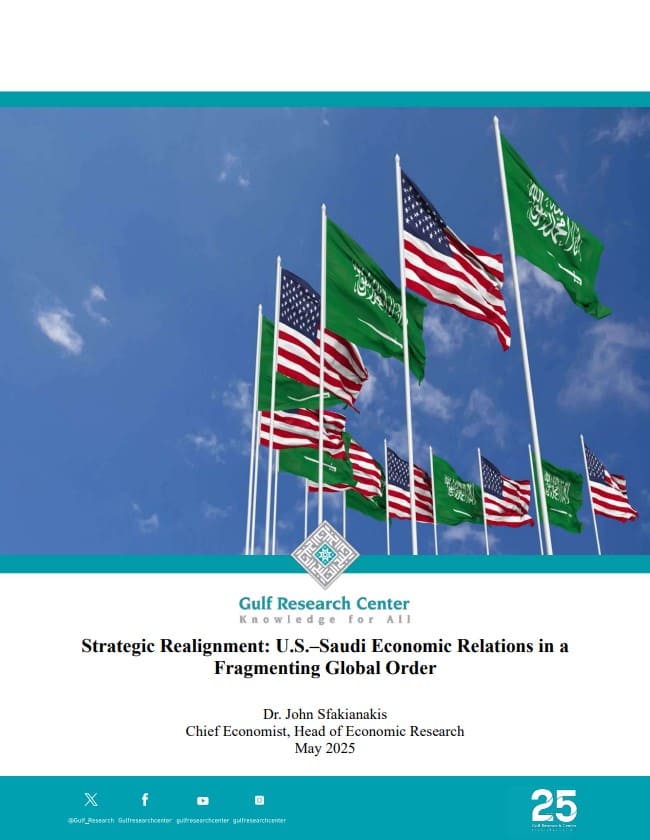
As U.S. President Donald Trump prepares for a high-stakes visit to Saudi Arabia this month, the geopolitical and economic landscape he navigates is more fractured—and more fluid—than at any point in recent decades. This official visit to the Kingdom, the first foreign trip of his second term, will take place amid the breakdown of long-held global trade norms, a reshaping of energy markets, and an accelerating drift toward regional self-determination. For both Washington and Riyadh, this is not a ceremonial engagement—it is a decisive opportunity to reconfigure the bilateral economic compact for a multipolar, tech-driven world.
For decades, U.S.–Saudi ties rested on a transactional foundation: American security guarantees and industrial expertise in exchange for oil stability and petrodollar reinvestment. But that formula, forged in the geopolitical architecture of the 20th century, has eroded. With oil prices hovering near the low $60s per barrel, Saudi Arabia’s fiscal space is narrowing. It can no longer rely solely on hydrocarbons to finance its domestic ambitions or project geoeconomic influence abroad. In this context, Riyadh’s investments in the United States must be matched by a new framework of mutually beneficial incentives—including preferential access, co-innovation platforms, regulatory harmonization, and industrial localization.
In 2024, trade between the two countries totalled approximately $39 billion, spanning aerospace, healthcare, defence, and education. Yet trade flows alone obscure the deeper realignment underway. Saudi Arabia’s Public Investment Fund (PIF), among the world’s most dynamic sovereign wealth vehicles, has become a strategic actor in U.S. capital markets—anchoring investments in AI, electric mobility, cloud infrastructure, and cinematic entertainment. This is not opportunistic capital. It is deliberate, long-term, and aligned with Riyadh’s transformation under Vision 2030.
From the U.S. vantage point, Saudi Arabia is not simply a market—it is an investment partner with regional scale and strategic reach. Giga-projects such as NEOM, Red Sea Global, Diriyah Gate, and New Murabba offer American firms an unparalleled testbed to scale frontier technologies— particularly in clean energy, AI, biotech, and next-generation infrastructure—underpinned by sovereign commitment and funding certainty.
President Trump’s visit is thus a critical inflection point. It offers an opportunity to move beyond the zero-sum rhetoric of transactionalism and re-anchor the relationship in a shared strategy of coinvestment and industrial policy coordination. To attract sustained Saudi capital, the United States must offer more than financial returns—it must offer access. This includes targeted investment incentives, joint innovation hubs, and Saudi participation in the development of foundational technologies, from semiconductors to quantum computing.
A particularly promising domain for strategic alignment is the nexus between energy and data. As data centers become the physical substrate of the AI economy, demand for secure, scalable, and clean power will soar. Here, Saudi Arabia—given its abundant land, engineering expertise, and sovereign financing—can serve as a critical partner in powering next-generation U.S.-linked data infrastructure using small modular nuclear reactors (SMRs). This is a high-stakes, high-value collaboration: the fusion of American technological leadership with Saudi scale and capital to codevelop resilient digital and energy ecosystems.
To realize this vision, institutional mechanisms are essential. The U.S. must provide clear and stable regulatory pathways for Saudi investment in sensitive sectors, including transparent national security review procedures. Riyadh, in turn, must ensure predictable legal and commercial frameworks that protect foreign investors and enable dispute resolution. A next-generation alliance should be underpinned by joint ventures, dual IPO listings, tech transfer frameworks, and mutual recognition standards across digital and industrial domains. This visit, then, is not a diplomatic overture—it is a geopolitical stress test. Can the U.S.–Saudi relationship evolve beyond its traditional oil-for-security model into a 21st-century partnership built on innovation, industrial resilience, and geoeconomic alignment? Or will it remain tethered to a geopolitical script that no longer reflects global realities? If successful, President Trump’s visit could mark the beginning of a more mature, adaptive, and future-facing U.S.–Saudi alliance—one that sets a precedent for how advanced and emerging powers can jointly navigate the complexities of a fragmenting global order.