Commentary & Analysis
A Return with Purpose: Trump’s Second Saudi Visit
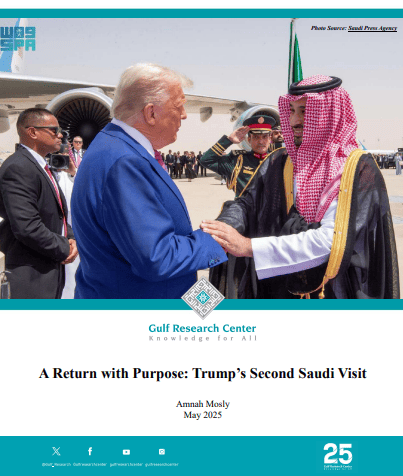
U.S. President Donald Trump has officially concluded his ‘historic’ Middle East tour, with the Kingdom of Saudi Arabia serving as his first official international visit following his re-election. While the choice of Saudi Arabia as his inaugural foreign destination echoes the precedent set in May 2017, the distinction between the two visits lies in the differing regional and global dynamics. The geopolitical circumstances and strategic stakes differ substantially from those that framed his first visit. The regional and international environment today is marked by greater volatility, multipolar competition, and evolving security architectures, all of which render this visit more consequential than the first.
Reaffirming ties with Riyadh signaled Washington’s intention to consolidate its traditional alliances. It further underscored Saudi Arabia’s strategic relevance in U.S. foreign policy. President Trump emphasized the Kingdom’s critical role in addressing some of the Middle East’s most intricate challenges, which demand a credible, capable, and trusted regional partner, calling the visit a “tremendous honor.” Through recent diplomatic and mediation efforts, Saudi Arabia has demonstrated both the capacity and legitimacy required to serve in such a role, reinforcing its credentials as a pivotal actor on the global stage.
President Trump’s keynote address at the Saudi-U.S. Investment Forum on May 13 was both celebratory and strategically assertive. Describing the bilateral relationship as a “bedrock of security and prosperity,” and offering repeated personal commendations of Saudi leadership, he effectively personalized diplomacy while projecting a strong message of strategic convergence. He lauded the Kingdom’s domestic transformations, referring to Saudi Arabia as “among the proudest, most prosperous, most successful nations anywhere in the world, as leaders of a modern and rising Middle East,” as well as “the greatest nation in the world,” and affirmed that “we are with you all the way, and you have a tremendous future.” He further declared, “Today, we reaffirm this important bond, and we take the next steps to make our relationship closer, stronger, and more powerful than ever before.” These messages, complemented by ceremonial gestures such as the escort of Air Force One by the Royal Saudi Air Force, symbolized mutual respect and trust, both at a personal level as well as at a state-to-state level between the two countries.
Beyond personal diplomacy, defense cooperation continues to serve as a cornerstone of bilateral relations and strategic partnerships. On defense matters, the White House announced that “Underscoring our commitment to strengthening our defense and security partnership, the United States and Saudi Arabia signed the largest defense sales agreement in history—nearly $142 billion, providing Saudi Arabia with state-of-the-art warfighting equipment and services from over a dozen U.S. defense firms.” The agreement can be seen as a reaffirmation of the U.S. commitment to Gulf security while underscoring the commitment of both countries to regional stability, with President Trump announcing that he would “never hesitate” to use military force to defend Saudi Arabia. “I will never hesitate to wield American power if it’s necessary to defend the United States or to help defend our allies. And there will be no mercy for any foe who tries to do us or them harm,” he stated. Such an unequivocal statement provided hard power assurances within the broader bilateral framework, a dimension that was missing during the previous administration.
The scope of cooperation discussed during the visit extended beyond traditional security domains into advanced sectors such as technology, space exploration, critical minerals, and transportation infrastructure. These areas align directly with the Kingdom’s Vision 2030 objectives, demonstrating a conscious convergence between Saudi domestic priorities and U.S. commercial and strategic interests. Saudi Arabia’s Crown Prince and Prime Minister, His Royal Highness Prince Mohammed bin Salman added that the deal could reach $1 trillion, and that the U.S. is a major destination for the Public Investment Fund, accounting for approximately 40% of the fund’s global investments, thus highlighting deepening economic interdependence and the emerging role of the Kingdom as a key economic partner for the United States.
There were also notable initiatives in the fields of energy, technology, and space exploration including a bilateral agreement on energy innovation between the Kingdom’s Ministry of Energy and the U.S. Department of Energy, a memorandum on mining and mineral resources between the Kingdom’s Ministry of Industry and Mineral Resources and the U.S. Department of Energy, and a CubeSat space research mission under NASA’s Artemis II program in collaboration with the Saudi Space Agency. The two sides modernized the Air Transport Agreement to enhance cargo mobility and committed to strengthening cultural, educational, and scientific partnerships, including cooperation between the Smithsonian Institution’s National Museum of Asian Art and the Royal Commission for AlUla, adding an element of soft power to the relationship.
In terms of regional issues, progress on the issue of Syria stood out. In his speech at the SaudiU.S. Investment Forum, President Trump explained, “My administration has already taken the first steps toward restoring normal relations between the United States and Syria for the first time in more than a decade. And I’m very pleased to announce that Secretary Marco Rubio will be meeting with the new Syrian foreign minister in Türkiye later this week.” President Trump then ordered the lifting of U.S. sanctions against Syria “in order to give them a chance at greatness,” representing a significant U.S. policy shift and a recalibration of Washington’s approach. The move came after the U.S. President had discussed the situation with the Crown Prince and Prime Minister, as well as Türkiye’s President Erdogan. This development, coupled with a high-level trilateral meeting with Syria’s President, underlines Riyadh’s diplomatic presence and its role as a facilitator of regional peace and security.
On Iran, President Trump repeated his warnings that the U.S. will never allow Tehran to obtain a nuclear weapon. While he condemned the “past chaos of Iran’s leaders,” he also asserted that he is “willing to end past conflicts and forge new partnerships for a better and more stable world, even if our differences may be very profound.” President Trump went on to say that he would like to make a deal with Iran, “But if Iran’s leadership rejects this olive branch... we will have no choice but to inflict massive maximum pressure.” Saudi Arabia maintains a similarly firm position on Iran’s nuclear issue, with the Kingdom, alongside the remaining GCC states, underscoring the importance of a firm commitment from Iran and all relevant countries to commit to the absence of any nuclear military program that threatens the security and stability of the Gulf region.
On Palestine, the U.S. President stated that it was his “fervent hope” that Saudi Arabia would also join the Abraham Accords, following other Arab states during his first term. However, he emphasized that it would be the Kingdom’s choice and that they will “do it in [their] own time.” This can be viewed as somewhat of a shift in U.S. policy. Unlike former President Joe Biden’s approach to the issue, the Trump Administration is demonstrating a readiness and willingness to move forward with bilateral relations and significant agreements without the previous condition or exchange for Saudi-Israel normalization. Saudi Arabia remains steadfast in advocating for a just resolution to the Israeli-Palestinian conflict, grounded on a two-state solution and adhering to international law. While valuing its international relationships, the Kingdom has affirmed, unequivocally, that normalization with Israel hinges on meaningful progress toward the establishment of a Palestinian state, with guarantees of sovereignty, dignity, and security for its people.
At the international level, the Ukraine conflict emerged in discussions, particularly in light of the Kingdom’s demonstrated ability to facilitate dialogue and host negotiations between conflicting parties. President Trump recognized and commended the Kingdom’s role, stating, “Let me take this opportunity to thank the Kingdom of Saudi Arabia for the constructive role that you’ve played in facilitating the Ukraine talks… You’ve been amazing. You’ve made everything available to us. Thank you very much. Thank you.” U.S. recognition and gratitude for Saudi Arabia’s facilitative role in hosting dialogue demonstrate growing international acknowledgment of Riyadh’s capacity to contribute to multilateral crisis management.
Although President Trump’s visit to the Kingdom was primarily framed through a bilateral lens, it undoubtedly intersects with the broader Gulf Cooperation Council (GCC) framework, as many of these themes carry clear implications for the Gulf. In this context, Riyadh hosted the GCC-U.S. Summit on President Trump’s second day in the Kingdom, reinforcing not only Saudi-U.S. relations but also broader GCC-U.S. relations. By reinforcing collective dialogue with the GCC, the visit advanced not only Saudi-U.S. bilateral relations but also the regional cohesion necessary for addressing regional and international challenges.
President Trump’s visit highlighted a broader centrality of Saudi Arabia’s role in U.S. foreign policy, with the combination of personal ties, strategic alignment, and mutual interests as pillars of the partnership. At the same time, there is an evolving nature to the bilateral relationship shaped by both historical depth and present-day realities. Against a backdrop of uncertainty and transformation, the Kingdom and the United States remain key partners in shaping the regional and global order.
*Amnah Mosly is a Researcher at the Gulf Research Center (GRC)