Commentary & Analysis
When Culture Becomes Strategic, Power Soft, and Identity Regional: The GCC Perspective
The intangible and often immeasurable effect that culture has on people’s “hearts and minds” has long invited reflection, not only for its emotional appeal, but for its deeper political and societal implications.
The United Nations Educational, Scientific and Cultural Organization (UNESCO), as the major global body for cultural governance, frames culture as a shared heritage of humanity, a bridge between communities, and a platform for intercultural dialogue, reconciliation, and mutual respect. Yet, even within UNESCO, cultural cooperation often unfolds against the backdrop of states’ political interests and becomes entangled in broader power dynamics. Disputes over the inscription of cultural items in World Heritage Lists, whether tangible or intangible, often become “highstakes” contests over national identity, ownership, and pride. In these moments, cultural arenas reflect, and sometimes intensify, underlying tensions between states.
Indeed, culture can mark differences, draw lines, and shape boundaries between “us” and “them.” Yet at the same time, it can do the opposite: forge unity, narrate shared memory, and anchor collective identity. In this sense, the strategic use of culture may serve as a foundation for building internal cohesion and for projecting a coherent image to the world. When channeled through public diplomacy or nation branding, this image becomes exportable and advantage-generating, achieved, as Professor Joseph Nye put it, “through attraction rather than coercion.”
Soft Power as a Strategic Asset for Regional Organizations
Soft power may be especially relevant for actors such as small and medium-sized states or regional organizations, whose influence does not primarily derive from “hard power” elements. Among these actors, the European Union (EU) stands out, both for the breadth of its soft power agenda and for its unique political structure, which enables coordinated implementation at the EU level. Meanwhile, by placing “culture at the heart of its international relations,” as states the EU Cultural Relations Platform, the EU starts from within. Since the adoption of the Declaration on European Identity in 1973, the issue of promoting a common European space has become one of the key elements of regional integration. A wide scope of cultural policy programs managed by the European Commission aims explicitly at fostering this shared identity and expanding the EU’s visibility and credibility globally.
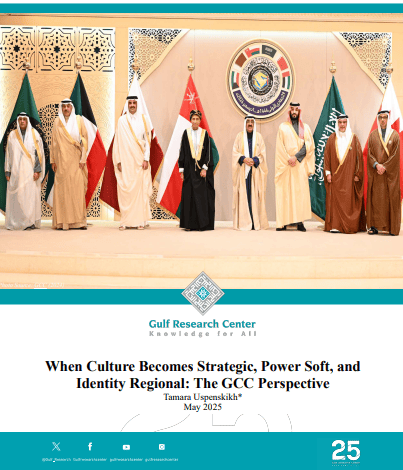
In a similar vein, the foundational charter of the Gulf Cooperation Council (GCC) grounds its establishment in shared cultural, religious, and political traits. Moreover, as all six GCC countries are currently undergoing significant transformations aimed at economic diversification, the need to engage with a global audience and build international visibility and a positive, coherent reputation becomes increasingly apparent. The GCC may seize this opportunity to position itself as a cultural diplomacy actor. However, projecting an image abroad also requires cultivating it from within.
Joint Soft Power Action of the GCC
In this context, each of the GCC states’ national vision strategies underscore the importance of reinforcing national identity and promoting a sense of belonging and citizenship. In parallel, the GCC, as a regional organization, has begun to engage more actively in the cultural field. The adoption in 2019 of the GCC Cultural Strategy 2020-2030 marked an important step, especially as it came during a period of intra-GCC tension. In a UNESCO-resemblant approach to culture as a peacebuilding instrument, the advanced joint action in the cultural field amid tensions highlighted the possibility of appealing to culture as a tool for bridging discord and constructing cooperation around shared narratives and cultural elements.
At the same time, while a common regional identity can serve as a basis for stronger internal cohesion and a more effective global presence, the resulting strengthened regional unity can also translate into tangible benefits: joint promotion, pooled resources, or shared visibility, which can further support the aspired economic and political objectives. The adoption of the GCC Cultural Strategy, followed by the endorsement of the GCC Tourism Strategy (2023-2030), together with implemented initiatives of the Gulf Tourism Platform or Gulf Tourism Capital, and supported by steps towards GCC unified visa all suggest a growing awareness that identity-building would be not only symbolic, but also economically and diplomatically useful.
Towards a GCC Structural Cultural Policy
Nevertheless, the process of constructing a shared identity raises complex questions. How can the rich cultural diversity of each GCC state be respected, while also articulating a common voice? Are these differences a challenge or an opportunity for the identity framework in-the-making? How should the new dimensions of Gulf identity, such as economic openness, innovation, and global connectivity, be integrated alongside traditional identity elements? And how does a distinct GCC identity relate to broader layers of belonging, such as “being” Arab, Muslim, or Middle Eastern? Equally important is the question of agency. Who should lead the effort to shape this common identity, national governments or the GCC common regional institution? And how can actions of all sides be made to complement rather than compete with one another? These questions point not only to a need for coordination but also for tools and mechanisms at the regional level to support a sustained, strategic cultural agenda.
Clarifying these issues can help formulate further concrete steps and programs to move towards building a common identity. A more coherent and unified regional stance may offer the GCC a stronger foundation for coordinated diplomacy, economic complementarity, and international influence. As the GCC is aiming to expand its role in global affairs, the need to project its ambitions and speak in a voice that resonates globally also grows. Cultural diplomacy, and common identity as a prerequisite, should then stand “at the heart” of the GCC regional cooperation.
Tamara Uspenskikh is a Resident Research Fellow at the Gulf Research Center (GRC)