Commentary & Analysis
USAID Budget Cuts
The Fate of Middle Eastern Studies at Specialized Think Tanks
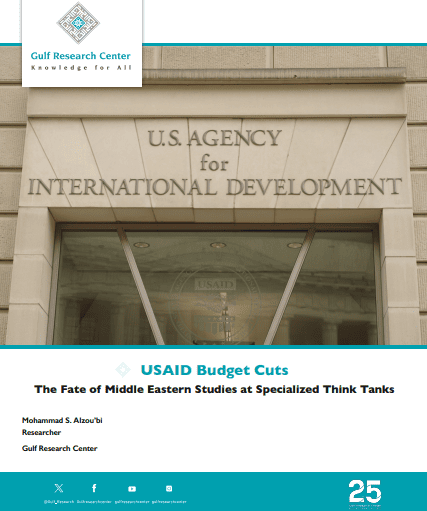
Donald Trump’s return to the presidency in January 2025 marked a critical turning point in U.S. foreign engagement strategy, with one of the earliest and most significant policy shifts targeting the U.S. foreign aid infrastructure. The Trump administration imposed a comprehensive freeze on U.S. development assistance, leading to the institutional dismantling of the U.S. Agency for International Development (USAID). This suspension evolved into a sweeping cancellation of the agency’s core programs, terminating nearly 90% of its operational portfolio and abruptly canceling almost 5,800 multi-year contracts.1
While the humanitarian ramifications of this move attracted considerable attention, the decision also precipitated a less visible, yet potentially devastating, collapse of U.S.- supported research infrastructure, particularly in Middle Eastern studies. At Washington’s think tanks, academic centers, and regional research institutions, the sudden withdrawal of USAID funding will profoundly disrupt research continuity, academic collaboration, and institutional sustainability.
This paper examines the structural consequences of USAID’s 2025 funding reduction for Middle Eastern studies at specialized think tanks and academic research centers. It argues that the collapse of this funding framework will not only weaken U.S. strategic engagement in the region but will also contribute to a broader erosion of knowledge capacity at the intersection of foreign policy, academic research, and regional diplomacy—paving the way for international competitors to fill this gap.
USAID as a Research Engine
USAID has played a dual role in U.S. foreign affairs: as a development assistance mechanism and as a guarantor of established global knowledge networks. In the context of the Middle East and North Africa (MENA) region, USAID has provided essential support, directly and indirectly, to research program initiatives focused on Middle Eastern affairs in Iraq, Jordan, Yemen, and Syria for example, in addition to university programs and research chairs at various universities. These institutions and others have also collaborated with many prominent regional research centers.2
USAID’s contribution has gone beyond grantmaking; it has facilitated field research in conflict and post-conflict zones, supported Arabic-language academic publishing projects, funded regional conferences on political reform, and enabled long-term fellowships that have fostered cross-cultural scholarly partnerships. USAID has been one of the few stable sources of support for sustainable, context-sensitive research in an academic environment increasingly reliant on shortterm metrics and funding fluctuations. The elimination of this infrastructure will destabilize a knowledge ecosystem that was resilient, albeit with limited resources.
According to a report by the Arab Center in Washington, D.C., numerous U.S.-funded projects in the fields of security, humanitarian assistance, development, climate, refugees, health, and democracy in the Middle East and North Africa (MENA) region have been affected, while the full regional picture remains unclear. Elon Musk’s “Government Efficiency Management” efforts have been chaotic, but given Secretary of State Marco Rubio’s March 10 announcement that he had approved the cancellation of 5,200 grants—equivalent to 83% of USAID grants worldwide—and reports of 4,100 State Department projects being terminated, it can be assumed that many MENA activities have been canceled.3 This will ultimately entail staff reductions, the closure of subprojects, and the abandonment of multi-year research streams.
The Collapse of Strategic Insight
Middle Eastern studies has long played a pivotal role in shaping the U.S. strategic posture in the region. Scholars and analysts in this field provide essential and unique knowledge on sectarian dynamics, social movements, regional security structures, ideological trends, and other critical areas, informing not only foreign policy decision-making but also intelligence assessments, legislative briefings, and conflict mitigation strategies.
The USAID funding apparatus has served as a conduit for this empirically grounded, regionally informed expertise. Its abrupt decline will sever a crucial link between regional developments and U.S. interpretive capacity. It will also create an “insight vacuum”—a diminished ability of the U.S. government to perceive, interpret, and respond to emerging crises in the Middle East and North Africa. The International Institute for Strategic Studies (IISS) issued a policy note warning that U.S. policymakers will become increasingly detached from domestic political signals due to the disruption of research networks that bring in-depth perspectives, analysis, and long-term foresight from the region to Washington.4
The Rise of Knowledge Competitors
As the United States withdraws from the research and development scene in the Middle East and North Africa, other global powers—most notably the People’s Republic of China—will quickly move to fill the void. In the wake of the Belt and Road Initiative, the Chinese government and its affiliated institutions may expand their research and intellectual presence through research chairs, joint university programs, and the establishment and support of specialized research centers. Beijing’s model has focused on reciprocal partnerships and infrastructure investment, but it will increasingly include support for regionally rooted policy dialogue and research. Chinese-funded academic initiatives are expected to emerge by late 2025, particularly in Arab universities in less developed countries. Arabic publications supported by Chinese institutions will also begin to circulate in policy circles previously dominated by U.S -sponsored research, which was often facilitated through USAID programs that emphasized transparency and democratic conditions.
The Brookings Institution does not believe that China will prioritize expanding its foreign aid despite U.S. aid cuts, citing its stagnant economy and self-interested aid strategy. While China’s aid focuses on building political capacity and promoting its governance model, Brookings acknowledges that China will exploit U.S. aid cuts to criticize American global responsibility, using this rhetoric to strengthen relations with countries in the Global South—even if U.S. aid levels remain higher than China’s.5
Despite these limitations, China is deeply committed to building and maintaining its soft power. Its expected approach to knowledge diplomacy will systematically reshape the research narratives that influence policy debates in the Global South. In the absence of U.S. engagement, this shift will enable China to expand its influence not only over infrastructure and trade, but also over knowledge production and epistemic legitimacy.
Academic Shrinkage and the Generational Gap
The repercussions of USAID cuts will not be limited to the Middle East. American academic institutions will also experience significant shrinkage. Graduate training programs in Middle East studies have reported a sharp decline in fieldwork and fellowship opportunities within the region. Faculty hiring freezes will become widespread, and many institutions will reduce or close their specialized research centers. Library acquisition budgets for primary sources in Arabic, Persian, and Turkish will also be severely impacted, as philanthropic support has not compensated for the loss of federal funding.
As a result, a generational gap in field experience will emerge. Scholars who might have participated in USAID-supported regional research will find themselves disconnected from the practical realities of the region they studied, as specialist students return to theoretical tools without field experience.
This academic shrinkage has serious consequences for the U.S. policy community. Fewer graduates of Middle East studies programs will now join public service, think tanks, or diplomatic roles with the linguistic, cultural, and analytical tools needed to navigate the region. The erosion of this talent pool is not just an academic concern but a long-term strategic liability.
Europe’s Constraints and Strategic Disengagement European institutions are attempting to fill some of the funding vacuum in the wake of the U.S. withdrawal. However, even the most ambitious EU civil society initiatives, such as “Horizon Europe” and the “European Endowment for Democracy,” will lack the scale, scope, and flexibility needed to replace the infrastructure previously supported by USAID. Internal political shifts and financial pressures in European capitals will also limit their willingness to assume a leadership role in knowledge diplomacy in the MENA region.
The Guardian reported in April 2025 that EU institutions themselves are suffering from budget cuts, limiting their ability to take on new commitments in the region.6 Meanwhile, Europe remains steadfast in its commitment to advancing research and innovation for higer purposes. In May 2025, the European Commission unveiled over €1.25 billion in new funding calls aimed at attracting top researchers to Europe “Choose Europe for Science.” This initiative is part of a broader strategy to position Europe as a global leader in science and technology.7 European Commission President Ursula von der Leyen emphasized the importance of science as an investment and called on EU member states to allocate 3% of their GDP to research and development by 2030.8
As a result, many academic centers and NGOs in the MENA region will turn to local funding or commercial partnerships—arrangements that could undermine academic independence or shift institutional priorities toward apolitical service delivery and alignment with the private sector. This shift will highlight a broader strategic disengagement on the part of the United States, marked by the loss of the research, intellectual, and normative influence that has been the foundation of its foreign policy presence in the region.
With the dismantling of USAID’s academic and civilian infrastructure, the United States is also abandoning a key tool of engagement— one that transcended military presence or economic influence and fostered longstanding relationships rooted in knowledge and mutual understanding.
Alternatives and Solutions
In response to the growing challenges facing Middle Eastern studies, particularly in light of declining U.S. funding, several forward-looking strategies can help sustain and even reimagine the field’s future.
Diversifying the funding ecosystem is crucial, including building philanthropic alliances with international U.S. institutions such as the Carnegie Corporation and the Ford Foundation. These institutions can provide vital funding to fill critical research gaps, while encouraging the establishment of endowments for Middle Eastern studies centers with mandates that prioritize resilience and longterm impact.
Leveraging the broader Arab American and diaspora communities in the MENA region can also unleash societal support for independent and politically resilient scholarship initiatives. These grassroots efforts can serve as a powerful complement to institutional funding.
Another key solution lies in developing university and consortium grant models. By pooling resources across multiple academic institutions, these consortia can support joint fellowships, field schools, and regional seminars. This collaborative model not only enhances research capacity but also fosters a sense of shared responsibility and academic continuity.
Equally important is fostering academic cooperation at the regional level. Reducing over-reliance on Western aid begins with fostering deeper partnerships between universities and think tanks in the MENA region. These collaborations can evolve into strong academic consortia that conduct peerreviewed research, host regionally aligned conferences, and facilitate the open exchange of data and research outputs, particularly in Arabic, ensuring accessibility and cultural relevance.
In parallel, digital platforms and remote collaboration offer a new lifeline for academic continuity. Virtual platforms can maintain dialogue and collaboration, especially when travel and in-person meetings are not possible. The creation of open-access digital repositories, including primary source archives, policy briefs, and analytical tools in both Arabic and English, can also make knowledge production and dissemination transparent and flexible in unprecedented ways.
On the policy front, there is an urgent need to reorient U.S. public diplomacy and congressional engagement. This begins with advocating for the restoration of USAID research funding sources through targeted legislative initiatives. The proposed “Knowledge Effective Diplomacy in the Middle East” (KEDMID) Act could be a transformative policy tool, revitalizing academic exchange programs, supporting bilingual publishing, and funding long-term research rooted in the region itself.
Finally, expanding international engagement, particularly from the EU and Gulf states, must be part of the solution. European institutions should be encouraged to establish joint funding mechanisms in partnership with U.S. universities and Gulf institutions. Triangular cooperation models involving the EU, MENA, and U.S. institutions could help balance diverse governance structures and funding priorities while promoting a more integrated academic ecosystem globally.
Gulf countries in particular, and Arab countries in general, must also work on a comprehensive research funding model that supports the continuity of specialized research in the region at all levels and in all fields, and that enables the dissemination of expert and informed insights to Western research institutions and international organizations specializing in the region and its affairs.
Together, these strategies provide a path not only to keep Middle Eastern studies alive, but also to revitalize its role in shaping accurate understanding, policies, and partnerships in a changing global landscape.
Mohammad S. Alzou’bi Researcher Gulf Research Center