

Commentary & Analysis
De-Risking or Drifting: Why The EU Needs to Look East
The implementation of US tariffs has created a highly hostile and potentially destabilizing climate for the EU, jeopardizing critical sectors and revealing flaws in the bloc's political and economic strategies. On March 27, the US government imposed a 25% tariff on all car imports, disproportionately affecting Germany and other major automobile exporters. This was followed by a sweeping 20% duty on practically all EU imports, which went into force on April 9 as part of a larger "reciprocal tariff" policy. While a 90-day halt has temporarily reduced the levy to a baseline 10% for most commodities, the higher 25% tariffs on steel, aluminum, and vehicles remain in effect, putting substantial pressure on European industry.
The economic implications are already visible: the EU's GDP is projected to fall by 0.3% in a nodeal scenario, with Germany risking an even greater reduction due to its export-heavy economy. EU exports to the US might plummet by up to 50% in price-sensitive industries, including manufacturing and agriculture, endangering employment and income across the continent, particularly in France, Italy, and Germany. The European Commission has called the tariffs "brutal and unfounded," warning of devastating implications for millions of people and businesses on both sides of the Atlantic. Nevertheless, the EU still adopted a measured approach, with policymakers aiming to avoid a full-fledged trade war while preserving the bloc’s interests.
While the EU has developed a phased countermeasure strategy, which includes tariffs on iconic American goods and a three-stage escalation mechanism, implementation has been delayed, allowing for negotiations. This strategy indicates a concerted effort to protect the bloc's economic interests and retain diplomatic channels while avoiding a rapid escalation into a full-fledged trade war. However, although the EU claims that the world is “lining up” to work with the bloc amid all these uncertainties, its economic outlook remains characterized by a wish for a constructive outcome from the US, persistent uncertainties, and the fear of additional escalation. This precarious situation has raised questions and concerns about the way forward and the future of the EU.
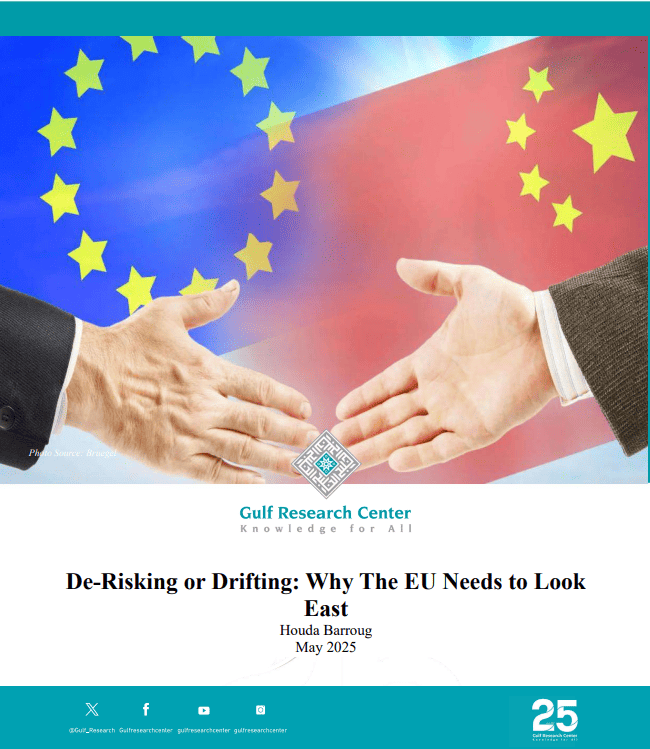
As the EU grapples with the fallout from US tariffs and rising transatlantic trade tensions, it is increasingly focused on expanding its strategic alliances beyond the conventional global powers: the United States and China. While some in Brussels acknowledge that greater connections with Beijing could serve as a counterweight to American protectionism, the overall sentiment across the bloc is one of skepticism, caution, and even outright opposition, reflecting China's standing as a "systemic rival" and "strategic competitor." This hesitancy stems from ongoing concerns about China's industrial policies, the bloc's expanding trade deficit, and fears of overreliance on Chinese technology and supply chains. Most importantly, there is a widespread perception across the EU that a closer rapprochement with China will provoke discontent in Washington, potentially leading to additional political and economic pressure, undermining transatlantic unity, and exposing the EU to greater security and trade risks.
Internal EU dynamics exacerbate the situation: export-driven nations like Germany and France quietly prefer pragmatic cooperation, while member states in Eastern Europe and the Baltic region push for a harder stance, especially on human rights and security. This represents a departure from the latter’s previous direct engagement with China through the 17+1 initiative, which focused on promoting business and investment between China and the 17 Central and Eastern European countries. These diverse viewpoints highlight the lack of a completely coordinated EU approach toward China.
Even as China celebrates the 50th anniversary of diplomatic relations with the EU and reality calls for a reassessment of the bloc’s approaches, strategies, and priorities, the recent actions from European leaders underscore a defensive attitude. Both sides have expressed a willingness to keep diplomatic channels open. China's recent removal of sanctions on EU parliamentarians, as well as President Xi Jinping's expected European travel in May 2025, indicate Beijing's desire to restore relations and prevent a devastating trade war.
The EU’s strategy, for its part, is best described as “de-risking,” where the bloc intends to reduce strategic reliance and retain a defensive stance, while keeping diplomatic channels open to avoid direct conflict. The EU has formed new cross-regional working groups to handle sectoral conflicts and is actively looking at negotiated solutions, such as "price undertakings" on Chinese EVs, to prevent future conflict. However, the path forward is unknown, as the bloc's internal tensions and the broader geopolitical atmosphere continue to mold a cautious, defensive approach to its relationship with China.
The European Commission has also increased its inspection of Chinese e-commerce giants such as Temu and Shein, demanding greater openness and adherence to EU standards on product safety and consumer protection. In May 2025, the EU levied a record €530 million fine on TikTok for illegal data transfers to China, highlighting continued concerns about data security and digital sovereignty. Moreover, Italy's recent decision to restrict the Chinese AI firm DeepSeek due to privacy concerns demonstrates the increased willingness of member states to take unilateral action in response to perceived hazards from Chinese technology.
While diplomatic engagement continues, it remains frequently reactive and transactional rather than proactive or forward-thinking. The EU's plan to convene a summit with China in July 2025 is motivated as much by the need to resolve ongoing disputes, such as those over electric vehicle tariffs and market access for European exports, as it is by a real desire for cooperation. Even symbolic gestures, like China's recent relaxation of sanctions on EU parliamentarians, have not resulted in a substantive thaw; the European Parliament has made it clear that sanctions relief alone would neither restart stalled deals nor change the bloc's core concerns.
While some warn that a tougher EU stance could provoke Chinese decoupling and detachment, the prospect of such a scenario remains low. China's economic model is heavily export-driven, and Beijing has recently expressed a desire to negotiate and avoid escalation, as evidenced by its outreach to both the US and the EU to avert a larger trade war. Bilateral trade remains highly substantial, estimated at €785.8 billion in 2024, with China serving as the bloc's third-largest export market and largest source of imports. The two economies are inextricably linked, particularly in green technology: China leads the way in worldwide solar panel and battery production, whilst the EU dominates in renewable energy adoption and carbon pricing.
Against this backdrop, both parties have significant incentives to moderate tensions and foster pragmatic cooperation, particularly in industries where they have a relative advantage. There exist various opportunities for synergies and joint actions between the EU and China that call for a more proactive approach from the EU. For example, aligning the EU's Emissions Trading System with China's emerging carbon market could accelerate global emissions reductions and stabilize green investment flows. Moreover, potential corporations on AI governance and sustainable infrastructure highlight the possibilities for synergies on global ethical, safe, and mutually beneficial technological development.
Critically, China's market remains vital to European industries. Dutch semiconductor suppliers, German automakers, and French aerospace companies rely on Chinese demand to counterbalance falling US exports. The China-Europe Railway Express, which has conducted over 100,000 cargo journeys since 2025, highlights the potential of supply chain diversification in reducing US tariff effects. Meanwhile, Chinese investment in EU renewable projects, notably Hungary's €7.4 billion battery gigafactory, contributes to the EU's energy transformation and job market. Turning away from similar collaboration opportunities risks ceding market share to US and Asian competitors in industries where Europe still has a technological advantage.
Most importantly, the EU-China multilateral partnership is critical for reshaping and reinvigorating global governance. As the United States withdraws from global organizations, the two powers continue to collaborate on WTO dispute resolution, vaccine distribution, and Middle Eastern peacebuilding. Their joint advocacy for a Global AI Governance Framework at the 2024 UN Summit exemplifies how linked interests can serve as a counterbalance to unilateralism. With similar interests in supply chain stability and climate change mitigation, a strategic EU-China collaboration provides a buffer against fragmentation in an increasingly polarized world.
A dual approach of "cooperation with vigilance" enables the EU to promote common objectives while protecting key sectors. For example, joint ventures in green hydrogen and carbon capture are consistent with both parties' net-zero aims, but they should be accompanied by more stringent vetting of essential mineral investments. The EU's Digital Services Act and China's data localization rules remain problematic as they both present hurdles to seamless digital operations and cross-border data flows; nevertheless, working groups on cross-border data flows can present a pathway to address regulatory divergences.
However, navigating today's volatile global landscapes necessitates more than a prudent China strategy. The EU's long-term resilience will be determined by its capacity to diversify partnerships, enhance engagement with other dynamic regions, such as the Gulf, Africa, Latin America, and Southeast Asia, and if needed, advocate for a "third way" that leverages strengths on the global stage. Ultimately, as global economic and geopolitical pressures increase, the EU's capacity to strike a balance between pragmatic engagement with China and a clear defence of its strategic interests will be critical. By remaining adaptable, extending diplomatic channels, and strengthening its own economic resilience, the EU can better handle unpredictability and ensure its continued role in establishing the rules and standards of tomorrow's global order.
* Houda Barroug is a Researcher at the Gulf Research Center (GRC)