

Commentary & Analysis
Strategic and Political Implications for Israel and Iran:
The Day After War
A critical turning point in the regional security architecture in the Middle East is emerging today, with the unprecedented direct military confrontation between Israel and the Islamic Republic of Iran that erupted in June 2025. This analysis explores the short- and medium-term political, strategic, and socio-ideological implications for Israeli Prime Minister Benjamin Netanyahu and the ruling elite in Tehran. Drawing on empirical data, current diplomatic signals, and open-source intelligence assessments, the paper argues that while Netanyahu and the Iranian regime may enjoy a tactical respite through the strengthening of nationalism during the Iran-Israel war, both governments are entering a period of heightened volatility, where their legitimacy, strategic cohesion, and deterrence postures will be thoroughly tested. The repercussions of this confrontation will reverberate across regional power alliances, alliance structures, and internal regime dynamics.
The escalation of overt Iranian-Israeli strikes in June 2025 ends decades of indirect confrontations and opens a new chapter of direct, overt strategic hostility that may be irreversible. Historically, the bilateral conflict has been characterized by asymmetric proxy clashes, espionage and assassination operations, covert cyber operations, and third-party theaters such as Syria and Lebanon. The transition to direct kinetic clashes between Israel and Iran indicates the failure of deterrence mechanisms and a recalibration of strategic boundaries. It is imperative to understand and explore the immediate implications of this escalation, and what might be called the “day after,” particularly in terms of its impact on domestic political calculations, international diplomatic freedom, and societal attitudes within each state.
Israel: Netanyahu’s Strategic Risk Balancing
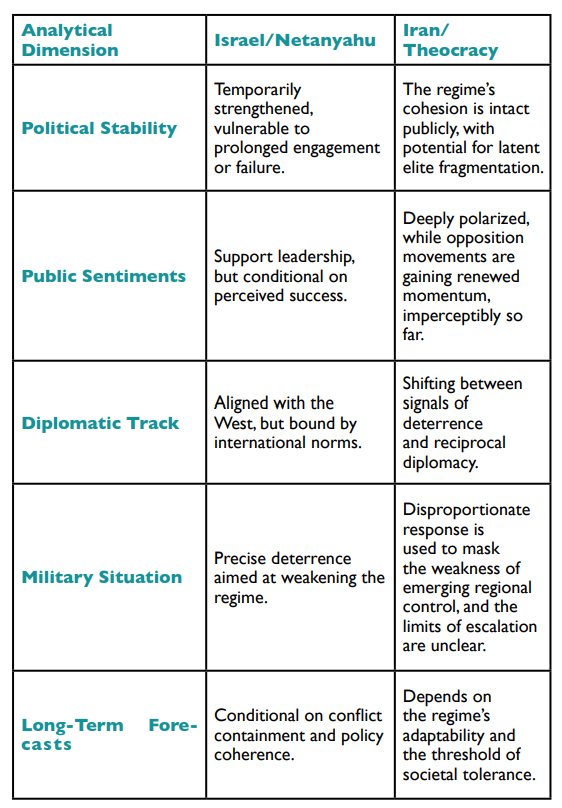
Israeli Prime Minister Benjamin Netanyahu exploited the direct consequences of the Israeli strikes to bolster his political base. This has lent an unusual, albeit temporary, rapprochement between political actors from the center-left and right-wing parties and legitimized his securityoriented narrative. It is worth noting that media commentary across the party spectrum initially characterized the strikes as a necessary show of deterrence in response to Iranian provocation.
However, historical precedent warns against overestimating the durability of this unity and temporary rallying cry. Israeli political culture, heavily influenced by previous security crises, tends to disintegrate when prolonged military operations lead to civilian suffering, economic disruption, or inconclusive results on the ground. Netanyahu’s challenge is to maintain the credibility of his deterrence doctrine while mitigating the political burdens associated with managing long-term conflicts. Israeli public opinion is undoubtedly supportive today, but history has shown that prolonged military engagements often undermine this support, particularly in the absence of clear objectives or goals.
On the diplomatic front, Netanyahu has trodden a risky rhetorical path. His efforts to distinguish between the Iranian regime and the Iranian people—emphasizing the regime-centric nature of Israeli strikes—are designed to conform to Western liberal standards of proportionality and just war theory. While this framing provided a temporary reprieve with Western allies, growing concerns among the G7 nations indicate a declining tolerance for any potential escalation that could expand the war, threaten regional stability, or exacerbate humanitarian crises or energy supply chains. Questions have long been raised about President Donald Trump’s initial refusal to endorse Netanyahu’s declared call for joint operations against Iran’s top leadership. This, of course, was answered by the need to highlight the limits of strategic synchronization—even among historically allied partners. This incident demonstrates the fragility of unilateral action in a highly interconnected and diplomatically sensitive environment, until the two sides seemingly reached deep convergence and a common formula fueled by the stalling of nuclear agreement negotiations with Iran, Israel’s strategic impatience with recent major regional transformations, the unprecedented escalation of regional intelligence efforts, and— first and foremost—Netanyahu’s personal desire for escalation to meet his political agenda and ensure the longevity of his rule, not least to escape pending corruption cases.
Netanyahu’s short-term gains are clear, but they are structurally fragile. Opposition parties, albeit temporarily cooperative, have begun to portray the conflict as a smokescreen for deeper internal disputes, particularly over judicial reforms and civil-military tensions. If the military campaign develops into a protracted affair or fails to achieve tangible security gains, Netanyahu risks exacerbating public skepticism and reigniting social unrest. The tables could turn on him once again, with the dangerous legacy of having permanently broken the barrier of direct deterrence with Iran. Therefore, he is once again betting on striking and weakening the regime and its military tools to create an opportunity for Iranian popular deterrence and internal unrest— developments that would thwart this legacy and serve Israeli interests, as well as his own personal interest in establishing himself as a national hero.
Iran: Regime Cohesion and Strategic Ambiguity
The Iranian leadership’s rhetorical and strategic response was predictably resolute. Supreme Leader Ali Khamenei, backed by senior IRGC commanders, declared the Israeli strikes a clear declaration of war. However, independent intelligence assessments indicate that the leadership was not strategically prepared for the operational precision and symbolic targeting of the Israeli attack—particularly given its impact on IRGC command and control facilities and the targeting of senior military leaders, not to mention the sensitive nuclear facilities that the Iranian regime has long boasted about. The regime was not surprised by the attack itself, but by its effectiveness and the resulting symbolic losses. While Tehran expressed its readiness to respond—and indeed began to—it sought to ensure that the strikes were harsh, painful, and irreversible, so as not to reveal the impact of the blow to its regional network and to avoid showing weakness in this first direct confrontation of its kind with Israel. Additionally, it sought to conceal the significant impact of the targeting of its senior military leaders and nuclear assets. While focused on its broader regional picture, internal divisions are festering imperceptibly behind the scenes. The response of Iranian society reveals deep divisions. Digital counter-narratives circulating on encrypted social media channels have undermined the regime’s attempts to create national solidarity through media saturation and clerical support. Anti-regime slogans, symbolic hashtags, and diaspora-led condemnations have resurfaced with remarkable force. These sentiments not only revive memories of the 2022–2023 protest movement but also highlight ongoing disillusionment with the regime and elite corruption. This popular ambivalence complicates Tehran’s strategic messaging, as segments of the population who view the IRGC not as defenders of the homeland, but rather as a domestic repressive force, challenge the legitimacy of the vengeful rhetoric.
Iran’s strategic trajectory now appears to be divided. On one hand, Tehran seeks to achieve deterrence through symbolic retaliation, threats of open, endless war, and veiled threats to withdraw from the Nuclear Non-Proliferation Treaty (NPT). On the other hand, diplomatic initiatives brokered by Qatar and Oman indicate a parallel effort to use the crisis as leverage in any future negotiations with the West after achieving a slim possibility of de-escalation. This hybrid stance—which simultaneously exhibits hostile and transactional characteristics— underscores the regime’s desire to reassess its deterrence credibility without incurring the costs of unchecked escalation. Its success depends on its ability to balance domestic political sustainability, alliance management, and the changing expectations of external power brokers.
Strategic Comparison and Expected Impacts
Conclusion
The recent dynamic exchange between Israel and Iran represents more than just an isolated episode in an interstate conflict. It constitutes a strategic crucible to test the institutional resilience of two rival regimes, their public legitimacy, and their foreign policy acumen. For Netanyahu, the confrontation offers a fleeting moment of political clarity amid domestic turmoil. However, the sustainability of this advantage depends entirely on his administration’s ability to contain escalation, demonstrate strategic effectiveness, and manage mutual expectations.
For the Iranian leadership, the confrontation reveals underlying vulnerabilities—operational, ideological, and social. While the regime has resorted to its rhetorical arsenal of resistance and martyrdom against an “eternal enemy,” the long-term viability of these narratives is increasingly questioned by a younger, globally connected, and politically agitated population. Whether the regional trajectory will veer toward escalation or a managed rebalancing will be determined not only by the parameters of the battlefield, but also by decisions made in the political operations rooms of Tel Aviv and Tehran. This confrontation ultimately reveals a deeper truth: the limits of coercive deterrence in an era of strategic interdependence and internal volatility. The winner of this war will be the one who understands this truth, manages it well, and navigates its consequences.
Note: This paper reflects events and interpretations available through June 17, 2025. Given the fluid nature of geopolitical developments, a subsequent reassessment is recommended.
* Mohammad S. Alzou’bi Researcher Gulf Research Center