Commentary & Analysis
From the Gulf to the Globe: Regional Instability and the Case for International Action on the Israel-Iran Conflict
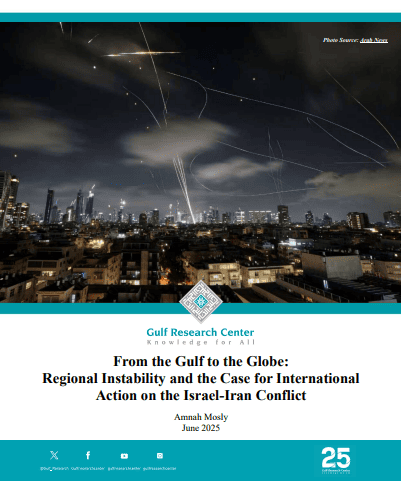
The recent escalation between Israel and Iran has triggered the alarm across the Gulf region, prompting the Gulf Cooperation Council (GCC) to convene an extraordinary virtual session on June 15 to address the implications of Israel’s recent airstrikes on Iranian territory. The GCC’s unified condemnation of the attacks reflects growing regional unease over the breakdown of international norms and the looming threat of a wider regional conflict with far-reaching consequences.
The GCC’s Position: Condemnation and Caution
In the immediate aftermath of Israel’s airstrikes on Iran, the GCC, both as a bloc and as individual member states, voiced its unequivocal condemnation, characterizing the attacks as a blatant violation of Iranian sovereignty and a breach of international law, including the United Nations Charter. Saudi Arabia, for instance, expressed its “strong condemnation and denunciation of the blatant Israeli aggressions against the brotherly Islamic Republic of Iran, which undermine its sovereignty and security and constitute a clear violation of international laws and norms.”
Moreover, the statement by GCC Secretary-General H.E. Jasem Mohamed Albudaiwi emphasized the “unprecedented” nature of the escalation, warning that the situation “sharply heightened tensions in the region” and “open[ed] the door to uncertain and troubling scenarios.” The extraordinary ministerial session highlighted that military actions targeting sovereign states, especially nuclear facilities, pose unacceptable risks not only to the targeted state but to the broader Gulf region and beyond.
The GCC’s statement reaffirmed the organization’s foundational principles: unity, collective security, and the pursuit of regional stability through diplomacy. H.E. Albudaiwi’s assertion that “full readiness and constant vigilance are essential” underscores both the immediate security concerns facing Gulf states and their longer-term commitment to conflict prevention. The emphasis on restraint, dialogue, and diplomacy reiterates the Gulf’s longstanding preference for political solutions over military confrontation. The Secretary-General renewed the GCC’s call to “all nations and actors to exercise maximum restraint and refrain from further military action.”
Strategic and Environmental Risks to the Gulf Region
Beyond its public condemnation of Israel’s airstrikes, the GCC’s most immediate concern is the risk of becoming an inadvertent party to the conflict. With several U.S. military installations located on GCC territory, Gulf states fear that retaliatory strikes could target these bases, thereby unwillingly drawing them into the confrontation. This risk has heightened regional concerns and reinforced the urgency of continuing diplomatic efforts.
At the same time, the GCC is aware of the environmental and humanitarian consequences that could arise from attacks on nuclear infrastructure. The activation of the GCC Emergency Management Center to monitor technical indicators and coordinate emergency responses highlights the gravity of the situation, as any damage to Iranian nuclear sites could result in radioactive contamination with transboundary implications. Such fallouts could threaten the population, agriculture, water supplies, and biodiversity in the Gulf region.
The repercussions are not limited to environmental concerns. Any damage to nuclear infrastructure or disruption of regional energy and export facilities would generate significant economic instability. As a key player in safeguarding vital energy resources and international trade routes, the Gulf region has a vested interest in ensuring that international waters remain secure and open. Recognizing this, the GCC Ministerial Council stressed the need to safeguard maritime security, calling for “confronting activities that threaten the security and stability of the region and the world, including targeting commercial vessels, threatening shipping lanes, international trade, and oil facilities.”
These waterways are vital for global oil and liquefied natural gas shipments, and any disruption would reverberate across international markets. Disruptions in these areas would not only damage Gulf economies but could also have cascading effects on global energy markets. Recent attacks on shipping lanes and energy installations have sparked volatility in energy markets. The GCC’s focus on defending the security of maritime corridors is thus a global concern. This provides additional urgency for international actors, including naval coalitions and the UN Security Council, to step in and uphold freedom of navigation, as well as safeguard commercial flows.
Diplomatic Engagement: A Gulf Tradition
While the GCC and Iran have historically diverged on various geopolitical issues, the Gulf states have demonstrated a consistent preference for diplomacy over confrontation. This commitment is evident in several recent developments. For example, Oman has played an active mediating role in U.S.-Iran nuclear negotiations, most recently in the April 2025 talks. Additionally, the Chinabrokered agreement between Saudi Arabia and Iran in 2023 to restore diplomatic ties marked a significant milestone in reducing regional tensions. Therefore, despite differences, all six GCC members have engaged Tehran diplomatically in recent years to manage tensions and reduce the risk of confrontation.
The October 2024 meeting between GCC foreign ministers and their Iranian counterpart further illustrated the Gulf’s commitment to dialogue, even amid ongoing disagreements. This approach contrasts sharply with Israel’s unilateral military action, which disregarded diplomatic processes and international mechanisms such as the International Atomic Energy Agency (IAEA) and the UN Security Council.
According to Dr. Abdel Aziz Aluwaisheg, the GCC Assistant Secretary-General for Political Affairs and Negotiation, “a paramount concern for the ministers was how Israel’s unilateral action has undermined respect for international law, including the UN Charter, in the region, which was already at a low point after 20 months of Israel’s unlawful war of extermination against Palestinians in Gaza.” Dr. Aluwaisheg further emphasized that Israel’s unilateral attack on nuclear facilities “undermined that lawful process and raised the risk of a dangerous environmental fallout as it attacked nuclear targets with abandon, in violation of international law and international humanitarian law, which prohibit the targeting of nuclear facilities and installations, as clearly stipulated in Article 56 of the First Protocol of the Geneva Conventions.”
Conclusion: From Regional to Global Responsibility
The current conflict has magnified the GCC’s longstanding concern over nuclear proliferation in the region. The recent IAEA Board of Governors decision declaring Iran in breach of its nonproliferation obligations intensified scrutiny of Tehran’s nuclear program. However, Israel’s unilateral attacks have severely undermined the international community’s ability to pursue lawful avenues of pressure through established channels. Therefore, the GCC has explicitly called on the international community, especially the UN Security Council, to “assume their responsibilities toward bringing an immediate end to this war and preventing escalation,” and for the resumption of nuclear talks between the US and Iran. Saudi Arabia and France’s joint call, in their capacity as co-chairs of the UN High-Level International Conference on the Peaceful Settlement of the Question of Palestine, further illustrates the need for multilateral solutions rooted in upholding international laws and norms. Ultimately, the international community, particularly the UN Security Council, must act to restore order. Thus, the Gulf’s appeal to international law and multilateral diplomacy must not go unheeded, as stability in the Gulf is not a regional matter alone, but a global imperative.
*Amnah Mosly is a Researcher at the Gulf Research Center (GRC)