
Commentary & Analysis
A Fragile Consensus in the Making: An Analysis of the NATO Summit in The Hague
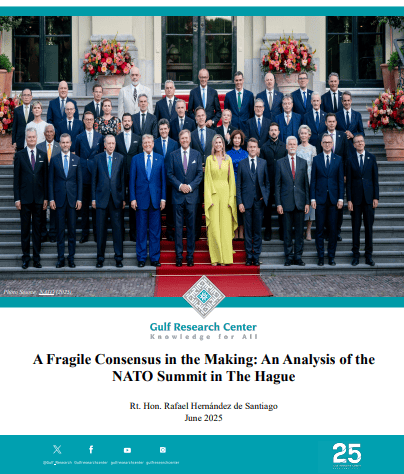
With NATO leaders meeting in The Hague on 24–25 June 2025, a historic inflection point is taking place. The alliance is on the cusp of its most ambitious attempt since the Cold War to overhaul burden-sharing rules, driven by geopolitical pressure and rising security threats. Secretary-General Mark Rutte’s call for a new 5% GDP defense target—3.5% for military expenditures and 1.5% for dual-use infrastructure—has laid bare longstanding transatlantic divides. While Washington backs the proposal with urgency, much of Europe remains hesitant, exposing a fragile consensus on the alliance’s future financial and strategic direction.
The Transatlantic Bargain Revisited
The United States, under President Donald Trump, is unapologetically assertive in its demand for increased contributions. Trump insists allies must commit to 5% or risk diminished American support, arguing that the U.S. already provides the alliance’s nuclear deterrent and should not bear disproportionate responsibility. This carrot-and-stick approach underlines the U.S. desire to push NATO toward greater self-reliance, but also reflects domestic political pressures to shift burdens to European allies.
Canada, meanwhile, approaches the summit with a more issue-specific agenda, focusing on Arctic security. Former Canadian Prime Minister Justin Trudeau has unveiled a significant submarine procurement plan tied to the ICE Pact with Finland and the U.S., illustrating Canada’s strategy to link climate resilience and territorial defense. Although Ottawa promises to reach the traditional 2% by 2032, its support for Rutte’s expanded vision remains measured and conditional.
Core Europe: Between Aspiration and Resistance
In Western Europe, responses to the proposed 5% target vary widely. The United Kingdom under Keir Starmer supports an increase in principle, with plans to reach 2.5% by 2027 and ambitions for 3% thereafter. However, London stresses that any new benchmark must remain economically viable, preferring a phased approach tied to growth rather than fixed quotas.
France adopts a more philosophical critique. Defense Minister Sébastien Lecornu dismisses “league table” politics, contending that military strength cannot be reduced to GDP figures alone. Paris supports improved capabilities but argues for a qualitative model aligned with strategic autonomy, targeting a 3.7% defense effort by 2030 without fully endorsing Rutte’s numeric approach.
Germany, led by Chancellor Friedrich Merz, emerges as a potential mediator. Building on the momentum of the Zeitenwende, Berlin backs a rise above 2% and emphasizes the need for European defense industrial revival. Crucially, Germany seeks to pair any headline GDP target with output-based metrics, such as ammunition production and air defense capacity, ensuring that financial commitments translate into tangible capabilities.
Southern Europe: Balancing Defense and Domestic Concerns
The most vocal opposition comes from Spain. Prime Minister Pedro Sánchez has labeled the 5% proposal as “unreasonable” and warns it could imperil social welfare priorities. Although Spain remains committed to NATO, it insists on flexibility, proposing instead a nuanced model that privileges capacity and modernization. Madrid’s €10.5 billion “Industrial and Technological Plan for Security and Defense” reflects this vision, aiming to reach 2% without tax hikes while boosting domestic industry.
Italy echoes some of Spain’s concerns. While the government under Italian Prime Minister Giorgio Meloni claims to have met the 2% threshold—mainly through reclassified spending—Defense Minister Guido Crosetto has openly questioned the alliance’s current trajectory. Citing domestic fiscal constraints, Crosetto backs a 3.5% cap and urges recognition of enabling infrastructure investments. His controversial pre-summit statement that NATO “no longer has a reason to exist” in its current form underscores Italy’s demand for a more adaptable, multipolar alliance.
Other southern states offer mixed responses. Portugal is open to increasing its contributions up to 3% if dual-use spending counts. Greece highlights its already high defense outlays, exceeding 3%, and argues these should be exempt from EU deficit constraints. Turkey, for its part, links its support to progress on arms transfers and the easing of export curbs, asserting its own priorities around counterterrorism and strategic autonomy.
Northern Europe: Enthusiastic but Cautious
Scandinavian and Baltic countries tend to support the higher spending targets, albeit with some caveats. Norway and Denmark back the full or core elements of the 5% framework, leveraging their wealth or acceleration funds. Iceland, lacking a standing army, emphasizes its contributions through radar coverage and air policing. Finland and Sweden tie their support to output-based assessments and concrete force contributions, such as Swedish Gripen deployments in Poland and Latvia.
The Baltic states stand among the most hawkish voices. With Estonia and Lithuania pledging defense budgets between 4–6% of GDP, these countries view the 5% goal as a necessary response to Russian aggression. They also warn against “creative accounting” and insist on accountability to ensure allies meet real, not cosmetic, commitments.
Central and Eastern Europe: Diverging Paths
Among the Visegrád and Central European nations, responses range from enthusiastic to hesitant. Poland, already spending 4.7%, champions a formal 3% floor and seeks to set the bar for others. Czechia backs gradual increases, citing its ammunition initiative for Ukraine as a model for meaningful contributions.
By contrast, Slovakia and Hungary remain noncommittal. Bratislava under Prime Minister Robert Fico raises questions about rapid rearmament, preferring a dual-use focused gradualism. Budapest continues to tie defense investment to economic returns, particularly through industrial ventures with Germany, reflecting a transactional view of NATO obligations.
Romania and Bulgaria offer practical support for increased defense spending but seek EU cofinancing or recognition of unequal starting points. Bucharest backs higher commitments in exchange for a stronger NATO presence in the Black Sea, while Sofia emphasizes modernization as a precondition for compliance.
The Western Balkans: Converging Timetables, Diverging Priorities
In the Balkans, defense contributions are shaped by EU aspirations and regional security roles. Croatia supports a convergence model similar to the EU’s fiscal framework, aiming for 3% by 2030. Albania highlights its naval bases and seeks maritime security credits. Montenegro and North Macedonia are advancing toward or have already achieved 2%, but warn that scaling up to 5% must be accompanied by pooled procurement schemes and longer timelines.
Slovenia, while slower on hard spending, champions broader resilience investments, from flood mitigation to cybersecurity, as legitimate NATO contributions—part of a growing push to redefine what counts as defense in an era of hybrid threats.
Southward Glance: Implications for the Middle East and the Gulf
While the summit’s spotlight remains on burden-sharing and deterrence against Russia, the discussions in The Hague also carry undercurrents for NATO’s southern posture—particularly its future engagement with the Middle East and the Gulf. The recalibration of defense budgets inevitably affects out-of-area missions and partnerships, with several southern allies, including Italy, Spain, and Turkey, linking increased defense contributions to a more robust Mediterranean and Gulf strategy. Italy, in particular, has stressed the importance of projecting stability southwards, arguing that NATO’s credibility cannot hinge solely on its eastern flank.
Though formal declarations are likely to remain cautious, there is growing expectation of a renewed interest in enhanced strategic cooperation with Gulf partners, especially around maritime security, energy infrastructure protection, and counterterrorism. Budgetary flexibility—such as recognizing dual-use investments—may incentivize southern members to support NATO missions that extend to the Red Sea, Hormuz, and beyond. As part of this, the alliance may explore expanded liaison frameworks with the Gulf Cooperation Council or deepen coordination with regional actors like Jordan, Saudi Arabia, and the UAE. Any movement in this direction would signal that NATO's evolving identity includes not just deterrence in Europe, but strategic vigilance across its southern neighborhood.
Toward a Managed Compromise
With Washington pushing aggressively and countries like Spain pulling back, a consensus on the full 5% appears out of reach. Nevertheless, diplomatic momentum is building toward a managed compromise. A likely outcome may involve a phased 3.5% commitment by 2032, an aspirational 5% for 2035, and expanded definitions of qualifying expenditures.
The Netherlands, host of the summit, has already embraced this formula domestically with Operation Orange Shield—its largest-ever defense spending initiative. This underscores what is truly at stake: not just budget figures, but NATO’s identity and cohesion in a more dangerous world.
Ultimately, The Hague Summit may be remembered not for the final numbers inscribed, but for signaling a shift in mindset—from a crisis management posture to readiness for high-end warfare. In Secretary-General Rutte’s words, this pivot may be “uncomfortable” but remains “indispensable” as the alliance enters its 76th year.
Rt. Hon. Rafael Hernández de Santiago, Viscount of Espés, is a Senior Researcher at the Gulf Research Center (GRC)