Commentary & Analysis
US Foreign Policy Retrenchment in Africa: Implications for Gulf Engagement and Strategy
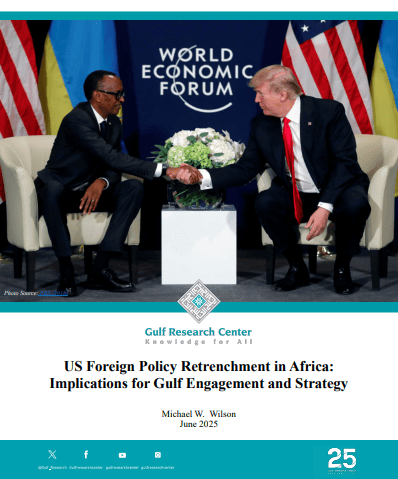
Under the guise of an America First Policy, US President Donald Trump has redrawn America’s foreign policy by shifting from adherence to soft diplomacy toward taking a more businessoriented and transactional approach. In this regard, he has halted most foreign assistance and is on course to close the United States Agency for International Development (USAID)- a beacon of America’s soft power diplomacy. Since 1961, the agency has strengthened healthcare, education, and economic development, particularly in Africa.
Decline of US Development Aid in Africa
African countries account for nearly a quarter of USAID’s beneficiaries, as the agency is present in over 40 African countries. In 2023, African countries received 17.4 billion USD in aid, for which USAID was the primary agent for distributing the funds. The aid has facilitated health and humanitarian initiatives by providing food, water, and access to healthcare services across vulnerable populations. Many of the projects have now come to a screeching halt.
Nutrition centers and water supply systems in Sudan and Somalia have been forced to shut down, introducing a risk for malnutrition. In Tanzania, 500,000 tuberculosis screenings have recently been suspended. In 2023, USAID allocated 400 million USD to support South Africa’s health sector by distributing essential medication in remote communities that now face uncertainties over access to treatment for infectious diseases.
In an additional step, in April 2025, the Trump administration ordered the Millennium Challenge Corporation (MCC)--a US agency that invests in infrastructure projects in Africa--to discontinue a large portion of its planned projects, including road development and power generation. Projects such as Zambia’s road improvement, irrigation, and energy production will be abandoned along with agriculture, rural infrastructure development, and water sanitation projects in Mozambique. Overall, these cessations will weaken private sector confidence in recipient countries, while immediately withering away new domestic jobs. In the long run, the funding cuts will hinder economic development, and for countries grappling with insecurity, it could aggravate the already unstable environment.
Since 2017, violent insurgency from the Islamic State in Mozambique has exacerbated instability in the Cabo Delgado Province, bearing negligible consequences for the domestic economy. Nevertheless, in 2023, the MCC dispersed 500 million USD to attract private investment and promote growth, while alleviating economic distress-fueled instability. Losing this facility will further deteriorate security and repel foreign investors who have set their sights on Mozambique's natural gas reserves, agriculture, and port operations.
Gulf States at a Crossroads: Filling the Vacuum With the future of American aid development in doubt, members of the Gulf Cooperation Council (GCC), including Qatar, Saudi Arabia, and the United Arab Emirates (UAE), suddenly find themselves confronted with potentially difficult choices. The immediate impact could be rising instability in a neighboring region as a vacuum of much-needed assistance is created.
In the case of Mozambique, Gulf states have expanded their economic ties there. In 2023, Saudi Arabia’s Chamber of Commerce, for example, established a Joint Business Council with Mozambique to support trade and investments in mining and agriculture, and Dubai’s Chamber of Commerce opened an office in the country. The UAE’s DP World operates the vital Port of Maputo and has invested over 3 billion USD in transport and energy, including AMEA Power’s 125 MW solar power plant. Qatar Petroleum has also sought to invest in Mozambique’s energy discoveries as it gained rights for gas exploration in 2019. The vacuum now created with the withdrawal of US investments will undoubtedly complicate the security of Gulf investments and increase their financial burden to protect their interests.
Yet, America stepping back from soft diplomacy and development assistance in Africa could also present opportunities for Gulf states to step in to fill at least part of the void. GCC members are already on track to expand their economic and political relations with African countries as part of a wider policy to diversify their economies away from oil reliance, increase their standing on the world stage, and broaden their international partnerships.
Part of the effort involves investing in various economic sectors. For example, Zambia’s stateowned energy company Zesco and the UAE’s Masdar signed a 2 billion USD solar panel agreement in 2023, underscoring a blooming relationship—one that now has further opportunities to grow due to the US withdrawal. More recently, in 2025, Zambia invited the UAE and Saudi Arabia to invest in its mining sector as it looks to bolster its copper production, demonstrating a focus on new partners. This trend is likely to grow across African economies.
In addition to the economic front, GCC states have also bolstered their humanitarian diplomacy with African states. Qatar Charity is working to build schools, orphanages, and hospitals, all while donating food and relief aid to vulnerable populations in Ghana,6 Djibouti, Mauritania, and Burkina Faso, among several others.7 Similarly, Saudi Arabia’s King Salman Relief (KSRelief) made generous humanitarian contributions to Sudan, Somalia, Niger, Nigeria, Cote d’Ivoire, and South Africa, among several others, in March 2025 alone.
Kuwait’s Direct Aid charity has contributed to the health and education sectors in Ghana, Chad, Sudan, Kenya, and various other countries. Notably, in 2025, Direct Aid implemented a vision screening program benefiting 17,000 children in Rwanda.8 Thus, the GCC states are already filling the void left by USAID's withdrawal while furthering their soft power and strengthening ties with African countries.
Constraints and Geopolitical Challenges for the Gulf
Taking over the role of USAID will not be so straightforward, however. For one, while these examples signify that the Gulf states can act as alternatives to US soft power, their agencies may not have the same support and infrastructure that USAID has had for over two decades. In the past, American governments ensured the agency’s continuity as a powerful tool in their foreign policy; in 2024, its budget was 21.7 billion USD. It also had 10,000 employees and some 3,000 partners, underscoring its ability to implement large-scale programs including vaccinations, medical treatment, training, education, and humanitarian relief. In 2024, it allocated 6 billion USD for humanitarian assistance in African countries alone, a sum that surpassed foreign aid from other contributors.
To this end, the Saudi Fund for Development, the Kingdom’s vehicle for financing sustainable development projects in emerging economies, supported 465 projects in 47 African countries totaling 13.15 billion USD in the last five decades. Since its establishment in 2005, KSRelief has supported 947 humanitarian projects in Africa for 600 million USD.9 In 2023, Qatar Charity10 and the Qatar Fund for Development11 collectively dispersed 850 million USD for global foreign assistance. Thus, there is a significant financing gap for Gulf states to fill in America’s absence. Although Gulf states have a keen interest in expanding their soft power on the continent and possess the financial resources needed, replicating the scale of USAID’s initiatives could detract from other Gulf investments targeting African energy, mining, agriculture, and infrastructure.
Second, the America First doctrine also presents opportunities for China to exploit as its Belt and Road Initiative promotes infrastructure development and mineral acquisition in Africa. Whereas Washington has withdrawn financial support for development projects, Beijing has steadily increased its economic engagement with African partners. At the 2024 Forum on China-Africa Cooperation, President Xi Jinping committed 50 billion USD to support energy, transport, infrastructure, and mining projects in Africa.
Chinese loans increasingly target renewable power generation as it has completed several geothermal, wind, solar, and hydro power plants in Madagascar, Burkina Faso, Uganda, Kenya, and Mozambique, among others. In April 2025, Kenyan President William Ruto signed 20 agreements with President Xi, targeting infrastructure, education and training, cultural exchange, and media cooperation, underscoring the current opportunity for China to buttress its engagement with African countries.
In contrast, some African leaders are reluctant to deepen their ties with Beijing. For instance, President Felix Tshisekedi of the Democratic Republic of the Congo (DRC) aims to counter China’s influence in the nation’s mining sector by partnering with other countries. In 2025, Tshisekedi invited Saudi Arabia to invest in Congo’s mines, highlighting a growing trend of relying more on Gulf states economically and diplomatically.
As a result, an opportunity is presented for the Gulf states and African nations to improve their rapport, as economic partnerships with the GCC are increasingly viewed as reliable. Unlike the United States, whose partnership is subject to change from election to election, and in this administration’s case, must satisfy US interests first, GCC countries can certainly adopt and promote a more stable, long-term policy approach.
By adopting a more transactional approach to foreign policy and sidelining traditional soft power strategies, the United States is now focusing on directly advancing its own economic interests, particularly securing access to critical minerals essential for technologies including smartphones and electric vehicles. This shift introduces the U.S. as an additional geopolitical competitor in Africa, joining China and the Gulf states in the scramble for strategic influence and resources.
The stakes are high: Rwandan-backed M23 rebels have besieged the mineral-rich eastern Congo, disrupting supplies of cobalt and other key minerals. This directly affects major U.S. companies such as Apple and Tesla. In this context, resolving the crisis is not just a humanitarian or security priority but also an economic one, which helps explain Washington’s recent diplomatic engagement with Presidents Kagame and Tshisekedi
As a condition for endorsing a regional peace accord set to be signed on June 27th, the United States is requiring that Rwanda and the Democratic Republic of Congo first conclude bilateral agreements granting U.S. firms access to critical mineral resources. 14 In May 2025, U.S. Secretary of State Marco Rubio hosted Congo’s Foreign Minister Thérèse Wagner and Rwanda’s Foreign Minister Olivier Nduhungirehe in Washington for negotiations aimed at de-escalating the M23 conflict and securing mineral cooperation. 15 These talks followed President Tshisekedi’s offer to grant the U.S. privileged access to Congo’s cobalt and coltan reserves in exchange for security support against the Rwandan-backed rebels.
According to senior Trump adviser Massad Boulos, the peace accord and the mineral agreements are intended to be signed simultaneously, paving the way for billions of dollars in U.S. and Western investment in Congolese mining and related infrastructure, as well as mineral processing in Rwanda. This arrangement also aligns with Tshisekedi’s broader objective of reducing Chinese influence in the sector.
For Saudi Arabia and the UAE, keen on producing electric vehicles with Congolese resources, this development does present a challenge by bringing a new competitor to the fore. In 2023, the UAE signed a 1.9 billion USD agreement with Société Aurifère du Kivu et du Maniema (Sakima) to develop four industrial mines in South Kivu. Meanwhile, in 2024, Saudi Arabia and DR Congo signed an MoU for mining investments, which aligns with Tshisekedi’s 2025 plea to the Kingdom to counter China’s near mining monopoly. America’s involvement in Congo’s minerals could now impede the Gulf nations’ intentions to diversify away from oil and strengthen their access to supply chains.
Qatar has already stepped into this exchange, mediating peace talks between the two leaders, in a display of Qatar’s soft power diplomacy. Qatar has promoted infrastructure and airport modernization in Congo and Rwanda.19 It has further cooperated with the United States to instill peace in the Great Lakes Region. Furthermore, the Qatar Investment Authority supported the US campaign to acquire more minerals when it invested 180 million USD in TechMet--a US International Development Finance Corporation Initiative, demonstrating how the two nations have a vast network of cooperation.
Conclusion
The Trump administration’s shift from soft power to a transactional foreign policy marks a significant departure from America’s previous engagement with Africa. Moreover, the abrupt withdrawal of development assistance has disrupted critical humanitarian and infrastructure programs, creating immediate economic and health-related vulnerabilities for millions across the continent. By cutting foreign aid and development programs, Washington has weakened the investment climate for foreign powers. This vacuum threatens long-standing partnerships and weakens America’s soft power, while also jeopardizing the stability of regions where US interests, such as access to critical minerals, are at stake.
The strategic retreat has, however, opens new avenues for GCC states to expand their economic, humanitarian, and diplomatic influence in Africa. Gulf states have already increased their presence on the continent, looking to build long-term partnerships and diversify their economies by investing in Africa. Yet, the opportunity provided by the US’s strategic withdrawal also has consequences for the Gulf states, which may face greater economic commitments to promote stability in different regions and protect their interests.
*Michael Wilson is a Researcher at the Gulf Research Center (GRC).