
Commentary & Analysis
Implications of Recent Escalations for the Saudi-Iran Rapprochement and China’s Role
The recent US strikes on Iranian nuclear facilities and Tehran’s retaliatory missile attack on the Al-Udeid US military base in Qatar on June 23, 2025, have jolted the fragile equilibrium in the Gulf. For Saudi Arabia and its Gulf neighbors, these events are not merely peripheral. They are a stark reminder of the enduring volatility in the region and the continued risks posed by Iran’s regional posture.
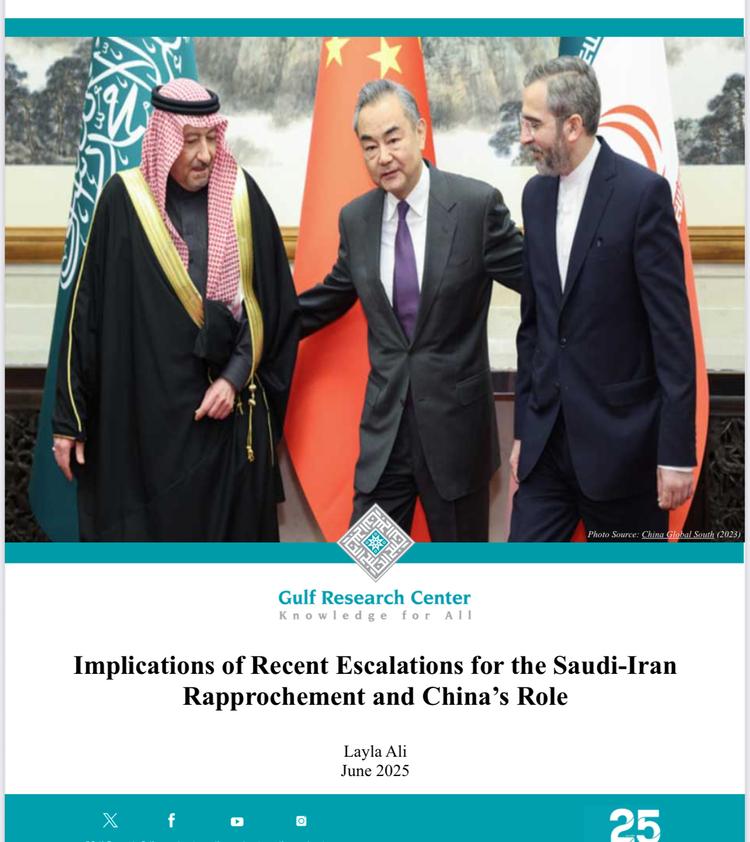
The implications are particularly profound for the Saudi-Iran rapprochement, a diplomatic breakthrough reached two years ago under the auspices of China. While that agreement marked a significant milestone in regional diplomacy, the recent developments cast doubt on its durability and underscore the limitations of external mediation, particularly China’s restrained and reactive role.
The Saudi-Iran détente, formalized on March 10, 2023, was a landmark achievement following years of hostility and proxy conflict. While the agreement was ultimately announced in Beijing, the bulk of the mediation was carried out earlier by Iraq and Oman, who facilitated multiple rounds of dialogue. China's involvement came at the final stage, primarily to provide international legitimacy and act as a guarantor, reflecting the desire of both Saudi Arabia and Iran for a P5 country to endorse the accord. In practice, the agreement yielded tangible benefits: cross-border attacks from Iranian-backed groups on Saudi territory subsided, tensions in Yemen de-escalated, and diplomatic channels between Riyadh and Tehran reopened. The Kingdom, in turn, was able to focus more on its domestic economic transformation, while Iran gained some regional legitimacy, momentarily easing its isolation amid ongoing international sanctions.
However, these gains are now being tested. Iran’s decision to launch a missile strike on Qatari territory, a clear violation of international law and a dangerous escalation, has sent shockwaves through Gulf capitals. Saudi Arabia’s unequivocal condemnation of Iran’s aggression against Qatar signals the limits of détente when regional stability is jeopardized by Tehran’s broader strategic behavior. For Riyadh, the missile strike raises uncomfortable questions: Can Iran truly be trusted as a partner in regional stability? Is the rapprochement merely a tactical pause in an otherwise antagonistic relationship?
This incident also highlights Saudi Arabia’s core concerns vis-à-vis Iran: first, that it not become entangled in a broader regional confrontation; second, that its territory and that of its allies remain untouched by Iranian or proxy aggression; third, that Iran itself does not collapse into chaos, thereby risking broader regional instability; and fourth, that the Iranian nuclear issue is contained. The missile strike on Qatar undermines all four concerns, particularly by revealing Tehran’s readiness to target regional countries in its strategic competition with the United States.
In this context, the spotlight inevitably turns to China. As the facilitator of the Saudi-Iran agreement, Beijing positioned itself as a stabilizing force in the Middle East, a power capable of mediating between bitter rivals. Yet China’s role since the 2023 accord has remained largely symbolic and passive. While it has supported continued dialogue and encouraged de-escalation, Beijing has refrained from playing an assertive diplomatic role amid the crisis. The recent missile attack on Qatar, a Gulf Cooperation Council GCC ally and key US partner, should have prompted a more proactive Chinese response, not only because it threatens regional stability, but also because it puts at risk the very agreement China brokered.
The limitations of China’s influence over Iran are now becoming more visible. Despite China’s deepening economic ties with Tehran, particularly in the energy and infrastructure sectors, Beijing has struggled to leverage this relationship into concrete political influence. Its calls for calm, repeated emphasis on “dialogue,” and avoidance of public criticism of Iran expose the constraints of its balancing act: China wants to expand its presence in the Middle East without becoming entangled in its conflicts. But in moments of crisis, this reluctance to act decisively can render its mediating role ineffective.
Saudi Arabia is likely recalibrating its expectations. While it appreciates China’s role in facilitating the initial diplomatic breakthrough, Riyadh remains clear-eyed about the limitations of the rapprochement and the need for sustained accountability. From the Saudi perspective, any normalization with Tehran must include a serious commitment from Iran to refrain from interference in Arab internal affairs, curb its support for regional militias, and address concerns about its missile and nuclear programs. The latest escalation has only reinforced the importance of these red lines.
Ultimately, Saudi-Iran relations are likely to endure in some form. The geopolitical logic behind the rapprochement, reducing the risk of direct conflict and enabling regional economic integration, remains valid. However, the trust deficit has once again widened. The missile strike on Qatari soil challenges the assumption that Iran is seeking a fundamentally new relationship with its Arab neighbors and casts doubt on its ability, or willingness, to separate its bilateral ties from its confrontations with the US and Israel.
China, for its part, must recognize that credibility as a mediator is tested not in moments of calm, but in moments of crisis. If it wishes to maintain its role as a diplomatic bridge-builder in the region, it must do more than convene summits and issue general statements. It must engage in active diplomacy, leveraging its political and economic capital with Tehran to prevent future escalations and reinforce the framework of détente.
Layla Ali is a Researcher at the Gulf Research Center (GRC)