Commentary & Analysis
Unexpected Facilitators: Gulf States and the IndiaPakistan Conflict
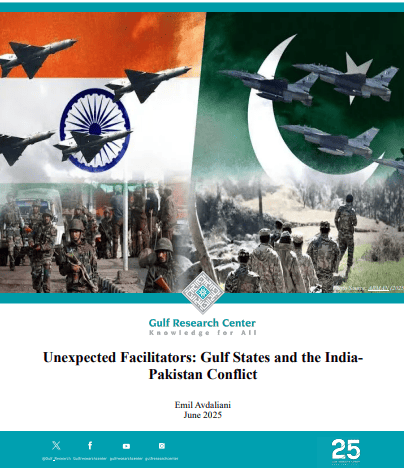
The Gulf countries emerged as major actors in soothing tensions between India and Pakistan. This greater engagement is driven by burgeoning economic, energy, and generally political ties between the Arab states and the Indian sub-continent.
As military clashes between Pakistan and India erupted in May 2025 and diplomatic efforts from a number of countries followed to reduce the tensions, one player, the Gulf Arab states, emerged as a powerful mediator between New Delhi and Islamabad. There is a lot at stake for the Gulf Cooperation Council (GCC). Trade, investments, and connectivity push the Arab states to play an increasingly active role in terms of the current crisis, as well as within the context of broader regional conflict.
On May 2, the Pakistan leadership held meetings with ambassadors of Saudi Arabia, the UAE, and Kuwait. Then, Saudi Minister of State for Foreign Affairs, H.E. Adel al-Jubeir, paid visits to both India and Pakistan, emphasizing the Kingdom’s commitment to stability and balanced relations with both sides. The UAE and Qatar likewise engaged with both sides through diplomatic channels, relaying concerns about the repercussions of escalating conflict. In one case, a top Gulf envoy visited Islamabad at the request of Pakistan’s premier, as Pakistan asked Saudi, Emirati, and Kuwaiti diplomats to press India on restraint. These mediation efforts signal the Gulf states’ willingness to use their political capital for de-escalation.
Though for many, the GCC’s activism might seem unexpected, the Gulf states have a history of mediation efforts in the India-Pakistan conflict. In February 2019, when the Pulwama attack took place and the fighting in Kashmir followed, the UAE and Saudi Arabia were main players in deescalating tensions, sending diplomats to Islamabad and New Delhi, and Riyadh hosting leaders of Pakistan and India. The UAE’s leadership was also among the first to describe it as India’s internal matter. Though the Pakistani government protested this framing, Gulf capitals maintained a neutral stance.
Similarly, Gulf media statements urged both India and Pakistan not to inflame the situation. Saudi and Emirati officials expressed hope that both countries would work in the interests of their people, but stopped short of placing blame on either side. In each case, Gulf leaders chose to tread a middle path, emphasizing the need for de-escalation. This pattern repeated in the April 2025 crisis after a major attack in Indian-administered Kashmir. Within days, Qatar and UAE foreign ministries publicly called on New Delhi and Islamabad to exercise “maximum restraint,” each issuing a statement that stressed dialogue and the prevention of war. Oman’s leader prayed for brotherly relations in both countries, and Kuwait (though quieter publicly) affirmed the importance of defusing tensions. These broad statements reflect a Gulf consensus: Conflict between India and Pakistan is unwelcome, and neither side should be allowed to drag the region further into conflict; moreover, the GCC will not choose sides but will push for rapid normalization of diplomatic ties. Throughout the India-Pakistan crises, the Gulf states have consistently couched their responses in calls for de-escalation, dialogue, and respect for sovereignty. In public statements, they have emphasized neutrality and the need for both sides to show restraint. These official pronouncements avoid taking explicit sides on core issues like Kashmir, reflecting a deliberate policy of noninterference. Notably, Gulf states have declined to endorse Pakistan’s framing of the Kashmir conflict as a humanitarian crisis or to condemn India’s integration of Kashmir as illegitimate. Instead, they often echo India’s language that Kashmir is an “internal matter” or emphasize that any border incidents must be handled peacefully between the two conflicting sides.
GCC’s Growing Influence
Each diplomatic intervention from the Gulf states is unique in some way. Each situation requires a specific deployment of tools that the Arab states possess. The constant, however, is that although the GCC countries could be expected to sympathize with Islamic Pakistan, the rhetoric has shifted away from religious framing. Instead, the Gulf diplomacy toward India-Pakistan clashes is driven by regional security and commercial interests. Indeed, the Gulf states' approach is purely geopolitical, with cultural and religious factors playing a lesser role.
Beyond more practical reasons, the GCC’s mediation efforts stem from the Arab states’ growing international profile. They are increasingly engaged in facilitation between warring sides, for instance, in Russia and Ukraine, where they have managed to facilitate numerous exchanges of prisoners of war. The Gulf states also act as a voice of reason when it comes to Middle Eastern affairs, especially the impasse around Iran’s nuclear program. While the US embraced a military solution to the crisis, the Gulf states have argued in favor of exclusively peaceful scenarios. This is all the more notable given the long history of rivalry and even outright enmity with the Islamic Republic. Even in the case of the war in Gaza, the Gulf states, though highly critical of Israel, are nevertheless open to diplomacy.
The Gulf states, unlike other major players, favor neither India nor Pakistan. This constitutes one of the strengths of their negotiating position, especially given the fact that it is in stark contrast with other actors’ postures. If Turkey is more aligned with Pakistan because of close military and commercial ties, Israel favors India. The US has likewise traditionally tilted toward New Delhi. Moreover, the GCC’s posture is further enhanced by the fact that neither Russia nor China could act as unbiased players. Beijing has a number of long-standing differences with India, ranging from border clashes to New Delhi’s fears that China is expanding its security and economic presence around India and in the Indian Ocean. Moreover, China is also closely linked economically and infrastructure-wise with Pakistan, with the latter serving as an important outlet for Chinese goods into the Indian Ocean. Pakistan’s access to the Indian Ocean serves as a comfortable conduit for China’s maritime ambitions. Russia is far better positioned, benefiting from its traditionally more balanced approach. But given Moscow’s close commercial ties with India, especially in arms exports, New Delhi is more important for the Kremlin. There is also the issue of the International North-South Transport Corridor (INSTC), running from Russia’s most populous provinces and ports toward Iran. Yet over the past couple of years, as Russia has been intent on recalibrating its commercial ties away from the West and more to Asia, ties with India have grown ever more critical for Moscow.
There is also an economic aspect that drives GCC’s outreach to Pakistan and India. In recent years, India has evolved into one of the Gulf’s largest commercial and investment partners. The UAE, for example, is now among India’s top sources of investments, New Delhi is increasingly dependent on Saudi and Qatari energy exports, and Pakistanis make up a huge portion of the Gulf workforce. Though the GCC countries tend to maintain balance, over the past decade, there has been a notable shift in how the GCC countries view Pakistan and India. India’s global rise and the Gulf’s diversification away from dependency on oil revenues have led the Arab countries to prioritize India as a partner for economic and technological collaboration. In 2023, for instance, India surpassed China as the largest buyer of Saudi oil, and Indian firms have won major investments and energy projects throughout the Gulf.
There are also infrastructure projects which are projected to connect the Gulf with the Indian subcontinent. One of them is Saudi Arabia’s proposed India-Middle East-Europe Economic Corridor (IMEC), which envisions a peaceful subcontinent as a key leg. Indeed, when the latest crisis broke out, India’s prime minister, Narendra Modi, was in Saudi Arabia for talks on the expansion of IMEC. In commercial terms, India now accounts for a significant portion of Gulf exports and investments, so alienating New Delhi over Pakistan would come at a heavy cost. Thus, Gulf leaders have ample motivation to defuse any confrontation between the two sides.
India’s rise in the Gulf states’ calculus was evident during the Indian PM’s visit to Saudi Arabia in April. While until recently, relations between KSA and India were characterized by India’s interest in having a secure source of oil for its booming economy, this transactional period of their relationship has transformed to encompass space cooperation, green energy, infrastructure, and security. The new scope of the India-KSA partnership has gradually evolved into one of the most impactful among the Global South. Indeed, in April, the two sides agreed on expanding cooperation in terms of gas supplies, defense, and agriculture. Over 50 memoranda of understanding were signed across the mentioned domains. Additionally, a comprehensive $100 billion strategic partnership agreement was signed, out of which around $10 billion will go toward the development of AI and space technologies, and $20 billion will be earmarked for investments into India’s infrastructure.
A similar expansion of ties is recorded in India’s engagement with the UAE. In 2024, the latter came out as India’s third-largest commercial partner with bilateral trade surpassing the $100 billion mark. From 2023-2024, the UAE was India’s seventh-largest source of investments ($2.9 billion). In April, Abu-Dhabi and New Delhi also announced that the two sides would push for ever closer ties in terms of military cooperation, following earlier reports that the UAE was interested in acquiring India-produced BrahMos and Akash missiles as well as joint weapons development – a policy befitting of the two countries’ ultimate goal of expanding domestic military production. The GCC, particularly the UAE and Saudi Arabia, represents a vital component in India’s so-called pivot to the West, whereby New Delhi is striving to diversify its foreign relations and economic contacts. For the GCC, extensive relations with India provide a powerful tool to build an ever more variegated foreign policy portfolio beyond more traditional relations with the United States and China.
Constraints
The rift between Qatar and the Saudi-UAE bloc (2017–2021) previously meant that not all Gulf voices spoke with one accord. During that period, Qatar sometimes provided a voice that was more sympathetic to Pakistan, in part due to its ties with Turkey and sprawling Muslim networks across the Middle East. With the GCC reconciliation settled in 2021, these cracks have narrowed, but nuanced differences remain.
Looking ahead, the Gulf states have emerged as chief promoters of peace between India and Pakistan. Their concerted appeals for restraint in May as well as in previous years, combined with their quiet diplomacy, underscore how much they value regional stability and appreciate the growing dependencies with India. With Pakistan and India likely remaining in rivalry mode, the Gulf’s balanced approach is expected to be consistent. Spurred by commercial ties with India and a need to balance relations with Pakistan, the Gulf states’ efforts will serve as an example of highstakes diplomacy in the era of a multipolar world order.
Emil Avdaliani is a professor of international relations at the European University in Tbilisi, Georgia, a scholar of Silk Roads, and a non-resident fellow with the Gulf Research Center.