

Commentary & Analysis
Results of the NATO Summit 2025 at The Hague: Unity, Threats, and Strategic Realignment
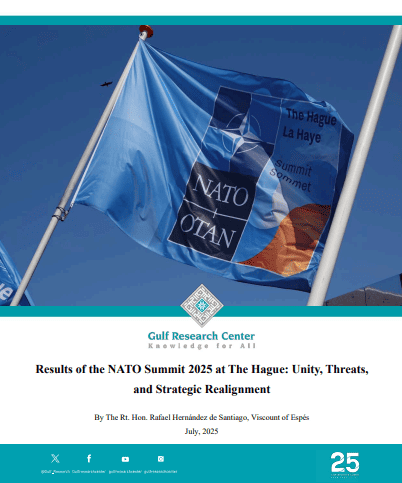
The 2025 NATO Summit, convened at The Hague on June 24–25, marked another important inflection point in the Alliance’s evolution, underscored by geopolitical fragmentation, strategic recalibration, and intensifying global insecurity. In response to this volatile environment, the summit produced several meaningful outcomes including a clarity on threat assessments, ambitious new defense investment targets, and NATO's shifting strategic posture under Secretary General Mark Rutte. To understand these developments, it is essential not only to recount the facts but also to analyze the implications of this strategic realignment. Why did the 5% defense benchmark emerge now? What does explicitly naming Iran signal about NATO’s southern engagement? And how does the increased inclusion of Indo-Pacific partners reshape the Alliance’s identity?
This article aims to assess the political drivers behind NATO’s decisions, interrogate the strategic balance between deterrence and diplomacy, and evaluate the long-term cohesion of the Alliance in light of diverging national priorities. This will allow one to provide a picture of what The Hague Summit means for NATO’s future and the global security order it seeks to preserve.
A Strategic Shift
Mark Rutte’s appointment as Secretary General of NATO in October 2024 brought both continuity and urgency. His political experience and transatlantic credibility has helped steer difficult negotiations, particularly on defense spending and southern security. In his opening remarks, Rutte framed the summit’s purpose succinctly: “Our deterrence must be credible, our defense must be real, and our unity must be unbreakable.” Yet beneath the rhetoric, Rutte's leadership signaled more than mere institutional steadiness. It marked a clear pivot toward reconciling NATO’s internal cohesion with external pressures. Rutte's role in brokering the contentious 5% GDP benchmark certainly underlined the urgency of aligning transatlantic political will with strategic realities.
The major headline from The Hague was therefore a new, more ambitious defense spending benchmark: 5% of national GDP. While it includes 3.5% earmarked for traditional defense capabilities and 1.5% for resilience, the proposal's significance lies in how it reflects a systemic redefinition of what constitutes security. Critical infrastructure, cyber defense, and energy resilience have moved from the periphery to the center of NATO’s collective defense agenda.
While 23 member states have already met or exceeded the previous 2% benchmark, the leap to 5% has exposed fault lines within the Alliance. Spain, leading the opposition, deemed the target economically "untenable." The eventual compromise- -a phased implementation by 2035--offered a way forward. Still, this outcome raises a key analytical question: Can NATO afford such ambitious goals without undermining political unity or domestic fiscal sustainability? The answer will likely determine the credibility of its deterrence posture in the years to come.
Moreover, creative interpretations of what counts as defense spending have begun to surface. Italy, for example, has proposed including its controversial bridge to Sicily project under the resilience component, arguing for its strategic infrastructure role. Germany has floated a similar justification for national road improvements. These instances reveal a broader trend: every country is now engaging in imaginative accounting to meet the target on paper, even as actual military outlays remain politically and economically contentious. This divergence between form and substance may well undermine the credibility of the 5% goal unless clear and enforceable criteria are adopted by NATO to define qualifying expenditures.
Redrawing the Threat Map: Russia, Iran, and China
The summit's updated threat assessment is notable for its candor and breadth. Russia remains the "most significant and direct threat," but the naming of Iran as a destabilizing actor and China as a systemic challenge signifies a broader geostrategic recalibration.
Iran’s inclusion, championed in particular by France, reflects growing concern over hybrid threats emanating from the Middle East—proxy militias, drone proliferation, and a strategic partnership with Russia. This represents a conceptual shift: NATO is no longer just concerned with territorial defense, but with destabilization emanating from asymmetrical actors beyond its borders. President Macron’s warning of Iran’s "hybrid challenge spilling into Europe’s southern flank" captures this evolution.
China’s designation as a "systemic challenge" also deserves attention. While NATO stops short of framing Beijing as a direct military threat, its activities in cyber, space, and economic coercion have placed it squarely on the radar. Analysts must now grapple with how NATO can maintain cohesion on China while member states maintain divergent economic relationships with Beijing. The Alliance’s balancing act—avoiding escalation while building resilience—is as such fraught with uncertainty.
Ukraine: Between Political Will and Strategic Patience
In the meantime, NATO’s reaffirmation of support for Ukraine was both expected and essential. Yet the absence of a clear timeline for accession reveals the enduring tension between strategic idealism and geopolitical caution. President Zelenskyy’s push for membership guarantees, for example, continues to clash with Germany and Hungary’s more restrained approach.
The summit’s conclusion that “Ukraine’s future is in NATO” keeps the door open, while maintaining a strategic hedge. The message is deliberately ambiguous, intended to reassure Kyiv while avoiding direct confrontation with Moscow. The ambiguity is both a diplomatic necessity and a potential source of long-term frustration.
From Sea Cables to Ransomware: Confronting Hybrid Warfare
The announcement of a Maritime Infrastructure Protection Task Force and the expansion of NATO’s cyber doctrine under Estonia’s leadership reflects a strategic shift toward multi-domain security. Incidents in the North and Baltic Seas served as stark reminders that NATO’s vulnerabilities are no longer confined to land or air.
The move to formalize doctrines around AI-enabled disinformation and cyberwarfare represents another important institutional response. However, it also raises a question: Can a military alliance originally designed for kinetic conflict adapt fast enough to emerging, often ambiguous threats? Here, institutional agility— not just funding—will be the decisive factor.
The Southern Flank and Indo-Pacific Engagement: A Dual Expansion
The summit confirmed a strategic broadening of NATO’s geographical scope. With instability in the Sahel, increased migration, and terrorism pressuring the southern flank, Mediterranean states like Italy, Spain, and Turkey made a successful case for deeper engagement.
Simultaneously, the presence of Indo-Pacific partners signaled a parallel, if more symbolic, eastward outlook. NATO’s dialogue with Japan, South Korea, Australia, and New Zealand reflects recognition that global rivalries are increasingly indivisible. Yet the challenge remains: How can NATO engage globally without diluting its regional coherence or overextending its resources?
Transatlantic Dynamics: Burden-Sharing and Strategic Autonomy
U.S. Secretary of Defense Pete Hegseth’s reminder that "security cannot be subcontracted" encapsulates the persistent tension in transatlantic relations. The 5% target was a clear American ask, but Europe responded with conditional support. France and Germany’s proposals to deepen EU-NATO mechanisms indicate a drive toward strategic autonomy, though not rupture. This trend points toward a new model of shared leadership--one where Europe assumes greater responsibility without undermining the transatlantic core. Whether this dual-track approach enhances or fragments NATO depends on the political maturity of its leaders and the institutional mechanisms that evolve from it.
Conclusion: From Rhetoric to Resolve
The Hague Summit delivered more than symbolic declarations. It charted a comprehensive recalibration of NATO’s priorities, acknowledging that the future of deterrence lies as much in fiber-optic cables and AI algorithms as in tanks and aircraft. Under Secretary General Mark Rutte’s pragmatic leadership, NATO has begun a new chapter—one rooted in realism, driven by shared threats, and tested by the very unity it seeks to preserve.
However, the true test of this summit will not be in communiqués or press conferences, but in implementation. The Alliance left The Hague more united in their intent, but on diverging paths toward execution. In this context, the coming decade will determine whether NATO can evolve into a truly multi-domain security alliance or whether the weight of political and economic asymmetries will erode the foundations of its unity.