
Commentary & Analysis
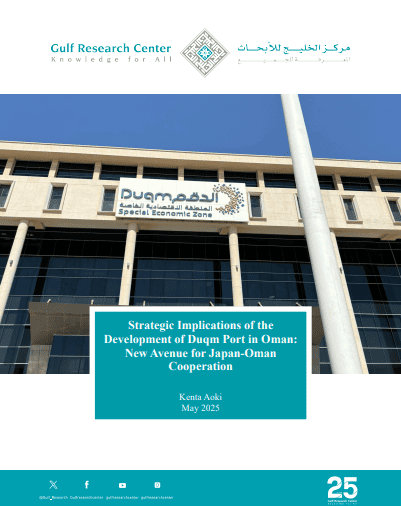
Strategic Implications of the Development of Duqm Port in Oman: New Avenue for Japan-Oman Cooperation
1. Introduction
The development of Duqm Port, strategically positioned in Al Wusta Governorate on Oman’s eastern seaboard, has demonstrated consistent progression by capitalizing on its geopolitical advantages and successfully attracting foreign direct investment. Scholarly discourse has predominantly contextualized this infrastructure development within the framework of Sino-Indian strategic competition in the Indian Ocean region.1 According to prevailing narratives, China, through its Belt and Road Initiative (BRI), is ostensibly expanding its influence with potential aspirations to transform Duqm Port into a dualuse facility with military capabilities. Concurrently, India has purportedly responded to this perceived strategic encroachment by negotiating naval access arrangements with Oman.2 This paper critically examines the validity of these assumptions against empirical evidence gathered during the author’s field research conducted in February 2025. It further analyzes the broader geopolitical implications of Duqm Port’s ongoing development within the regional maritime security architecture.
2. Duqm Port: An Emerging Geostrategic Maritime Node in Oman
Oman’s maritime infrastructure comprises four principal ports—Muscat, Sohar, Duqm, and Salalah—with Duqm Port representing the 1 Muhammad Abbas Hassan, “Growing China-India Competition in the Indian Ocean: Implications for Pakistan,” Strategic Studies, 39(1), April 2019, pp 77-89. 2 Stephen Crowther, “Once Oman a Time: A Tale of India Escaping China’s “String of Pearls”?,” Institute for Security and Development Policy (ISDP), May 14, 2018, most recent development in this network. Originally a modest fishing settlement, Duqm has undergone substantial transformation since its full operational commencement in 2012, with accelerated infrastructure development encompassing maritime facilities, terrestrial connectivity, aviation capacity, and prospective rail integration. The terrestrial transportation network has achieved completion, establishing connectivity with Oman’s broader road infrastructure. Additionally, Duqm Airport now facilitates domestic aviation services, enabling approximately one-hour connectivity with the capital Muscat via low-cost carrier SalamAir.
A distinguishing characteristic of this port development is the designation of an extensive 2,000-square-kilometer Special Economic Zone (SEZ) under the regulatory authority of the Public Authority for Special Economic Zones and Free Zones (OPAZ). This area, formally designated as the Special Economic Zone At Duqm (SEZAD), constitutes the most expansive SEZ within the Sultanate of Oman and signifies the government’s strategic prioritization of regional development. Within SEZAD’s jurisdictional boundaries, multiple industrial ventures have been established, including a passenger bus assembly facility by KARWA Motors with Qatari investment capital, a green steel (low-carbon iron source) manufacturing complex by Indian industrial conglomerate Jindal, and the China-Oman Industrial Park. Concomitant development has occurred in residential infrastructure, exemplified by the construction of Renaissance Village, a sprawling accommodation for workers, alongside initiatives to cultivate tourism attractions leveraging the region’s geographical attributes, such as cetacean observation opportunities. In addition, an international school is operational, designed to accommodate the familial requirements of international investors and workers.
SEZAD hosts petroleum refining capabilities that process Kuwaiti-sourced crude oil for subsequent international export. Significantly, the development of green hydrogen and ammonia production has assumed critical importance in Omani economic planning, aligning with the sustainability objectives articulated in Vision 2040.4 Since Oman has a very short oil and natural gas shelf life at the moment compared to other Gulf countries, the imperative for economic diversification and rapid decarbonization has gained particular urgency (for details, please see Section 4).
The Duqm deep-water port, featuring an 18- meter draft capacity, is equipped with gantry crane infrastructure capable of facilitating container vessel operations and accommodating roll-on, roll-off (RORO) vessels that enable direct discharge of heavy vehicular and oversized cargo. Adjacent to the commercial maritime facilities, the port complex incorporates military berthing capabilities that host naval vessels from various nations. 5 The port infrastructure is complemented by operational dry dock facilities that provide vessel inspection and maintenance services.
Within the framework of Oman’s economic diversification strategy articulated in Vision 2040, Duqm Port possesses significant potential to assume a pivotal role in facilitating green hydrogen and ammonia production infrastructure, capitalizing on its geographic positioning and environmental attributes. Nevertheless, Duqm Port faces substantial competitive challenges in establishing regional significance amid increasingly attractive maritime infrastructure offerings from neighboring Gulf states. Additional infrastructural limitations—specifically the incomplete railway network and absence of international aviation connectivity at Duqm Airport—create logistical impediments for cargo transportation and investor accessibility. These factors constitute significant developmental constraints requiring strategic intervention.
According to data obtained through interviews with Duqm Port Authority representatives, operational management rights for the port have been allocated to a joint venture between Omani logistics service provider ASYAD and Belgium’s Port of Antwerp, structured as an equal partnership (50%-50% equity distribution). This arrangement differs substantially from the operational framework of Iran’s Chabahar Port Agreement with Indian investment and operational rights granted to India Ports Global Limited (IPGL).
To understand the background of this response by the Omani authorities, it is important to understand Oman’s unique foreign policy. Throughout this research investigation, a recurring narrative emerged regarding Oman’s historical geopolitical significance as a nexus between Eastern and Western civilizations. This positioning has apparently cultivated a societal ethos characterized by tolerance and cultural pluralism, which manifests in Oman’s foreign policy approach of balanced diplomacy. With a relatively modest demographic profile of approximately 5 million inhabitants, Oman appears to have deliberately maintained equidistant relationships with major powers including the United States, China, India, European nations, and East Asian countries— neither aligning too closely with any particular power nor creating significant distance.
3. Foreign Strategic Interests and Investment Patterns in the Development of Duqm Port
Consistent with its distinctive diplomatic posture, Oman exhibits a non-partisan approach toward international relations, a principle that extends to its port development strategy. This is important in relation to the role that foreign powers play in the development of Duqm Port. For example, China has attempted to leverage great power competition dynamics while strengthening its global supply chains through the BRI. This strategy has manifested in the establishment of a naval facility in Djibouti (2017) and the advancement of the ChinaPakistan Economic Corridor (CPEC), with Pakistan’s Gwadar Port serving as a gateway. Within this broader geopolitical context, China has established the China-Oman Industrial Park (Photo 1), ostensibly to enhance bilateral investment. During 2018-2019, Japanese media outlets, including the Nikkei Newspaper and JETRO publications, expressed concerns regarding China’s expanding influence in Oman, employing rhetoric such as “Red economic zone ‘maritime powerhouse’ spreads alarm”7 and “China’s influence on Oman expanding?”
However, empirical field research contradicts these narratives of Chinese dominance. During the author’s site visit to the China-Oman Industrial Park, observations revealed significant disparities between ambitious development proposals and actual implementation. Despite China’s initial announcement of investment worth US$ 10.7 billion, the majority of designated industrial park sites remained undeveloped, presenting an uninhabited landscape. The limited infrastructure consisted of a facility resembling a gymnasium, apparently intended as a materials market, one Chinese restaurant, and a commercial building with minimal operational activity.
Equally, while initial operations at Duqm Port in 2012 reflected Omani-Chinese cooperation predicated on anticipated Chinese investment, subsequent developments reveal Oman’s strategic decision to incorporate European stakeholders rather than granting operational control exclusively to Chinese entities. The observed conditions at the China-Oman Industrial Park suggest a deliberate Omani strategy to avoid excessive dependence on any single international partner.
Nevertheless, China maintains significant economic importance for Oman as its primary export destination and third-largest import source.11 China represents Oman’s predominant market for crude oil exports. Given this economic interdependence, China’s influence on the broader Omani economy remains 9 “Oman counts on Chinese billions to build desert boomtown,” Reuters, September 5, 2017, https://www.reuters.com/article/business/oman-countson-chinese-billions-to-build-desert-boomtownidUSKCN1BG1WI/. 10 Within this diplomatic framework, Oman has prioritized third-party mediation capacities, establishing communication channels with opposing factions during regional conflicts and political tensions. The Sultanate has demonstrated a propensity for hosting reconciliation forums and engaging in shuttle diplomacy. A notable example of this mediatory role was Oman’s facilitation of negotiations leading to the Joint Comprehensive Plan of Action (JCPOA) between Iran and the P5+1 powers, culminated in July 2015. Reports further indicate that Oman utilized its established communication networks with Houthis to negotiate the release of crew members from the NYK-operated vessel Galaxy Leader, which had been seized by Houthi forces in Yemen. “GCC Chief Welcomes Oman Mediation for Release of ‘Galaxy substantial and warrants comprehensive analysis, particularly when juxtaposed with the apparently limited progress in Chinese involvement in Duqm Port development.
In addition to China, developments in naval access of the United Kingdom and India are also important factors when looking at foreign involvement in Duqm Port. Documentation indicates that the UK government formalized a Memorandum of Understanding with Oman in 2017 to establish a logistics hub at Duqm Port, intended to function as a strategic position for Royal Navy deployments in the Indian Ocean region.12 The UK Defense Secretary announced an additional 23.8 million GBP investment in its logistics hub at Duqm Port in September 2020. According to the statement, the investment will triple the size of the existing UK base and help facilitate Royal Navy deployments to the Indian Ocean. It also has a dry dock facility which could support the UK’s two aircraft carriers HMS Queen Elizabeth and HMS Prince of Wales.13 In fact, a joint military exercise between the Sultanate of Oman and Britain was conducted in November 2021with the participation of HMS Queen Elizabeth.14 These facts indicate that the Port of Duqm has a strategically important role for the UK with a view to its presence in the Indian Ocean.
Additionally, Oman’s historical maritime and commercial exchanges with the Indian subcontinent via monsoon trade routes have resulted in substantial Indian cultural and economic influences across numerous sectors of Omani society. This deep bond is not limited to the economic sphere, but can be seen in the military sphere as well. In May 2021 India renewed its 2018 defense pact with Oman, which gives the Indian military access to the Port of Duqm.15 The agreement was made during Indian Prime Minister Narendra Modi’s trip to Oman, and allows the Indian Navy to sustain long-term operation in the western Indian Ocean. This move also needs to be understood in terms of India’s check on China’s presence in the Indian Ocean.16 It is worth noting that a significant Indian diaspora maintains an active presence in Oman, and Indian corporations have demonstrated considerable investment in Duqm Port’s development.
However, Oman has refrained from exclusive dependence on Indian partnerships, as was seen in China’s case. The above-mentioned balanced approach extends to Oman’s relations with the US, European nations, China, and India, reflecting a sophisticated diplomatic strategy that maintains productive international relationships while preserving national autonomy and decision-making sovereignty. Duqm Port’s development continues to progress incrementally, attracting multinational interest while leveraging its strategic geographic positioning outside the critical maritime chokepoints of the Strait of Hormuz and the Bab al-Mandab Strait. In addition to the powers mentioned above, the US also has significant military influence in the Indian Ocean, including a support facility on the island of Diego Garcia, a British possession. In other words, the Indian Ocean, which the Port of Duqm faces, is a stage on which the interests of diverse actors such as the US, the UK, China, and India compete.
4. Duqm and the Role of East Asian Nations
In addition to its geopolitical significance, Duqm also exhibits significant potential for renewable energy generation, attributed to its topographical characteristics of gentle undulation, coastal wind patterns, and extended insolation periods. In this context, the role played by East Asian nations such as Japan and South Korea needs to be highlighted. The Omani government has actively solicited investment in green hydrogen and ammonia production initiatives, with Japanese corporations Mitsui & Co. and Kobe Steel Ltd. collaboratively advancing preparations for a comprehensive green steel production project. According the company’s statement, Mitsui & Co. and Kobe Steel Ltd. have been jointly studying the possibility of establishing a low CO2 iron metallics production plant in SEZAD, and are planning to commence the production by 2027.
South Korean companies are also accelerating their presence in Duqm. LUPRO, a Korean green energy company, signed a three-way agreement with Oman’s largest energy company, Muscat House, and Thailand’s energy company, MA Corporation, to produce, supply, and sell green ammonia. The consortium plans to produce 1 million tons of green ammonia per year to supply to Thailand starting in 2027.18 As mentioned above, the Duqm Port has attracted the attention of many foreign investors, including from East Asian countries, as part of the Omani government’s “Vision 2040” plan to move away from fossil fuels.
At the same time, and within this geopolitical context, Japan’s archipelagic configuration necessitates diplomatic consideration of substantive contributions toward Duqm Port’s development as a matter of strategic significance. Given Japan’s approximately 95% dependence on Middle Eastern petroleum resources for its crude oil imports,19 the nation faces an imperative requirement to formulate alternative strategic contingencies that ensure maritime navigational freedom and mitigate vulnerabilities associated with potential disruptions at critical maritime chokepoints. Specifically, Duqm Port presents potential functionality as a strategic node within Japan’s energy security architecture, particularly salient amid escalating uncertainty characterizing contemporary great power competition in what scholars have designated the “age of geopolitics.”
The historically amicable bilateral relations between Japan and Oman present significant opportunities for strategic enhancement through the development of premium-quality infrastructure, convening of international maritime security forums, and establishment of 18 “LUPRO Signs $4.5 billion Green Ammonia Deal with Oman and Thailand,” Saudi Gulf Projects, January 3, 2025, https://www.saudigulfprojects.com/2025/01/lupro-signs4-5-billion-green-ammonia-deal-with-oman-andthailand/. 19 In 2023, Japan’s dependence on the Middle East as a source of fossil fuel imports was 95.3%. This includes collaborative research initiatives—all oriented toward advancing the conceptual framework of a “Free and Open Indo-Pacific.” Japan possesses considerable latitude to expand multidimensional cooperation with Oman, an established maritime power, particularly regarding port infrastructure development programs.
Furthermore, while strategic discourse has predominantly concentrated on the eastern maritime domains of the Indo-Pacific region, ensuring navigational security in the western Indo-Pacific maritime space—encompassing Iran, Pakistan, and East African littoral states— represents a critical imperative for Japan as a trade-dependent nation. Consequently, the geopolitical significance of Oman’s Duqm Port, situated at the nexus of these strategic regions, acquires additional dimensions when analyzed within the framework of enhanced regional connectivity. The fundamental importance of sustained commitment to maintaining oceanic domains as universally accessible global commons remains paramount in this context.
Overall, this analysis has demonstrated that Duqm Port’s development trajectory has not followed a China-centric investment model but rather reflects Oman’s strategic diversification of partnerships encompassing Belgium, the UK, India, Japan, and South Korea. While the port remains in ongoing developmental phases, its distinctive geopolitical advantage— circumventing two critical maritime chokepoints—has attracted progressive international investment. For a country like Japan, this offers both opportunities and challenges and thus underlines the importance of better understanding the strategic relevance of Duqm both in the near- and the longer term.
*Views expressed in this article are author’s own and do not represent the views or opinions of author’s current and/or former employer(s).
Kenta Aoki is a Former Executive Research Fellow at the Middle East Institute of Japan (MEIJ).