Commentary & Analysis
The United Nations at 80: Reforming Global Governance and Arab Inclusion
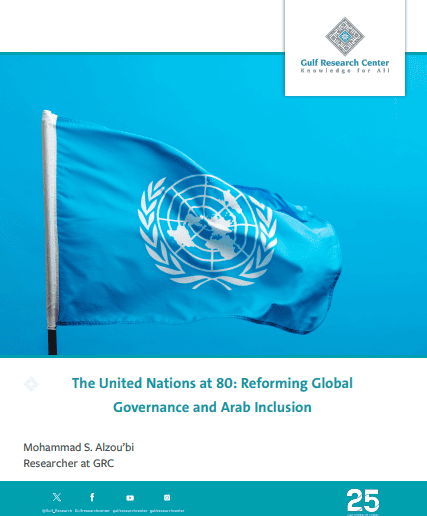
On the occasion of its 80th anniversary, the United Nations finds itself at a critical junction, marked by deepening disillusionment with the effectiveness of multilateralism and a systematic erosion of its authority. The Arab region serves as a mirror reflecting the UN’s institutional shortcomings most clearly. Despite the principles upon which the organization was founded, aspiring to establish a resilient international order based on peace, security, and equality, it has repeatedly failed to respond effectively to chronic and recurring challenges in the Arab world. From the Israeli occupation of Palestine to the internal conflicts in Syria, Libya, and Yemen, and the ongoing situation in Iraq, the UN’s record appears marred by legal inertia, politicized selectivity, and subservience to the interests of major powers. At this critical juncture, it is imperative to reevaluate the organization›s role in the Arab context and identify the structural and political shortcomings that have hindered its effectiveness. Today, we are in dire need of a comprehensive reform agenda, clearly and transparently based on reorganizing international standards, strengthening institutional pluralism, and expanding the base of inclusiveness, to ensure both fair representation and effective performance.
The Crisis of Multilateralism and the Arab Situation
The United Nations Charter, adopted in 1945 in the wake of a devastating global conflict, established a vision based on cooperative security and collective responsibility. However, despite its declared universal character, this vision has not, in the view of many intellectual and political elites in the Arab world, translated into actual justice or tangible strategic reform in this region in particular. The Arab region has remained trapped in successive cycles of occupation, sectarian division, and external military intervention. The United Nations has addressed these conditions with varying degrees of passivity or procedural formality, without adopting a radical approach commensurate with the gravity of the crises or the depth of their complexities. This failure is exacerbated by a lack of cognitive symmetry, wherein concepts such as sovereignty, rights, and commitment to international law are formulated within hierarchical power structures that systematically marginalize the Arab region’s expressions of its grievances and rights within the organization›s central agenda. It is not lost on observers that the institutional structure of the United Nations, while seemingly neutral, is designed to perpetuate the privileges of dominant powers. This undermines the neutrality of the UN mandate and threatens the organization›s credibility in fulfilling its core functions in the areas of peace and security, particularly in Arab contexts, which continue to pay the price for the imbalances of the international system.
The United Nations and Arab Issues: Documenting Successive Failures
The Palestinian issue, which has remained unresolved for decades, stands as the most glaring indictment of the United Nations’ failure to uphold its founding principles. Since the 1947 Partition Plan, the organization has failed to translate its resolutions—affirming the rights of the Palestinian people to self-determination, return, and territorial sovereignty—into tangible, implementable outcomes. The ongoing paralysis of the Security Council, exacerbated by the repeated use of the U.S. veto in particular, has contributed to the entrenchment of a form of “legal nihilism,” whereby international law is reduced to an advisory authority with no binding force and devoid of any enforcement tools. Similarly, the deterioration of UNRWA’s role, due to funding withdrawals and systematic delegitimization campaigns, further demonstrates the erosion of the UN’s mechanisms originally established to mitigate this structural injustice embedded within the international system. The organization›s marginalization has been compounded by the accelerating trend of normalization pursued by several regional actors in recent years. This shift has undermined the UN’s role as an institutional authority on the conflict, relegating it to a secondary actor content with issuing diplomatic praise and moral condemnation. Perhaps nothing has more clearly embodied the organization’s fragility and loss of moral and political weight than its failure to take a serious stance on the unprecedented humanitarian catastrophe witnessed in the Gaza Strip. Behind closed curtains and through cautious diplomatic statements, the UN appeared more like a spectator to one of the greatest tragedies in contemporary history, content with face-saving condemnations. In my view, this moment dealt a painful blow to the organization’s standing and moral legitimacy in the eyes of the region’s peoples.
Add to this the crisis of international governance, most evident during the Syrian civil war, which represented a critical test of the UN’s ability to fulfill its role in an era of renewed great power competition. The organization’s political and humanitarian apparatuses have been systematically crippled by the inertia resulting from the repeated use of the veto, particularly by Russia and China, preventing the formulation of any effective collective position on core issues, from accountability for the use of chemical weapons to the enforcement of a ceasefire. Despite the symbolic importance of the Geneva and Astana processes, they failed to achieve comprehensive or sustainable political settlements, reflecting the limits of the UN’s ability to move beyond procedural engagement into the realm of actual resolution. In Yemen, the crisis represents a paradigmatic case of the acute gap between the UN’s humanitarian capabilities and its political dysfunction. The organization has managed to mobilize a massive relief infrastructure amid a worsening famine and an unprecedented epidemic outbreak, demonstrating the effectiveness of its humanitarian system when the will and resources are available. However, this relative success did not translate into a similar achievement on the political track, as the United Nations’ efforts to formulate a credible and inclusive peace process faltered. The 2018 Stockholm Agreement, which initially promised to reset the negotiating process, collided with a fragile reality marked by weak implementation mechanisms and the absence of sufficient international guarantees, undermining the possibility of building upon it as a foundation for a sustainable political solution. In another case, the UN intervention in Libya after 2011 was a stark example of reactive engagement rather than strategic engagement guided by a long-term vision. Following NATO’s intervention under the mandate of Resolution 1973, the resulting political vacuum gave rise to centrifugal forces and internal rivalries that the UN found itself ill-equipped to contain. Furthermore, the United Nations Support Mission in Libya (UNSMIL) suffered from structural shortcomings in managing the political process, due to fragmented sovereignty, intensified external proxy interventions, and the absence of coercive pressure or meaningful influence. These shortcomings rendered ceasefire attempts fragile, intermittent, and unsustainable. In parallel, Iraq represents another example of the UN’s declining effectiveness, particularly after 2003. Its efforts were limited to technical and advisory roles, with no real ability to influence the reconstruction discourse or engineer local political balances. In “postoccupation environments,” where unilateral powers dominate the power equation, the United Nations’ standing has diminished, and it has gradually lost its centrality as a neutral mediator capable of forging consensus.
Diagnosing Institutional Deficiencies and Structural Constraints
Article 27 of the UN Charter enshrines the veto power granted to the five permanent members of the Security Council. This power has transformed the Council from a body intended to be the cornerstone of collective security into an arena for geopolitical conflict. This transformation has been clearly evident in Arab crises, where the repeated use of the veto, particularly by the United States and Russia, has obstructed accountability and granted de facto immunity to the strategic allies of these powers, regardless of their violations of international law or human rights. In this sense, the United Nations, through its Security Council, no longer embodies a system that elevates the value of human beings as the supreme normative reference. Rather, it has become, in many cases, a tool for reproducing equations of hegemony, self-interest, and competition under the guise of international legitimacy. In response to this reality, ambitious reform initiatives have been proposed—such as the French-Mexican initiative calling for restrictions on the use of the veto in cases of mass atrocities. However, despite the broad rhetorical support these initiatives received, they have remained without legal enforceability.
Like any other global governance organization facing profound challenges that require structural reform, the United Nations’ complex institutional system suffers from entrenched functional isolation, inter-agency competition, and a lack of horizontal coordination and integration. This bureaucratic disintegration results in weak field performance, particularly in complex contexts where humanitarian, development, and political dimensions intersect, and where efforts are supposed to complement one another and mandates intersect, rather than clash or overlap haphazardly. Conflict zones in the Arab world, particularly in Syria and Yemen, have exposed acute shortcomings in the organization’s structure, manifested in the absence of unified leadership frameworks and the overlap of different mandates.
This has led to incoherent responses and, often, conflicting outcomes.
There is widespread criticism in Arab academic and diplomatic circles regarding international selectivity. The apparent asymmetries between firm responses to violations of international law in non-aligned contexts and tepid or symbolic positions on issues such as the Palestinian question—or those involving states allied with Western powers—reinforce entrenched perceptions of a dual or bifurcated legal system. This contradiction contributes to the weakening of the United Nations’ moral capital and accelerates regional estrangement from the multilateral system, both through the erosion of trust and the pursuit of parallel alternatives. While some manifestations of this estrangement may produce positive dynamics, such as encouraging the development of more independent regional cooperation frameworks, as seen in the International Coalition to Implement the TwoState Solution, they often lead to isolationist behaviors that exacerbate divisions in the international system and threaten to undermine the fundamental principles upon which the United Nations was founded, foremost among them justice, the rule of law, and the protection of peoples from grave violations. It is worth noting that the lack of effective representation of Arab experts and diplomats, coupled with the relative absence of Arab institutions in decisionmaking positions within the UN system, not only affects the balanced formulation of policy but also hinders the integration of conflict resolution models that take into account cultural differences and specific local contexts. The marginalization of regional knowledge systems and the neglect of local institutional capacities undermine the effectiveness and legitimacy of UN missions, often rendering them alien to the environments in which they operate.
Towards a Strategic Restructuring of the Arab Region
Restructuring the UN Security Council and recalibrating its standards is not impossible.
This can be achieved, in part, by expanding permanent representation to include Arab and African countries, thereby addressing the structural inequalities inherent in the Council’s composition. Furthermore, activating a legally binding mechanism to restrict the use of the veto in cases involving mass human rights atrocities and grave violations of binding international law is a vital step toward enhancing the Council’s credibility and restoring balance to the global governance system. It is also advisable, in this sensitive region, to establish a regional association for responding to Arab crises, institutionalized as a key division within the UN structure, specifically under the umbrella of the Department of Political and Peacebuilding Affairs. This would aim to ensure strategic coherence among diplomatic, humanitarian, and development tracks, as well as to establish liaison offices in regional capitals to enhance understanding of local contexts and facilitate real-time conflict analysis. The United Nations should deepen its strategic partnerships with multilateral regional bodies by concluding and reviewing formal cooperation agreements with the League of Arab States, the African Union, and the Gulf Cooperation Council (GCC). These agreements would aim to strengthen the deployment of early warning systems, develop mediation platforms, and establish joint frameworks for post-conflict reconstruction. Regional think tanks, research institutions, and training centers specializing in conflict resolution and peacebuilding should also be supported, and participatory mechanisms should be institutionalized to enable them to effectively engage within the organization’s deliberative and dialogue structures, in line with the social and political specificities of the Arab world. The United Nations should revitalize its role by empowering the Office of the High Commissioner for Human Rights (OHCHR) to exercise greater independence in monitoring conflicts, based on the application of international standards. An effective accountability framework should also be developed to enable rapid response, similar to the International, Impartial and Independent Mechanism for Syria (IIIM), with the potential to be adapted and applied in other regional contexts.
Conclusion: A New Multilateralism That Includes All
The credibility of the United Nations stands at a critical historical turning point, particularly in, and because of, the Arab region, where its performance has often oscillated between procedural constraints and operational paralysis. To overcome these limitations, the organization must rebuild itself as an inclusive, norm-consistent, and structurally more flexible institution. This requires reassessing power imbalances, dismantling the colonial logic embedded in its institutional structure, and enhancing the Arab role within global governance frameworks. Absent such transformative reform, the United Nations risks not only losing its functional relevance but also becoming morally complicit in perpetuating the very injustices it was originally created to address. Restoring its core mission will depend on its willingness to engage in a process of radical institutional reflection and genuine global partnership. Fortunately, there is still time to achieve this, as the organization moves toward its first centenary.
Researcher at GRC