

Commentary & Analysis
The End of Ambiguity: A Global Call for a Two-State Solution
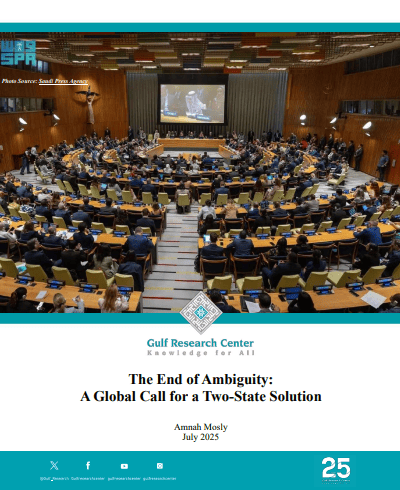
The High-Level International Conference for the Peaceful Settlement of the Question of Palestine and the Implementation of a Two-State Solution, co-hosted by Saudi Arabia and France at the headquarters of the United Nations in New York from July 28 to 30, marked another positive step in the international response to the war in Gaza. The message delivered by participants was unequivocal: The time has come for decisive, collective action toward the establishment of a Palestinian state.
The conference underscored a rapidly coalescing global consensus in support of a two-state solution, despite the absence of key actors such as the United States and Israel. “This is not simply a political position. Rather, this is a deeply entrenched belief that an independent Palestinian state is the true key to peace,” stated Saudi Arabia’s Foreign Minister H.H. Prince Faisal bin Farhan. French Foreign Minister Jean-Noel Barrot stated that the meeting’s strong turnout demonstrated “the consensus and the mobilization of the international community around the appeal for an end to the war in Gaza.”
Central to the conference’s momentum was the unveiling of the “New York Declaration on the Peaceful Settlement of the Question of Palestine,” a joint initiative by Saudi Arabia and France that calls for a phased and time-bound implementation of a two-state solution and the establishment of an independent, sovereign Palestinian state, with security guarantees for both Palestine and Israel. The declaration lays out a detailed roadmap, including an immediate ceasefire, the withdrawal of Israeli forces from Gaza, the reunification of Gaza and the West Bank under the Palestinian Authority (PA), and an eventual pathway toward Palestinian sovereignty based on the 1967 borders with East Jerusalem as its capital.
The declaration, endorsed by a broad coalition that includes Brazil, Egypt, Japan, Ireland, and the European Union, represents what Foreign Minister Barrot called “unprecedented and unstoppable momentum.” It seeks to transform rhetorical support into concrete international mechanisms: a reconstruction of Gaza, endorsing an Arab-Organization of Islamic Cooperation recovery plan; a forthcoming Gaza Reconstruction Conference to take place in Cairo; the creation of a dedicated international trust fund; the role of UN Relief and Works Agency; and the Palestinian Authority’s agenda for reforms.
Growing recognition of the need for a sovereign Palestinian state has been building among major powers. French President Emmanuel Macron’s pledge to recognize Palestine at the UN General Assembly in September, echoed by similar announcements from British Prime Minister Keir Starmer and Canadian Prime Minister Mark Carney, signals a diplomatic shift within Western institutions. The UK notably conditioned its recognition of Palestine on Israel ending the “appalling situation” in Gaza, ceasing annexation efforts, and committing to a viable two-state process.
Beyond the immediate crisis, the conference sought to place the two-state solution within a wider regional context. Participants proposed the establishment of an inclusive regional security framework modeled on organizations such as ASEAN or the OSCE, focused on negotiation, human security, and cooperation. They also proposed the establishment of a future “Peace Day” to formally commemorate the end of the conflict and initiate regional collaboration in areas like trade, energy, and infrastructure.
Prince Zeid Ra’ad Al-Hussein, former UN High Commissioner for Human Rights, warned against strategic ambiguity and called for a pragmatic and clearly defined peace plan. He advocated for a “cleverly designed, regionally anchored security arrangement to prevent unilateral abrogation as a first urgent transitional step,” paired with a reconstruction mission to begin healing Gaza’s devastated infrastructure and institutions. UN Secretary-General António Guterres reinforced this call, urging an end to unilateral actions undermining the two-state solution and reaffirming the international legal framework rooted in the 1967 borders.
Despite the breadth of support, the absence of the United States from the proceedings reflected a continuing divide in global diplomacy. The U.S. administration deemed the conference “counterproductive,” arguing that unilateral recognition of a Palestinian state could complicate ongoing ceasefire negotiations and hostage releases. Israel also boycotted the event, denouncing it as “disconnected from reality.”
While the U.S. was not present in the meetings, this does not preclude future engagement. Given Washington’s influence in the Middle East, sustained diplomatic efforts by France and Saudi Arabia may be key to encouraging a more constructive U.S. role. As the process advances toward the UN General Assembly, a concerted push by key transatlantic and Arab partners may help push the U.S. for more engagement, particularly around security guarantees and institutional legitimacy. Looking ahead, the co-chairs of the conference pledged to submit a progress report during the 80th UN General Assembly session in September. The working groups tasked with follow-up efforts will operate under the Global Alliance for the Implementation of the Two-State Solution, indicating the institutionalization of the process beyond symbolic diplomacy.
The 2025 UN High-Level International Conference marks a diplomatic moment in a prolonged, overwhelmingly tragic conflict. The joining of international actors around a detailed and time-bound two-state roadmap signals a potential inflection point. However, the road ahead remains fraught with political resistance, humanitarian urgency, and geopolitical fragility.
As Gaza reels from destruction and despair, the stakes of inaction are clear. The challenge now lies not in articulating the goal of Palestinian statehood, but in sustaining the collective will and coordinated action required to bring it to fruition. The time for ambiguity is over. What is required is implementation--urgent, principled, and irreversible.
*Amnah Mosly is a Researcher at the Gulf Research Center (GRC)