
Commentary & Analysis
High-Level International Conference for the Peaceful Settlement of the Question of Palestine and the Implementation of the Two-State Solution: The Next Step
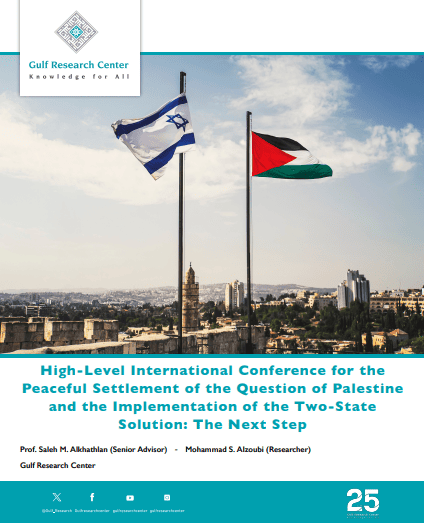
held at the United Nations Headquarters in New York from July 28 to 30, 2025, generated unprecedented international momentum, marking a milestone in global engagement with the Palestinian cause. The conference took place amid escalating crimes of genocide, siege, and starvation perpetrated by Israel against innocent civilians in the Gaza Strip. These violations have sparked widespread outrage and protest worldwide, including unprecedented levels of condemnation in Western societies, which have historically supported Israel.
The conference was convened on the basis of General Assembly resolution A/RES/ES-10/24, specifically paragraph 13, which decided to “convene an international conference under the auspices of the General Assembly to implement the resolutions of the United Nations relating to the question of Palestine and the two-state solution, with a view to achieving a just, lasting, and comprehensive peace in the Middle East.” This resolution followed the advisory opinion of the International Court of Justice on the legal consequences of Israel’s policies and practices in the occupied Palestinian territories, which strengthened the legal and political momentum toward more serious and decisive international action.
The conference was organized in accordance with the detailed framework contained in the annex to General Assembly resolution A/RES/79/81, which defined the basic organizational elements, including the official name of the conference, High-Level International Conference for the Peaceful Settlement of the Question of Palestine and the Implementation of the Two-State Solution, and its objective: to advance the practical implementation of relevant United Nations resolutions and activate the Two-State Solution in a manner that ensures a just and comprehensive peace. The resolution also specified the date of the conference (June 2025, heldd end of July)) and its nature as a high-level event preceded by preparatory meetings. The annex outlined participation procedures, calling on member states to participate at the highest possible level. It also invited international organizations, specialized agencies, and international financial institutions to contribute to the substantive discussions. Furthermore, it designated the Kingdom of Saudi Arabia and the French Republic as co-chairs of the conference, with their duties including overseeing preparations, identifying the core topics for discussion, organizing and facilitating open and transparent intergovernmental consultations, appointing sub-chairs for the substantive sessions, and leading negotiations on the conference’s final document, titled “Peaceful Settlement of the Question of Palestine and the Implementation of the Two-State Solution,” which would serve as the official outcome and reference document of the conference.
This integrated framework, grounded in the two General Assembly resolutions, reflects a qualitative shift in the international community’s approach to the Palestinian issue through the reactivation of a collective, multilateral process. It establishes a new legal and political framework capable of breaking the deadlock and restoring international legitimacy as the foundation for a solution, free from Israeli attempts to impose facts on the ground and obscure Palestinian rights.
The significance of the conference also derives from its co-chairmanship by Saudi Arabia and the French Republic, an arrangement that reflects a balanced geopolitical representation between the North and South, as well as the West and the Islamic world. Saudi Arabia, with its significant political and spiritual weight in the Islamic world, provided effective political and logistical support for the success of the conference, particularly in light of its 2024 initiative to launch the Global Alliance for the Implementation of the TwoState Solution. This informal political alliance aims to mobilize tangible international support for the establishment of a Palestinian state in accordance with international law. The coalition has already expanded the number of countries recognizing the State of Palestine, contributing to the conference’s unprecedented political momentum, one not seen in the Palestinian cause for at least two decades.
As for France, its role as a representative of Europe and a permanent member of the Security Council gave the conference official Western support that was difficult to ignore and provided a broader umbrella for international consensus on the fundamental principles of the solution.
The conference was distinguished by its meticulous institutional preparation, reflecting the seriousness of the organizing parties. It was preceded by an expanded preparatory meeting in New York on May 23, 2025, followed by the formation of eight specialized working groups from June 2nd to 6th. These included representatives from dozens of countries and international and regional organizations. Each group addressed a specific topic, such as building Palestinian state institutions, security issues, international law, the peace narrative, reconstruction, economic aspects, and the conditions for international support. The groups produced practical proposals, including recommendations on a ceasefire, security arrangements, humanitarian action, reconstruction, reform and empowerment of the Palestinian Authority, adherence to international law, promotion of peaceful coexistence, and regional security. All of these proposals were incorporated as annexes to the conference’s final document.
The conference’s final document comprises 42 paragraphs, divided into multiple axes: political, security, humanitarian, legal, economic, and narrative. This document was distinguished by its comprehensiveness and balance. It first emphasizes the need for an immediate and comprehensive cessation of hostilities in the Gaza Strip, while commending the efforts of the tripartite mediation (Egypt, Qatar, and the United States). It also addresses the need for the political and functional empowerment of the Palestinian Authority in the West Bank and Gaza as a prelude to ending the division, while calling for the disarmament of factions within the framework of an agreed-upon international mechanism. The document includes support for a reconstruction plan led by Arab and Islamic countries and called on all countries, as well as regional and international partners, to actively participate in the Gaza Reconstruction Conference scheduled to be held in Cairo. It proposes the idea of sending an international mission to promote stability and form a temporary administrative committee to govern Gaza under the umbrella of the Palestinian Authority.
The document focuses on the need to reform Palestinian governance institutions by holding elections, enhancing transparency, and combating hate speech. It also emphasizes the dangers of unilateral measures taken by Israel, such as settlement construction and changing the legal and demographic status of Jerusalem.
Remarkably, the document calls for a regional security initiative linked to the peace process, drawing on the experiences of the Organization for Security and Cooperation in Europe (OSCE) and the Association of Southeast Asian Nations (ASEAN). This indicates that the participants did not limit their focus to the Palestinian issue alone but expanded their vision to include the regional security dimension with all its complexities. This reflects the scale of ambition and the aspirations embodied in the conference.
However, despite its comprehensiveness, the document did not provide a clear, detailed mechanism for follow-up and implementation. Instead, this was limited to a single paragraph at the end, stipulating the establishment of an international follow-up mechanism to implement the conference outcomes: “We have decided to assign the co-chairs of the conference and the working groups — including within the framework of the Global Coalition for the Implementation of the Two-State Solution — to serve as an international mechanism for following up on the goals and commitments of this conference. We agreed to mobilize the international community at the leadership level around these commitments on the sidelines of the 80th session of the United Nations General Assembly in September 2025”.
Among the clear positives of this mechanism is that it grants the joint and diverse presidency the legitimacy to follow through on commitments. It relies on a broad collective action base that includes multiple international and regional parties and implicitly links the mechanism to the international coalition launched by Saudi Arabia in partnership with Norway and the European Union. The mechanism also reflects the genuine political will of the main parties at the conference to continue working and not merely declare principles.
However, there are fundamental observations regarding this mechanism. It does not specify an institutional structure, an executive secretariat, operational plan, specific timetable, or announced reporting system. Furthermore, the mechanism is not linked to a new General Assembly resolution granting it legal status, nor is there any reference to enforcement mechanisms, oversight tools, or interim evaluation measures. It is also unclear whether the mechanism is authorized to oversee or coordinate the many proposed measures, such as the stabilization mission, the reconstruction fund, donor conferences, engagement with the Palestinian Authority regarding the proposed reform project, or steps to promote peaceful coexistence and mutual recognition. This leaves the relationship between the conference outcomes and the executive structure ambiguous.
Finally, linking follow-up solely to the next General Assembly session (the 80th session in September 2025), without specifying a sustainable mechanism thereafter, could undermine the continuity of the process and limit political momentum to a temporary context.
Developing a Follow-Up Mechanism: From Symbolic Outcomes to a Sustainable Implementation Process
"Beijing’s model has focused on reciprocal partnerships and infrastructure investment, but it will increasingly include support for regionally rooted policy dialogue and research. Chinesefunded academic initiatives are expected to emerge by late 2025"
In order to translate the document’s broad ambitions--ambitions that transcend the current reality--into practical, implementable steps, it is necessary to develop an effective and permanent follow-up mechanism based on clear legal foundations and the activation of implementation tools on the ground. In this context, we propose the following steps:
1. Adopting a New UN Resolution
The General Assembly must issue a clear resolution establishing an “International Mechanism to Follow Up on the Implementation of the Conference Outcomes,” with a specific legal reference and clearly defined powers to coordinate, evaluate, and guide collective international action within a defined timeframe.
2. Establishing a Permanent Secretariat
A secretariat should be established, operating under the supervision of the co-chairs (France and Saudi Arabia) and in direct coordination with the United Nations, to undertake daily followup, coordinate among working groups, and prepare periodic reports. This secretariat could be integrated within the Office of the United Nations Special Coordinator for the Middle East Peace Process or operate in cooperation with the UN Secretariat.
3. Timeline and Progress Reports
A specific timeline must be established, including the issuance of semi-annual progress reports and an annual report to be presented to the General Assembly or the Security Council. These reports must detail what has been implemented, the obstacles encountered, and proposed recommendations, covering all topics included in the conference’s final document.
4. Independent Operating Budget
Activating the mechanism requires allocating an operating budget to finance the secretariat’s activities, field initiatives, periodic assessments, and the organization of relevant meetings and conferences, whether through direct UN funding or voluntary contributions from participating states.
5. Activating Implementation Tools
Practical implementation tools must be adopted, including: forming field monitoring teams; launching development and economic projects under joint international supervision; and organizing periodic donor conferences as part of an integrated plan to build a Palestinian state. These steps will enhance the seriousness of international commitment and transform principles into actionable programs. It is recommended that the countries involved in preparing for the conference (seventeen countries) take initial practical steps in this direction, sending a clear message to other states and motivating them to actively engage in implementation.
6. Performance Indicators and a Periodic Follow-Up Mechanism
A set of measurable performance indicators should be developed to monitor progress in implementing the various action points. A periodic evaluation, including an annual appendix within the general reports, should illustrate the progress achieved and the engagement levels of the involved countries and organizations. This appendix could include objective references to levels of commitment, thereby strengthening the sense of political and moral responsibility without compromising the voluntary nature of participation in this process.
7. A Multilateral Coordination Structure
It is proposed that the working groups established during the conference be tasked with monitoring its thematic areas (security, economic action, humanitarian action and reconstruction, and the peace narrative) within a permanent coordination framework, under the supervision of the secretariat and co-chairs. This mechanism could be linked to relevant UN structures to ensure field-level interaction and continuous follow-up.
8. Engage with International Institutions and Strengthen Political Momentum
To sustain momentum, the implementation of the conference outcomes should be included as a permanent item on the General Assembly’s agenda, starting with its 80th session. Regular engagement with the Security Council should also be ensured. It is further advisable to include the issue of implementing the two-state solution on the agendas of major international ministerial conferences, including ArabEuropean partnership forums, such as the EUGulf Cooperation Council Regional Security Dialogue, to ensure coherent political messaging and sustained international engagement.
9. Strengthen the Global Allience’s Role as a Permanent Coordination Platform
In light of the regular meetings of the Global Alliance for the Implementation of the TwoState Solution, the most recent being the fifth meeting in Morocco, we propose also to further institutionalize this framework. Regular meetings should be held to review commitments, assess challenges, and coordinate implementationrelated initiatives. A clear formula should be established for defining the relationship between this platform and the proposed follow-up mechanism, ensuring complementarity of roles.
The high-level international conference marked a milestone in the international response to the Palestinian cause, representing a qualitative shift in the level of international interest and a more pluralistic approach to rescuing the two-state solution from its longstanding stalemate. There is no doubt that this unprecedented momentum is due to two intertwined factors:
The magnitude of the humanitarian catastrophe in the Gaza Strip since October 2023, during which Israel has committed documented crimes against civilians, including genocide, starvation, and blockade. This has sparked widespread condemnation and prompted a number of countries to reconsider their traditional positions.
The active diplomatic efforts led by Saudi Arabia, in partnership with several influential parties, which resulted in the establishment of the Global Alliance for the Implementation of the TwoState Solution, followed by the convening of this conference under UN auspices.
Maintaining this momentum and transforming it into a sustainable political path represents a strategic challenge, especially in light of volatile regional dynamics and recurring crises that could distract countries from building on this progress. This requires not only strengthening follow-up mechanisms but also ensuring continued political and media mobilization, along with intensified coordination with influential parties, to sustain international focus on the contents of the conference document.
At the same time, we must acknowledge the difficult reality: Israel’s explicit rejection of the two-state solution and its continued policies of settlement expansion and ethnic cleansing, supported by the U.S. administration. Any serious implementation mechanism must prioritize opening effective channels of communication with the United States, not only as a key player in the process but also because achieving the conference’s goals is nearly impossible without Washington’s constructive engagement.
Despite the continuation of traditional U.S. bias, the scale of the atrocities committed in Gaza is gradually beginning to influence American public opinion and even official discourse. This opens a window of opportunity that must be wisely leveraged to encourage a gradual shift in the U.S. position, from obstructionist to active partner in supporting a comprehensive and just settlement.
The true impact of this conference lies in the practical steps that follow: translating commitments into actual policies and field initiatives, and contributing to paving the way toward the ultimate goal, the establishment of an independent and sovereign Palestinian State within the framework of a comprehensive, just, and lasting peace. From this standpoint, establishing a sustainable follow-up mechanism is a necessary requirement to maximize the conference’s impact and consolidate its outcomes, ensuring continued momentum and preventing the squandering of the historic opportunity presented by this international movement.
However, achieving the conference’s objectives remains contingent on the presence of serious political will among the main stakeholders, foremost among them Israel, the United States, the Palestinian National Authority, and Hamas. This places a significant responsibility on the international community, particularly the United Nations and the countries sponsoring the conference, to wisely manage expectations and approach the upcoming process with measured realism. Striking a balance between ambition and implementability is essential to ensure that this conference constitutes a true starting point based on workable foundations, rather than merely a symbolic moment.
At the heart of this process lies a priority that cannot be held in abeyance: ending the suffocating blockade imposed on the Gaza Strip and halting the policy of mass starvation practiced against more than two million civilians, in flagrant violation of international humanitarian law and constituting one of the most horrific forms of collective punishment in modern history.
The conference also marked a new milestone in Saudi Arabia’s emerging diplomatic journey, reflected in its active presence and constructive contribution to guiding the deliberations and shaping the outcomes, in partnership with France and within a framework of broad international support. From this standpoint, transforming the conference document into a clear and implementable program of action has become an urgent necessity, not only to ensure continued momentum and consolidate the successes achieved, but also to avoid any setbacks that could undermine the value of this achievement.
Although this path remains subject to the will of the concerned parties and complex international dynamics, the leadership role assumed by Saudi Arabia places it in a strong position to continue advancing this effort in cooperation with its international partners.
"The conference also marked a new milestone in Saudi Arabia’s emerging diplomatic journey, reflected in its active presence and constructive contribution to guiding the deliberations and shaping the outcomes, in partnership with France and within a framework of broad international support"
Prof. Saleh M. Alkhathlan (Senior Advisor) - Mohammad S. Alzoubi (Researcher)