Commentary & Analysis
The Lee Jae-myung Administration's Pursuit of Closer Korea–Middle East Relations
A Pragmatic Approach to the Middle East under the Lee Government
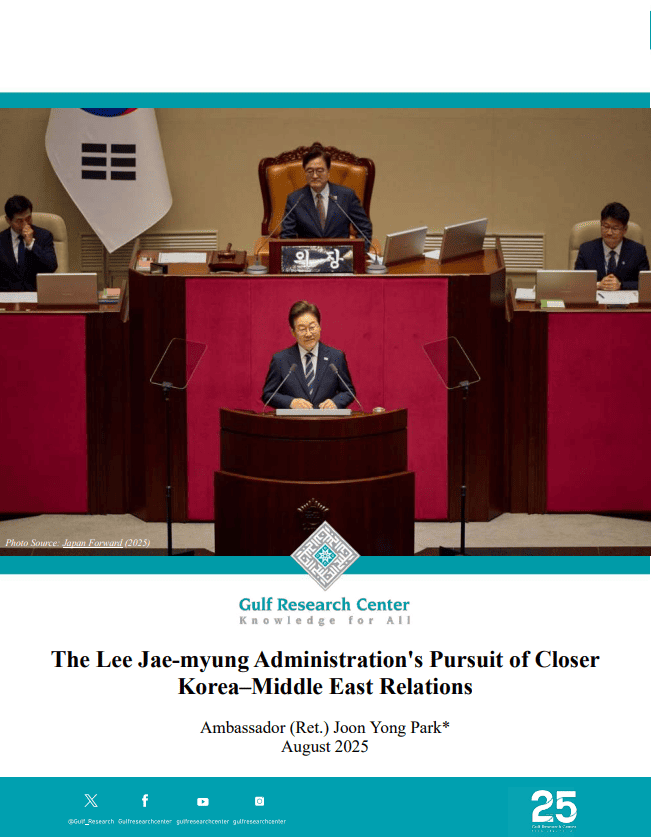
On the night of December 3, 2024, then South Korean President Yoon Suk-yeol declared martial law—a decision that shocked not only the Korean public but the entire international community, including the Middle East. In the months that followed, South Korea was gripped by political turmoil, and governments around the world watched closely as events unfolded in South Korea.
The situation reached a turning point on April 4, 2025, when President Yoon was impeached by unanimous decision of eight Constitutional Court justices. In accordance with the Constitution, South Korea held a nationwide presidential election on June 3 to elect a new leader. Approximately 35 million citizens cast their votes, resulting in a turnout of 79.38%—the highest since 1997. Lee Jae-myung won the election with 49.42% of the vote and was inaugurated the following day as the 21st President of the Republic of Korea.
The challenges facing the Lee Jae-myung administration are arguably more complex than those confronted by any of his predecessors. The current international environment is defined by multiple events: the ongoing war between Russia and Ukraine, the crisis in Gaza, the tariff war initiated by U.S. President Donald Trump, the intensifying U.S.-China rivalry, a prolonged global economic slowdown, the adverse effects of China’s industrial overcapacity on Western economies—including South Korea, and the ongoing global restructuring of supply chains.
South Korea is among the countries most vulnerable to instability in the current geopolitical and economic landscape. Its economic structure is highly dependent on exports and imported energy. Its security architecture relies heavily on the United States. Moreover, in a rare geopolitical configuration, South Korea faces persistent political and military confrontation with North Korea—an actor that maintains formal alliances with both China and Russia.
The domestic conditions inherited by the Lee Jae-myung administration are equally fraught with challenges. Many of these issues have accumulated over decades, while others are more nascent. They include deep political polarization among the populace, widening wealth inequality, erosion of the country’s long-term growth potential, the lowest fertility rate among OECD nations, structural rigidities in the labor market, an ongoing brain drain to the United States, sluggish domestic consumption, a stagnating construction sector, and the declining resilience of small and medium-sized enterprises (SMEs) facing intense competition from Chinese products in domestic as well as global markets. Even on the political front, each of three special prosecutors appointed by President Lee on June 12 is currently leading an investigation into alleged unlawful activities involving the former president and first lady.
These intertwined domestic and international constraints have taken a toll on the South Korean economy. GDP growth stood at only 1.4% in 2023 and 2.0% in 2024. The so-called “Miracle on the Han River,” once a symbol of South Korea’s extraordinary economic rise, has now become a nostalgic memory for many in the country.
Since its inauguration, the Lee Jae-myung administration has appointed 17 out of 19 cabinet ministers—roughly 90%—and is expediting the review of existing policies and the formulation of new ones to address the formidable challenges outlined above. Among these urgent priorities is the strategic overhaul of South Korea’s policy toward the Middle East.
In this context, a growing number of forums and policy discussions are being convened in South Korea, drawing participation from government officials, business leaders, civil society organizations, scholars, and former diplomats. These discussions focus on devising innovative strategies to strengthen relations— particularly economic ties—between South Korea and the Middle East, including the GCC countries. Such efforts reflect the Lee administration’s clear intent to deepen Korea–Middle East relations, guided by a pragmatic approach rooted in flexibility, mutual benefit, and strategic engagement.
Korean Perceptions of the Middle East: Past and Present
The Middle East has never been well connected to South Korea. Out of more than 20 countries in the region, only four to five currently operate direct flights to and from Korea year-round. Historically, the Middle East began to register as a significant presence in the Korean public consciousness following two key events in 1973: the global oil crisis and the successful bid by Korea’s Samwhan Enterprises Co. Ltd. to construct the 175-kilometer Khaybar–Al-Ula highway in Saudi Arabia— the first Middle Eastern construction contract ever awarded to a Korean firm.
Oil from the Middle East was critically important to South Korea’s rapid industrialization during the 1970s. At the same time, foreign currency earnings from the massive deployment of Korean construction companies and workers across the region helped offset the severe foreign exchange shortages, a large part of which resulted from the oil price shock. These events are still vividly remembered by the Korean people today through official records and the testimonies of those who worked on the ground at the time. In parallel, many in the Middle East continue to hold Korean workers and engineers in high regard for their historic contributions to the development of infrastructure across the region since the 1970s.
Meanwhile, fueled by oil revenues, the oil-producing states of the Middle East began to spearhead ambitious construction projects that gradually drove the region’s economic development and social transformation. These transformative shifts advanced despite the heightened social rigidity that followed the 1979 Islamic Revolution in Iran and endured amid recurring political and military unrest that punctuated the region from the 1980s to the 2000s. Key global developments further accelerated these changes—including the onset of globalization in the early 1990s, the shale energy revolution and Arab Spring in the early 2010s, and the signing of the Paris Climate Agreement in late 2015.
Even the sharp collapse in global oil prices in the mid-2010s and the sudden emergence of the COVID-19 pandemic in the early 2020s could not suppress the Middle East’s determined pursuit of adaptation and survival in a changing era. Today, Saudi Arabia, the United Arab Emirates, and Qatar are widely regarded as the leading forces of transformation in the region. In reality, however, most Middle Eastern countries are also actively pursuing economic and social change—often engaging in competition with one another in the process.
On the other hand, countries geographically distant from the Middle East—including South Korea—continue to rely primarily on global media coverage to understand the region’s current realities. As a result, there is a prevailing perception that the Middle East has become significantly more volatile since October 7, 2023. As Israel, with military support from some Western countries such as the United States and Germany, has carried out strikes not only in Gaza but also in Lebanon, Yemen, Syria, and Iran, many observers expect there to be a continuation of such operations in pursuit of eliminating perceived security threats, with a very limited regard for the humanitarian consequences.
Despite the French government’s recently declared intention to formally recognize Palestine as a state at the United Nations this coming September, the two-state solution—supported by more than 150 countries around the world—is widely seen as unlikely to gain traction due to opposition from key stakeholders, including Israel and the United States.
In Korea, public sentiment also holds that the Iranian nuclear issue remains gridlocked, as Iran’s demand for international recognition of its low-enriched uranium program continues to clash with staunch opposition from Israel and the U.S. A sustainable, long-term compromise appears increasingly elusive.
Meanwhile, attacks by the Houthis on ships passing through the Red Sea are expected to recur at any time, making the normalization of maritime navigation in the Red Sea unlikely in the near future.
Overall, although the White House emphasized its economic gains following President Trump’s visit to three Gulf countries in May 2025, many analysts believe that the United States—whether by choice or necessity—is playing an increasingly diminished role in stabilizing the region.
These prevailing perceptions among Koreans tend to obscure the vital efforts many Middle Eastern countries have made since the mid-2010s toward economic and social advancement. While the pace and scale vary by country, these nations have been pursuing comprehensive domestic transformation—including economic diversification—and, in their foreign policy, have sought to promote peace, stability, and diverse international partnerships.
Despite rising anti-Israel and anti-American sentiments among their populations, most of these states have refrained from severing ties with Israel or engaging in military retaliation. Instead, they have consistently advocated for an immediate ceasefire and emphasized the need to expand humanitarian assistance to Gaza, favoring diplomatic solutions over escalation. Clearly, their current approach marks a significant departure from the pan-Arab and pan-Islamic solidarity movements that characterized the region from the end of World War II through the mid-1970s.
This remarkable restraint can be attributed to three main factors. First, many of these states lack the political and military capacity to directly confront Israel and the United States. Second, a number of Arab governments have long harbored deep- seated distrust toward groups such as Hamas, Hezbollah and the Houthis, and countries such as Syria and Iran. Third, these governments prioritize their own economic and social development and are wary of allowing the Gaza crisis to trigger domestic political or social instability.
New Business Opportunities for Korean Companies in the Middle East
While the continued decline in global oil prices has led to the downsizing or delay of several major projects, Middle Eastern countries—particularly those within the GCC—have nonetheless made substantial strides in economic and social development. Although they still lag behind advanced economies in areas such as industrial advancement, social openness, institutional modernization, competitive frameworks, and business environments, the pace and scale of recent transformations across these societies are striking when compared to just a few years ago.
With the exception of a few outlier states, the majority of countries in the region have moved beyond the destabilizing aftershocks of the Arab Spring, maintaining a degree of social stability that forms the essential foundation for sustained economic development. Through this ongoing process, these countries are steadily integrating into the global economic system and aligning more closely with universal norms and values.
A significant number of Middle Eastern countries have adopted economic and social development plans targeting the years 2030 or 2035. The question remains: will these plans materialize into actionable visions—or will they prove to be little more than mirages?.
To realize their ambitions, these countries are actively forging partnerships with foreign enterprises. However, among the 193 countries in the world, only a limited number possess the capacity to contribute meaningfully to these goals. One Arab nation, for instance, has designated eight countries as its key strategic partners. Fortunately, South Korea has been identified by many Middle Eastern states as one of their most important collaborators. This stems from the foundation of trust South Korea has established with countries in the region since the 1970s. Today, Korea is able to offer a unique combination of advanced industrial technologies and valuable development experience that aligns closely with the needs of the Middle East.
In addition, like China, Korea is among the few countries that encourage outbound investment by domestic firms, including into the Middle East. In December 2023, Korea signed a Free Trade Agreement (FTA) with the Gulf Cooperation Council (GCC), marking only the third such agreement ever concluded by the GCC with a foreign partner.
Moreover, South Korea imports approximately 70% of its crude oil and about 40% of its liquefied natural gas (LNG) from the Middle East—a critical driver of sustained economic cooperation between Korea and oil-producing states. Saudi Aramco holds a major equity stake in S-Oil, one of South Korea’s largest refining and petrochemical companies—further underscoring the strategic and deeply interlinked nature of Korea–Middle East economic ties.
Traditionally, South Korean government and businesses have intensified their efforts to identify and capitalize on new opportunities in the Gulf states. For instance, South Korea has established strategic partnerships with Saudi Arabia, the United Arab Emirates, and Qatar, with successive Korean presidents having visited these countries over the past decade.
Since June 2021—when Gulf oil-producing states began to emerge from the COVID-19 pandemic and global oil prices rebounded to approximately $70 per barrel—a range of industrial diversification plans have entered the implementation phase in earnest. This shift has created a growing array of business opportunities for Korean companies, particularly in Saudi Arabia and the UAE. It is now noteworthy that the nature of the Korea–Middle East cooperation has evolved from earlier patterns. Korean firms are going beyond traditional construction contracts to pursue partnerships with local entities in a wide range of industries, including manufacturing, information technology, biotechnology, renewable energy, and defense.
As a result, the number of joint ventures between Korean and local companies in non-energy sectors has grown substantially. Even in the construction sector, Korean firms are no longer limited to engineering, procurement, and construction (EPC) roles. Some Korean design and planning firms have now established permanent corporate entities in the region, signaling a deeper and more diversified level of engagement.
Innovative Ideas for Opening a New Chapter in Korea–Middle East Relations
A range of innovative proposals is being put forward in policy forums held in South Korea under the Lee Jae-myung administration, as the country explores ways to deepen economic cooperation with Middle Eastern states. Among these ideas is the call to build long-term partnerships and trust between the highest political leaders on both sides. To this end, it has been suggested that, in addition to reciprocal state visits, regular summits between South Korea and the GCC should be established. Another frequently discussed proposal is to appoint a presidential envoy dedicated to the Middle East.
Further, beyond competing for local projects, Korean businesses are being encouraged to expand their direct investments across diverse industrial sectors in the Middle East. There is also growing support for enhanced policy coordination between the two sides, including the sharing of Korea’s development experiences to support the economic and social transformation of the countries in the region. Human capital development is another key area of common interest, with growing calls from the Middle East for expanded cooperation in education and vocational training by South Korea. It has also been suggested that South Korea's exports to the Middle East should be significantly expanded, given that GCC countries were subject to only 10% reciprocal tariffs under the Trump administration, and that Korea’s export volume to the increasingly open Middle Eastern market still falls short of expectations.
The cultural content sector, in which the Middle East has recently demonstrated robust growth, has also been highlighted during the discussions as a promising field for bilateral cooperation, with recommendations to boost joint initiatives. There is no doubt that Korean companies are eager to play a more active role in the Middle East’s defense industry, while the nuclear power projects currently under consideration in Saudi Arabia and the UAE remain top strategic priorities for Korea’s industrial and diplomatic agenda.
Some experts, in an innovative yet somewhat bold manner, have proposed the establishment of a global-standard private consulting firm specialized in the Middle Eastern market to better assist Korean firms. Others advocate for Korea to strengthen triangular cooperation with third countries—such as the United States or China— within the region, or to partner with Middle Eastern countries in third markets outside the region to enhance competitiveness.
Strengthening Bilateral Cooperation to Overcome Local Challenges
Despite growing momentum for closer Korea–Middle East cooperation, a number of challenges remain. In an intensely competitive global market, Korean companies tend to prioritize markets with higher profitability and more favorable business environments. They remain particularly attentive to unfavorable local business conditions, and while significant improvements have been made, many Middle Eastern countries still operate economic systems that favor entrenched local interests, exhibit slower business communication, and face issues with labor discipline—areas that require more dramatic reform if international competitiveness is to be achieved.
It is true that Korean firms have seen a significant erosion in their price competitiveness relative to both local companies in the Middle East and global rivals such as China. This has narrowed the scope of their viable overseas investments, as they have faced a sharp increase in domestic operational costs over the past decade. At the same time, China’s aggressive push into the Middle East as a way to offset domestic industrial overcapacity poses a formidable challenge for Korean businesses. The impact of remarkable outcome of President Trump’s visit to Saudi Arabia, Qatar, and the UAE in May also remains uncertain for Korean stakeholders.
Furthermore, some local governments in the region have introduced policies that require companies, including foreignKorean firms, to meet specific targets for localization of production and employment of local nationals. Although Korean firms acknowledge the policy necessity of these requirements, they have nonetheless contributed to rising business costs in the region.
Compounding these concerns is the fact that, despite ongoing regional instability, global oil prices continue to decline. This trend “driven fundamentally by an oversupply of oil and a transition in the global energy mix” raises doubts about the oil-producing states’ capacities to sustain investment in local development projects—a key factor in determining the pace and scale of future Korea–Middle East economic cooperation.
Nevertheless, cooperation between South Korea and Middle Eastern countries— particularly the politically stable and economically resilient GCC states—continues to show a steady upward trend. Once the follow-up discussions related to the compromise recently made with the U.S. on tariffs are concluded, the Lee Jae-myung administration is expected to introduce new initiatives aimed at strengthening both intergovernmental and business-to-business strategic partnerships with the region.
In addition, President Trump’s trade policies are likely to push South Korea to place even greater importance on its engagement with the Middle East. As local business environments align more closely with international standards, Korean companies are expected to gradually increase their direct investments in diverse industrial areas in the region, making enhanced coordination between the Korean government and its Middle Eastern counterparts crucial. Against this backdrop, the domestic procedures required for the ratification and implementation of the Korea–GCC Free Trade Agreement are also likely to accelerate. Among all global partners, South Korea will remain one of the most sincerely invested in the successful realization of the Middle East’s long-term visions and development goals.
*Ambassador (Ret.) Joon Yong Park is a Senior Non-Resident Research Fellow at the Gulf Research Center (GRC). He served as the Korean Ambassador to the Kingdom of Saudi Arabia from June 2021 to January 2024.