
Commentary & Analysis
Dubai’s High-Rise Paradox: Peak, Pause, or the New Normal?
Dubai has made an industry out of defying gravity. Each time sceptics declare the end of its property boom, the emirate rebounds, buoyed by geopolitical turmoil, global liquidity, or waves of new arrivals. But the question in mid-2025 is more challenging to dismiss: has Dubai’s real estate market finally peaked, or is this merely another pause before the next surge?
The headline numbers remain dazzling. In the first half of 2025, the Dubai Land Department recorded transactions worth AED 431 billion ($117 billion)—roughly equivalent to the emirate’s GDP. Sales volumes rose 22 percent, and values jumped nearly 50 percent year-on-year in Q2. Home prices have soared 70 percent since 2019, and villas remain fiercely contested. Yet beneath the glittering data, signs of strain are accumulating.
More than 250,000 homes are in the development pipeline, according to JLL—a 30 percent expansion of the housing stock. Already in 2025, 17,000 units have been completed, with 61,000 more expected before year’s end. Developers are staggering releases to avoid flooding the market, but construction finance allows only limited patience. Once projects finish, banks demand repayment, and inventory must be sold. If demand falters, the result will be compressed yields and price corrections.
Fitch Ratings has already forecast that residential prices could fall by as much as 15 percent into 2026. Rents, once spiraling upward, are softening in neighborhoods like Jumeirah Village Circle, Arjan, and even established areas such as The Greens. Dubai’s boosters argue that strong fundamentals and sustained demand will keep the market buoyant, but history suggests gravity asserts itself eventually.
Even if demand persists, affordability is becoming a constraint. Mercer ranked Dubai the 15th most expensive city in the world for expatriates in 2024—the costliest in the Middle East. For many professionals, especially mid-level executives, rents now devour disproportionate shares of income. Villas will likely retain value due to limited new supply, but the flood of apartments risks oversaturation. If tenants balk at steep rents, landlords may face declining yields, undermining valuations.
What makes Dubai unusual is how its market thrives on global turbulence. Russian capital surged after Western sanctions; Chinese investors shifted funds abroad as domestic property markets wobbled; Indian, Iranian, and other Middle Eastern buyers continued steady inflows. Western multinationals, unnerved by political risk and tax regimes at home, relocated executives and regional headquarters to Dubai. Each external shock seemed to fuel another local boom.
This reflexive resilience is impressive, but it is also a vulnerability. Dubai’s property market has become a barometer for global volatility, thriving when others stumble. Yet that dependence is double-edged. If multiple shocks converge—China’s slowdown cutting overseas investment, U.S. interest rates staying elevated, oil prices swinging wildly, or geopolitical risks turning into prolonged instability—the inflows that have buoyed Dubai could dry up. Rising competition from regional peers, persistent affordability strains, and the risk of oversupply add further pressure. Global moves toward decarbonization and the energy transition could also reshape investor sentiment and long-term capital flows into the Gulf. The same global turbulence that has been an asset may yet expose the fragility of the model, not only by curbing demand but by challenging Dubai’s promise of perpetual resilience.
Dubai’s past offers a cautionary tale. The exuberance of the 2000s ended with the 2008 crash, when values collapsed and projects stalled. A second bust followed the 2014 oil price collapse, delaying developments across the city and leaving a glut of unfinished projects. Today’s cheerleaders argue that regulatory reforms have made the system more resilient. Lenders now cap mortgages at 80 percent of property value, and developers must pay for land up front before building. These guardrails limit speculative excess, but they cannot repeal the fundamental laws of supply and demand.
Rental yields remain respectable by global standards—7.4 percent on average in early 2025—but they have already slipped 30 basis points from late 2024, even before the Israel-Iran war rattled markets. If yields tighten further, investors will begin questioning whether Dubai offers returns commensurate with its risks. That scepticism would only grow if global borrowing costs remain high or if risk appetites shrink in a world where capital is scarcer and competition for it fiercer.
The macroeconomic backdrop is equally mixed. Non-oil growth remains robust, buoyed by tourism, logistics, and financial services. But property’s outsized role in the economy means any correction would reverberate widely. Dubai’s open, globalized model makes it a magnet for capital—and a hostage to its flows.
Comparisons with other global cities underscore the risks. Hong Kong once thrived as Asia’s financial crossroads, its property market underpinned by foreign inflows. Yet political shifts and Beijing’s tightening grip exposed its vulnerability, prompting an exodus of talent and capital. London, long the world’s premier safe haven, saw property demand whipsawed by Brexit, new tax regimes, and shifting investor sentiment. Singapore, though more stable, has had to contend with cooling measures and cyclical slowdowns. Dubai shares elements of each: the global inflows of Hong Kong, the safe-haven allure of London, and the regulatory recalibrations of Singapore. What it lacks, however, is its longer institutional track record of stability. That makes its resilience impressive—but also untested in a prolonged downturn.
Saudi Arabia’s Vision 2030 has introduced Riyadh as a more visible player in the region’s competition for capital and corporate presence. Incentives to attract multinational headquarters and a series of ambitious mega-projects have begun to shift perceptions. Yet the reality is less a direct rivalry and more a gradual widening of regional options for investors and executives. Dubai still retains clear advantages in infrastructure, connectivity, and the depth of its ecosystem, but it can no longer take automatic primacy for granted. Even incremental successes in Riyadh may chip away at Dubai’s dominance, especially as its housing pipeline grows increasingly heavy.
The wider Gulf also offers lessons. Qatar’s property market, flush with supply after years of building, has seen oversaturation dampen yields and soften prices. Dubai is not immune to similar dynamics, particularly if demand fails to match the flood of new units. Its ability to weather competition and avoid Qatar-style oversupply will be an essential test of whether its current cycle is truly different or simply another variation on the familiar boom-and-correction story.
Dubai’s defenders argue that this cycle is different: the buyers are wealthier, less leveraged, and more likely to be end-users than the flippers of past booms. There is truth in that. The rise in foreign professionals making Dubai a semi-permanent home has deepened demand. The city’s infrastructure, safety, and connectivity remain powerful draws. But the test ahead is not whether Dubai can attract residents in good times. Still, whether it can sustain momentum when global liquidity tightens, supply surges, and new competition emerges from its largest neighbor remains to be seen.
Every time doubters doubt, Dubai has found ways to prove them wrong. It thrives on extremes—political shocks, economic dislocations, even wars—turning global uncertainty into local opportunity. Yet resilience is not immunity. The emirate is increasingly exposed to forces beyond its control: interest-rate cycles set in Washington, investor sentiment shaped in Beijing, energy markets unsettled in Moscow and Riyadh. If its housing cycle is to mature, Dubai must learn not only to ride turbulence but also to withstand it.
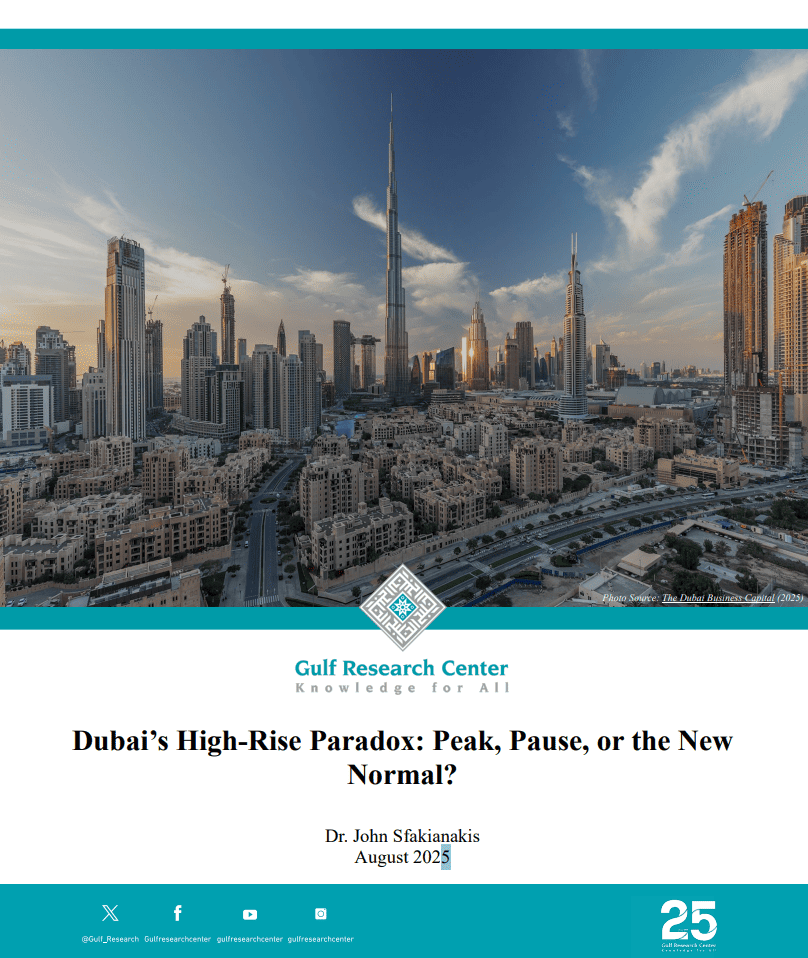
For now, Dubai’s skyline still glitters. But the cranes multiplying across the horizon are not only symbols of ambition—they are reminders that property cycles, no matter how buoyant, cannot defy gravity forever.
Dr. John Sfakianakis is the Chief Economist at the Gulf Research Center (GRC)