Commentary & Analysis
The International North-South Transport Corridor
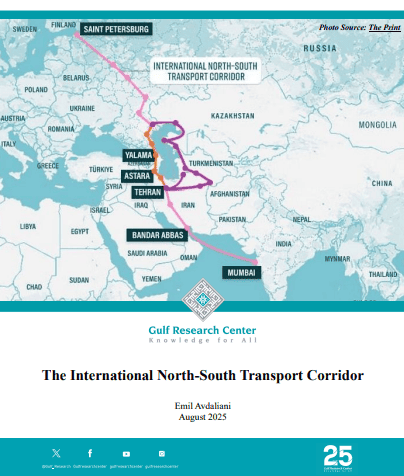
Despite the persisting instability in the Middle East, the Russia-led North-South International Transport Corridor (INSTC) continues to expand. In fact, recent tensions between the United States and India over the imposition of tariffs, remaining uncertainties around Iran’s nuclear program, as well as the Arab states’ openness to pursue closer ties with Russia, create favorable long-term conditions for the development of the north-south trade.
The INSTC, with a length of about 7,200 km, links Russian ports and major inland cities with Iran, the Gulf region and the Indian Ocean. The agreement on the creation of the corridor was signed back in 2000 between Russia, Iran and India, later joined by Azerbaijan, Belarus, and Central Asian countries. So far, the INSTC is nearly 75 percent complete in terms of physical infrastructure and despite geopolitical instability in the Middle East, its expansion is progressing.
The advantages of the INSTC are obvious. First of all, it enables a reduction in the delivery time of goods from India to Europe. Indeed, the INSTC can connect the Gulf and Indian ports with Russia, a dream that fired the Russian imagination ever since the early 18th century expansion under the rule of Peter the Great. Access to warm water ports is essential for Russia, and the INSTC provides an alternative to lengthy sea routes for trade with the Middle East and the south Asia. Ideally, the route takes 18 days from the Baltic Sea to reach India through Azerbaijan and Iran. Goods can be delivered via the INSTC twice as fast as through the Suez Canal.
Trade along the INSTC is expanding. In 2024, Russian authorities reported a 19% increase in total cargo via the corridor, equaling some 26.9 million tons. One of the drivers behind the surge is the burgeoning trade ties between India and Russia. Russia’s goal is straightforward – to diversify its commercial ties away from more traditional reliance on the wealthy Western markets and turn toward the Middle East and Asia. Greater engagement with the Global South has turned into one of Moscow’s foreign policy ambitions. Indeed, given the high likelihood of continuing tensions (even open rivalry) between the EU and Russia, the latter’s emphasis on further development of the INSTC is much expected. Moreover, the development of the corridor is a two-way process. India, Iran and increasingly, the wealthy Arab Gulf states, regard the initiative as a way to tap into the vast Russian market which usually remained out of their reach given the geographic distance, logistical difficulties and often geopolitical differences.
Longevity of the Project
The expansion of the INSTC is pushing shippers to bypass the Suez chokepoint and instead rely on the corridor which is about 40 percent shorter and up to 30 percent cheaper than traditional routes. Moreover, along the INSTC, volumes have considerably increased: export goods now include energy and commodities, and stakeholders are developing new logistics patterns (e.g. combined rail/sea routes) to maximize efficiency.
Despite the instability in the Middle East following Iran’s short war with Israel, the work on the INSTC continues. This was the sentiment expressed on the sidelines of St. Petersburg International Economic Forum (SPIEF) – 2025 held in June, where the Russian side was hopeful that geopolitical disruptions will be temporary. Indeed, even when the short Iran-Israeli war ended, the Iranian side suggested to fully buy Russia’s Astrakhan port, a key element in the central branch of the INSTC, which runs through the Caspian Sea. At the Tehran Caspian forum in early 2025, five littoral states issued a joint communiqué reaffirming their support for the INSTC. At the same time, Russia also reached several corridor-related accords such as the Russia–Iran Roadmap 2025, which involves commitments from Tehran and Moscow on completing the still unfinished Rasht-Astara railway. The Russian side also announced that geological surveys began on this section and the final construction was planned to begin in early March 2025. Iran from its side confirmed Teheran’s commitment to build related logistics centers. Completion of Rasht–Astara is expected to provide uninterrupted rail transit from St. Petersburg to Iran’s Bandar-Abbas, raising the corridor’s potential to carry approximately 15 million tons per year along the Western shore of the Caspian Sea, or the western branch of the INSTC. From its side, Azerbaijani officials pledged Baku would further invest in North–South infrastructure to handle rising cargo flows.
Adabtability of the INSTC
The INSTC is not static but a constantly changing transcontinental connectivity project which reacts to geopolitical adversities by adjusting to new realities on the ground. It is also an farreaching project. For instance, in March, Uzbekistan applied to join the INSTC, and in July, Russia proposed that Georgia join the INSTC even though the country remains outside of Moscow-led integration frameworks and Russia and Georgia waged a short but traumatic war in 2008. The proposal to include Georgia serves Moscow’s strategic goals of building more expansive routes southward to alleviate the loss of the European market. But it also serves as a testament to the INSTC’s adaptability. Despite the historically fraught relations between Tbilisi and Moscow, the corridor is nevertheless adjustable to rising opportunities which emerge from recently relatively stable ties between Russia and Georgia.
Another example of the adabtability of the INSTC is the rise of the eastern branch of the corridor. This relatively underdeveloped route which passes through Central Asia recently came under focus. In 2024, Russia, Kazakhstan, Turkmenistan and Iran signed an “Eastern Corridor Roadmap” to synchronously develop that route. Russian Railways is cooperating with Kazakhstan and Turkmenistan on rail gauge and electrification improvements.
As Russia is increasingly interested in the development of the eastern branch of the INSTC, the goal is not only to reach Iran but also Afghanistan whose Taliban government Russia has just recently recognized becoming the first country to do so. Afghanistan might not have a sea access, but it is attractive for Russia when it comes to transit potential and most of all the country’s natural resources. Moscow’s approach fits into the growing engagement in infrastructure development and active commercial ties between the Central Asian states and Afghanistan.
Transit through Afghanistan also features in India’s plans. New Delhi aspires to bypass Pakistan to reach Afghanistan and Central Asia. In order to achieve that, the country has made significant investments to upgrade Iran’s Chabahar port to bolster the corridor. While India is specifically aiming at the eastern branch of the INSTC, Russia is also working with Pakistan. In June 2024, a transport Memorandum Of Understanding (MOU) with Pakistan railway was reached to organize test freight via the INSTC’s eastern section. Earlier in 2025, Islamabad announced that it would inaugurate its first freight train from Lahore to Russia in June 2025, marking Pakistan’s formal entry into the INSTC. The freight train, is expected to go through Karachi and Zahidan, covering approximately 8,000 kilometres to reach Astrakhan, all within 20 to 25 days.
From its side, Tehran has lately made major moves toward developing connectivity with Russia and China through Central Asia. In May Iran and Turkmenistan reached a roadmap on comprehensive cooperation for the period of 2025-2027. Iran is looking much beyond Central Asia. later in June, Tehran and Ashgabat signed an MOU on boosting shipping and logistics coordination. One emerging route is from China to Iran via Central Asia. On May 12, 2025, a meeting in Tehran among senior railway officials from Iran, China, Kazakhstan, Uzbekistan, Turkmenistan, and Turkey was held on developing transcontinental rail network. On May 25, 2025, the first freight train from Xi’an, China, arrived at the Aprin dry port, Iran, marking the official launch of a direct rail link between the two countries.
Another important actor which insreacingly interested in the expansion of the INSTC is the Gulf Cooperation Council. Its members see the INSTC as a new route to reach the European market and therefore to diversify their commercial ties. Take Oman, for instance, which has publicly expressed desire to join the INSTC, and even signed a MoU on transit and transport cooperation with Russia in April. Qatar has likewise expressed interest to engage the corridor. Other Gulf countries are likewise interested in the western branch of the route which goes via Azerbaijan and Iran. Yet, the Western sanctions imposed on Russia continue to hamper the GCC’s greater engagement with the INSTC. So do uncertainties regarding potential military escalation around Iran. The brief war between the Islamic Republic and Israel underscored the vulnerability of the transit via Iran. It is no wonder then that the GCC countries have largely made no major investment in the expansion of the INSTC. This could however change, given the active US-Russia diplomatic engagement, if the war in Ukraine ends and sanctions on Russia are lifted.
Challenges Remain
Despite the overall positive work that Iran, India and Russia have carried out, a few significant constrains remain for the INSTC to evolve into a fully-fledged connectivity project. Firstly, due to the underdeveloped infrastructure which remains hampered by US sanctions, Iran’s transit potential is currently lower than 10 million tons – a stagerring discrepancy with the estimated potential 200 million ton per year. Moreover, there is still a shortage of transit wagons, and relatively poor road infrastructure which makes it difficult to sustain higher levels of traffic. The railway infrastructure is likewise poorly developed due to geographic constraints and lack of investment. As a result, around 90 percent of the country-wide transit is carried out through the road system, putting additional stress on its capacity.
Among other practical problems is the slow construction work along the Rasht-Astara railway section. A standardized railway gauge option has still not been adopted for the INSTC. The Russian standard of gauge for railways is 152 cm, while the standard in Iran is 143.5 cm.
Additionally, due toe heavy sanctions from the Western countries, Iran and Russia have less financial bandwidth to push for a quicker implementation of the INSTC.
Geopolitically speaking, tensions between Russia and Azerbaijan, though not fundamental in scope, show that Moscow cannot fully rely on the route along the western coast of the Caspian Sea. Iran also seems uncomfortable with the stronger Azerbaijan, pushing the Islamic Republic to look for alternatives, such as one through Armenia. In 2024, Tehran suggested building a new bridge on the border with Armenia. Iran views Georgia’s Black Sea ports as vital outlets for its trade with the EU. Tehran has long been in favor of transit via Armenia, as well as Georgia under the broader TRACECA initiative which links the Black Sea ports with the Caspian basin.
Furthermore, amid the war in Ukraine and Azerbaijan’s stronger geopolitical position toward Armenia, Baku’s push to have lesser reliance on Russia especially after the latter withdrew its peacekeeping forces from Nagorno-Karabakh in 2024 becomes ever more evident. The Russian government is understandably weary, but has very few tools to influence Azerbaijan’s foreign policy trajectory. Rising tensions hence trickle down every aspect of the relations between Moscow and Baku. Additionally, Iran and Russia harbor deep-seated distrust toward each other. The two are praising their cooperation, which is propelled by animosity toward the liberal order. Yet, amid converging perspectives, uncertainties persist as Iranians are suspicious of Russia’s strategic goals and interests in the South Caucasus and the Middle East.
Looking Ahead
Geopolitical tensions persising in Eurasia and the Middle East, though risky for the development of the INSTC, are actually pushing Russia, Iran, India and the countries in-between to seek greater involvement within the project. Russia’s pivot to the Middle East and Asia is a long-term process, as is Iran’s search for ways to limit the negative impact of Western sanctions. India, which enjoys stable relations with the Western countries, still seeks alternative trade routes to reach the major global markets. Yet, for the INSTC to fulfill its grand ambitions, continuous investment and, more importantly, cohesive multilateral cooperation will be essential. Streamlining customs, aligning different standards, and minimizing technical bottlenecks must become shared priorities for all participant countries. The INSTC can then evolve into a fully optimized, major commercial route for Eurasian commerce. The same three branches of the INSTC were used to link the Eurasian steppes with the Middle East and South Asia in ancient and medieval times. With greater technological availabilities, the evolution of the route into a major artery could only be a matter of time.
Emil Avdaliani is a non-resident fellow with the Gulf Research Center and professor of international relations at the European University in Tbilisi.