

Commentary & Analysis
Anchoring the Future: How China and Saudi Arabia Are Reshaping Their Partnership
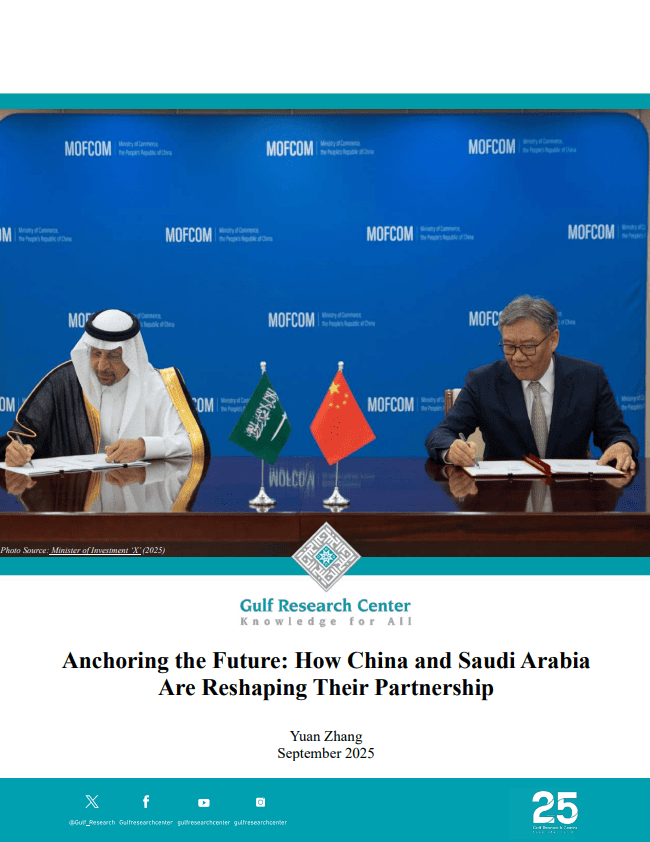
Saudi Arabia's Investment Minister Khalid al-Falih's late-August visit to Beijing, Shanghai, and Hong Kong, accompanied by senior officials and business leaders, marked another step in the consolidation of Sino-Saudi economic relations. Coming in the year that marks the 35th anniversary of diplomatic ties between the two countries, the visit conveyed more than symbolic goodwill. Beyond the optics of high-level meetings and the signing of MoUs, the delegation underscored a more consequential trend: the deliberate integration of Chinese capital, technology, and supply chains into Saudi Arabia's Vision 2030 strategy, and the reciprocal opening of Chinese markets and finance to Saudi investment.
From Symbolic Diplomacy to Execution
The framing of al-Falih's meeting with Chinese Commerce Minister Wang Wentao in Beijing as the "implementation of leaders' consensus" was revealing. The emphasis was not exploratory but operational: how to translate top-level strategic directives into projects and financial flows. In practice, this meant aligning the Belt and Road Initiative (BRI) with Vision 2030 in concrete areas-industrial localization, capital market access, and renewable energy development.
For China, the stakes are twofold: consolidating its role as Saudi Arabia's principal economic partner in a region still dominated by the United States, and securing long-term positions in non-oil sectors that will define the Kingdom's economic future. For Saudi Arabia, deepening with China means more than diversifying away from hydrocarbons; it signals a willingness to balance Western and Eastern partnerships while embedding Chinese technology and finance into its diversification drive.
Trade and Investment: Momentum and Direction
Bilateral trade already exceeds USD 100 billion annually, but the more striking trend lies in accelerating investment flows. Chinese investment stock in the Kingdom rose nearly 29 percent between 2023 and 2024, while the investment flows surged by over 160 percent. Manufacturing remains dominant, but finance, construction, healthcare, and advanced materials are now drawing significant attention.
This expansion is not merely opportunistic. It reflects Riyadh's determination to court Chinese firms in sectors critical to Vision 2030-renewables, petrochemicals, advanced manufacturing-while offering itself as a stable, strategically located production hub. For Beijing, the Kingdom offers secure energy supply and a platform for Chinese enterprises to expand into the Gulf and wider Middle East.
Importantly, both countries are framing these economic linkages within a broader commitment to rules-based multilateral trade and open markets. Saudi officials have consistently emphasized that attracting Chinese capital is inseparable from safeguarding global trade governance and resisting fragmentation. In turn, Beijing views Riyadh not only as an energy partner but also as a Gulf advocate for multilateral norms at a moment when global trade faces headwinds from protectionism and sanctions. This convergence of economic interests and trade philosophy underpins the durability of the commercial relationship.
Embedding Supply Chains
Arguably the most strategic element of the visit was the focus on supply chain localization. For example, al-Falih co-chaired a maritime supply chain roundtable with China State Shipbuilding Corporation in Shanghai, alongside over 50 Chinese firms. The Saudi delegation also toured carbon fiber and chemical companies, exploring local manufacturing and joint industrialization opportunities.
These moves align with Riyadh's Global Supply Chain Resilience Initiative (GSCRI), which aims to position Saudi Arabia not just as a consumer of imported goods but as a node in global production networks. The implicit bargain is clear: Chinese firms gain a low-cost, strategically situated base with privileged Gulf access, while Saudi Arabia acquires industrial know-how and reduces dependency on imported finished goods.
Finance as a Strategic Pillar
The delegation's meetings with China's financial regulators and top banks highlight the next frontier: capital markets and financial integration. Al-Falih's exchanges with the China Securities Regulatory Commission (CSRC) and executives at ICBC, Bank of China, and Agricultural Bank of China focused on cross-border investment facilitation, project financing, and regulatory alignment.
For Riyadh, engaging Chinese financial institutions serves three strategic aims, channeling Chinese capital into Saudi projects and privatizations; allowing Saudi investors-particularly the PIF-to deepen their presence in Chinese equities and technology sectors; and building pathways for renminbi-linked transactions in the Gulf.
For Beijing, the appeal lies in embedding Saudi capital into Chinese markets and advancing incremental renminbi internationalization. While the dollar continues to dominate oil trade, financial cooperation of this kind creates the infrastructure for gradual diversification-an outcome that appeals to both sides, albeit for different reasons.
Policy Implications: Toward Structural Interdependence
What distinguishes this visit from earlier episodes of Sino-Saudi engagement is the breadth and structured depth of cooperation. Energy remains foundational, but the relationship is now being scaffolded by industrial supply chains, financial architecture, and regulatory dialogues. This shift carries several policy implications:
Locking in Economic Ties: By embedding Chinese firms into Saudi manufacturing and integrating Saudi capital into Chinese markets, both sides are creating structural dependencies likely to outlast political cycles. This is less about one-off MoUs than about building long-term mechanisms of entanglement.
Geopolitical Balancing: Riyadh's willingness to deepen financial and industrial ties with Beijing signals a more assertive multi-alignment strategy. While the United States remains the Kingdom's primary security guarantor, China is increasingly indispensable as an economic partner. For Washington, this trajectory complicates efforts to contain Chinese influence in the Gulf.
Energy Transition Nexus: The pivot to renewables and supply chain localization highlights how the next phase of Sino-Saudi ties will be judged not just by oil volumes but by joint capacity to manage the energy transition. China's solar and electric vehicle technologies align directly with Saudi Arabia's need to diversify its energy mix-suggesting a future where cooperation is both commercial and existential.
Multilateral Messaging: Both sides used the visit to underscore their commitment to multilateral trade governance and opposition to unilateral sanctions, a pointed rejoinder to US-led protectionism. For Riyadh, aligning with Beijing on multilateralism is consistent with its effort to attract foreign investment under predictable global rules. For Beijing, Saudi support strengthens its case that alternative centers of power can reform the international economic order. This convergence could translate into joint initiatives in international and regional organizations such as the WTO, G20, and SCO. Al-Falih’s visit to China occurred only days before the 2025 SCO Summit in Tianjin (China), which once again underscored the importance of a multilateral order and introduced new financial mechanisms, echoing themes central to Sino-Saudi engagement. While Saudi Arabia participates in the SCO only as a Dialogue Partner, this status nonetheless provides a platform to align with Beijing’s push for a reformed multilateral order. In practice, Riyadh can leverage the SCO selectively to amplify its Vision 2030 agenda, while China benefits from embedding a key Gulf economy into Eurasian governance forums. The result is a convergence that extends beyond bilateral ties into the shaping of emerging multilateral frameworks.
Conclusion
HE Saudi Arabia’s Minister of Investment Khalid Al-Falih's latest visit to China showcased more than a diplomatic gesture. It illustrated a deliberate strategy on both sides to move beyond symbolic MoUs toward embedded economic interdependence. By linking China's BRI and Saudi Vision 2030 in industrial, financial, and regulatory domains, Beijing and Riyadh are constructing a partnership that is both pragmatic and strategic.
It is increasingly evident that Sino-Saudi ties are no longer defined solely by hydrocarbons. They are becoming a lattice of industrial supply chains, financial flows, and multilateral coordination. The question now is not whether this partnership will deepen, but how resilient it will prove amid global economic fragmentation and intensifying great power rivalry.
* Yuan Zhang is a Senior Non-Resident Research Fellow at the Gulf Research Center (GRC).