Commentary & Analysis
A New Axis of Instability: Iran’s Africa Strategy and Gulf Security Risks
Amid growing geopolitical instability and shifting global alliances, new partnerships are emerging for African states beyond traditional Western powers. As the United States and France recalibrate their priorities away from Africa, countries such as Niger, Burkina Faso, Mali, Senegal, and Chad are increasingly looking East, to Russia, China, Turkey, the Gulf states, and, more recently, Iran. These powers are filling the vacuum left by the West, deploying a mix of strategic investments, infrastructure development, and military cooperation.
While much attention has focused on China’s Belt and Road Initiative, the Gulf’s economic diversification agenda, and Russia’s Wagner Group activities, Iran has quietly raised Africa as a foreign policy priority. Tehran is employing a multipronged strategy to deepen ties with African countries by expanding defense cooperation, energy partnerships, and economic investments, while capitalizing on growing anti-Western sentiment in the Sahel.
Security and Military Cooperation
Iran is expanding its military and security partnerships in Africa, particularly in the mineral-rich Sahel region, where recent coup d’états have shifted interests away from Western influence. From 2022 to 2025, coup leaders from Burkina Faso, Mali, Niger, and Chad expelled French troops and diplomatic missions and seized foreign military outposts. These events created an opening for external actors, notably Russia and Iran, to exploit. For instance, Russia’s Wagner Group offered military support to the new regimes in the Sahel in return for access to critical minerals.
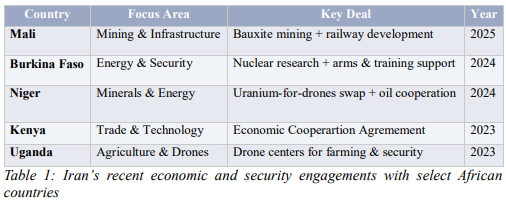
In parallel, Iran has seized this opportunity to build bilateral defense ties. In May 2025, Brigadier General Ahmad Reza Radan, Iran’s Chief of Police, signed a memorandum of understanding with Niger’s Interior Minister General Mohamed Toumba to strengthen security cooperation.1 The agreement formed a joint expert committee to facilitate intelligence exchange and coordinate operational strategies, underscoring a robust and mutually beneficial alliance. Niger has vast uranium deposits, which are of strategic interest to Iran’s nuclear program. In 2024, Iran acquired 300 tons of refined uranium in exchange for drones and surface-to-air missiles to Niger, underscoring that “defense for minerals” is becoming a key transactional model to build relations in Africa.
Burkina Faso’s Foreign Minister asserts that Burkina-Iran cooperation is a “top priority” given their “friendly and brotherly” relations. Accordingly, Iran has trained forces and discussed the potential supply of military equipment to Burkina Faso.2 Iran is expanding its defense and arms trading across the continent as an alternative source of income amid international sanctions on its oil economy and to strengthen its sphere of influence in an increasingly fragile geopolitical environment, given its recent war with Israel. In 2023, Vice President Rouhollah Dehghani announced plans to establish drone centers across Africa for military and agricultural purposes, beginning in Uganda.
While Iran’s defense diplomacy has enabled it to build military ties across the African continent,4 its presence is also seen as posing a direct threat to regional stability. Operating through Lebanon’s Hezbollah militia and the Islamic Revolutionary Guard Corps Quds Force, Iran has organized attack cells in the Central African Republic, Ghana, Chad, the Gambia, Niger, and Sudan to target Western interests, embassies, and tourists.5 Between 2019 and 2022, joint intelligence agencies prevented Iranian-backed cells from attacking American and Israeli tourists in Ethiopia, Ghana, Senegal, and the Democratic Republic of the Congo.
Iran has also sought to further expand its influence in the Horn of Africa, exacerbating the region’s instability. Strategically positioned along the Bab el Mandeb Strait and the Red Sea, the Horn is a crucial transit point; it accounts for 15% of global trade. Tehran has used its proxies to fuel unrest, with Houthi rebels posing a particular threat to maritime security. Over the past year, the Houthis have launched multiple attacks on commercial ships and oil tankers crossing the Red Sea.
In September 2025, Houthis fired a missile at an Israeli-owned tanker in response to Israeli strikes that killed Ahmed Ghaleb al-Rahawi, prime minister of the Houthi-led government, underscoring the continuing risks to international shipping in the region.
In addition to direct attacks, Houthi militias are operating weapons smuggling networks, recruiting and training vulnerable citizens across the Horn. Already, Iran’s support for the Houthis in Yemen, coupled with its weapons deliveries to the Sudanese Armed Forces, has amplified the risks posed by its military presence, propagating instability that endangers Gulf economies and their regional investments.
Energy and Nuclear Cooperation
Iran’s nuclear program remains a strategic asset, crucial to its defense and energy sectors. Through decades of investment in nuclear research and infrastructure, Iran has compiled significant knowledge on nuclear power, which it is now extending to friendly states. Several African countries, including South Africa, Niger, and Burkina Faso, face chronic energy deficits and have expressed interests in developing nuclear programs for civilian use, an opportunity Iran seeks to exploit.
In this regard, Iran is forging stronger energy partnerships with African countries, including South Africa, Burkina Faso, and Niger, which are increasingly critical of Western countries, and seeking to diversify their energy production. In September 2024, Iran and Burkina Faso signed a memorandum of understanding to deepen cooperation in nuclear research and training.7 More recently, in April 2025, Iran’s First Vice President, Mohammad Reza Aref, discussed energy cooperation with Niger’s Minister of Oil, Sahabi Oumarou, during a high-level visit to Tehran.
Similarly, relations between South Africa and the United States deteriorated since South Africa’s legal case against Israel at the International Court of Justice over its military campaign in Gaza, a case that Iran strongly supports and one that the United States vehemently opposes. During U.S. President Trump's administration, tensions escalated as his administration cut funding to the nation, expelled South Africa’s ambassador, imposed the highest tariffs on South African exports on the continent, and criticized President Cyril Ramaphosa’s domestic policies during a tense Oval Office meeting in May 2025.
The shared reservations towards America's foreign policy have brought Iran and South Africa closer, as South Africa’s Petroleum Minister Gwede Mantashe welcomed bids from Iran and Russia to develop its civilian nuclear capacity. In the private sector, Johannesburg-based energy company Sasol invested in Iran’s Arya Sasol Polymer Company, underscoring the breadth of cooperation in the private and public sectors. Iran’s cooperation with South Africa, Niger, and Burkina Faso illustrates how new partnerships are forming based on mutual strategic interests.
Iran’s outreach towards African countries appears to be succeeding. At the International Atomic Energy Agency’s June 2025 meeting, Burkina Faso was one of only three countries to oppose the resolution condemning Iran for violations of its nuclear obligations, while South Africa abstained from voting.8 These votes underscore how Iran is effectively developing its ties in Africa and garnering support, or at least neutrality, on international platforms.
Economic Cooperation
In the shadow of international sanctions and diplomatic isolation, Iran is also nurturing its economic and diplomatic presence on the continent. In 2023, thenPresident Ebrahim Raisi visited Kenya, Uganda, and Zimbabwe to gather diplomatic support and advance economic, trade, political, and cultural cooperation. For Kenyan President William Ruto, Iran is a “strategic partner” for Kenya, as the two nations have agreed to cooperate in investment promotion, technology, and fisheries.9 Iran has signed further joint economic cooperation agreements with Niger10 and Burkina Faso, targeting mining, energy, and technology.
The Iran-Africa Economic Cooperation Summit is the centerpiece of Iran’s diplomatic and economic charm offensive on the continent.12 The third edition, held in April 2025, brought delegations from over 30 African countries, including vice presidents, ministers, and private sector leaders. The summit focused on expanding trade and investment, with Iran aiming to increase its trade volume with Africa from $800 million to $10 billion, allocating $2 billion to the purchase of African goods. Tehran is looking to invest in African agriculture, infrastructure, ports, energy, mining, and aviation sectors.
At the summit, Iran signed agreements on mining, agriculture, petrochemicals, and medical equipment, and announced a joint Iran-Africa development fund.13 The fund aims to attract $2 billion in investments and an additional $2 billion to finance strategic mines on the continent. It also aims to establish shipping lines and transportation networks, while increasing the number of joint chambers of commerce from 13 to 20 to facilitate trade with African countries. Iran has also raised its participation with African states through its membership in BRICS.
Tehran appears to concentrate on selecting countries where it identifies political and economic alignment. This narrower strategy is designed to turn pledges into tangible outcomes, and early evidence of it can already be seen. In July 2025, the Iranian Mining Engineering Organization and the Mali Chamber of Mines signed an agreement to cooperate in knowledge exchange, training programs, and creating a business-friendly environment for Iranian investors in Mali. The two countries hope to form a consortium to develop Mali’s bauxite mines, refine the output domestically, and construct supporting railway infrastructure.14 These initiatives demonstrate an apparent effort to translate summit pledges into action.
Limitations
While these plans are ambitious, especially considering Iran’s economic constraints and recent setbacks, it remains uncertain whether it has the capacity to deliver. The E3 (France, Germany, and the United Kingdom) have initiated a snapback mechanism following the expiry of the 2015 JCPOA, which could see wide-ranging sanctions reimposed. In the meantime, individual sanctions continue to be introduced, including measures against Iranian companies and individuals accused of supplying arms to Russia.16 These sanctions will continue to strain Iran’s economy and test its ability to fulfill investment pledges. Tehran may be forced to scale back, delay, or even abandon projects agreed on at the Iran-Africa conferences.
These measures will also complicate Iran’s efforts to increase trade with African partners. For countries such as Ghana and Kenya, which are beneficiaries of IMF loans, engaging with Iran will bring reputational and financial risks, as was the case for South Africa. Washington wields tariffs as a punitive tool; the Trump administration could impose higher tariffs on states cooperating with Iran. For African governments working to secure favorable trade terms with the Trump administration, even the appearance of Iranian cooperation could weaken their hand, creating further barriers to Iran’s economic ambitions on the continent.
The competitive landscape is equally unforgiving. Iran is entering a field dominated by the Gulf states, China, and Russia. Its offer, $2 billion for goods and $2 billion for investment, pales in comparison to the $100 billion that the Gulf states have invested in Africa in the past decade. In 2024, China committed $51 billion to its African agenda over the next three years, while the United States and its European allies are increasingly investing in mining and infrastructure. This underscores the vast economic powerhouses vying for influence in Africa. Against such rivals, Iran’s ability to meaningfully compete remains uncertain.
Yet the greater challenge lies in geopolitics. Tehran’s attack on American facilities in Qatar was an unprecedented provocation that rattled regional security and strained its already fragile ties with the GCC. More troubling for the Gulf, however, is Iran’s growing footprint in the Red Sea. The instability it fuels through weapon smuggling networks to the Sudanese Armed Forces, its bid for a naval base in Sudan, and fueling extremism in Africa directly undermine Gulf interests.
The Red Sea is critical for Gulf oil and gas exports, and any threat to maritime security jeopardizes the backbone of its economies. A permanent Iranian naval presence across from Saudi shores would give Tehran a launchpad for targeting commercial shipping or Western assets in the Gulf, considerably raising the stakes.
Iran’s involvement in Sudan’s civil war only deepens the risks. Prolonging the conflict fuels instability in the Horn of Africa, threatening spillover violence that undermines regional security and endangers Gulf investments in infrastructure, agriculture, energy, and mining. For the GCC, such instability erodes the very principles outlined in its vision for regional security, including secure maritime routes and a stable environment for trade, energy, and tourism.
In this context, Iran’s presence in Africa poses a direct threat to Gulf security, economic stability, and the viability of regional cooperation. If left unchecked, Tehran’s pursuit of influence in Africa could spark new proxy conflicts, further erode Gulf-Iran relations, and continue to destabilize one of the world’s most vital maritime corridors.
Conclusion
Iran’s evolving relations with Africa reflect a geopolitical shift and the continent’s search for new partners beyond the traditional Western sphere. Tehran positioned itself as an alternative partner for some African regimes by pursuing defense, energy, and economic cooperation. Notably in Niger, Mali, Burkina Faso, and South Africa, Iran leveraged its political interests and opposition to Western influences to build deeper bilateral ties.
However, Iran’s ambitions face clear limitations. Its economic constraints, international sanctions, and recent military conflict with Israel raise questions about its capacity to follow through on large-scale promises. In addition, the Gulf states, China, and Russia’s financial and strategic footprints far surpass those of Tehran. What differentiates Iran’s approach, however, is its targeted engagement with ideologically aligned governments, rather than a continent-wide strategy. Whether this narrower approach proves effective remains to be seen, but it signals Tehran’s intent to secure influence in Africa.
Michael W. Wilson is a Researcher at the Gulf Research Center (GRC)