Commentary & Analysis
India’s Eastward Pivot: What Modi’s Tilt Toward Asia Means for the Gulf Amid U.S. Tariffs
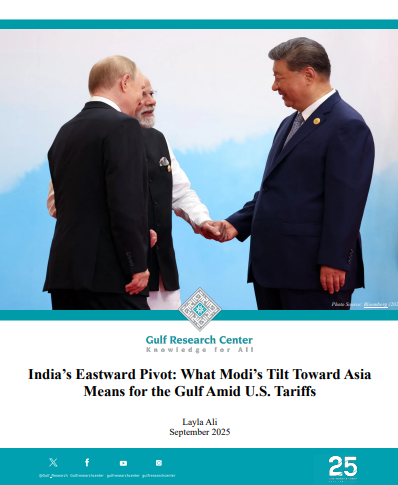
India’s foreign policy is undergoing a notable recalibration. While New Delhi had in past years prioritized a partnership with the United States, recent developments suggest a more assertive eastward pivot. Prime Minister Narendra Modi’s outreach to Asian powers, including Japan and China, as well as his participation at the Shanghai Cooperation Organization (SCO) summit, also reflects an effort to diversify India’s partnerships amid growing global economic and geopolitical uncertainty. For the Gulf states, which have historically viewed India through a bilateral, energycentric lens, this shift has important implications. As the Gulf manages its own complex balancing act between Washington and Beijing, it may now need to integrate India more deeply into its strategic calculus.
A Strategic Recalibration Under Pressure
India’s tilt toward Asia has been accelerated by external shocks, most notably the United States’ decision under President Donald Trump to impose sweeping tariffs on Indian goods. On July 30, 2025, Trump announced a 25% tariff on Indian imports “plus an unspecified penalty” for purchasing Russian oil and weapons. Posting on his Truth Social platform, Trump stated that the measures would take effect from August 1, 2025, the U.S. deadline for a trade deal. He described India as a friend, but whose "tariffs are far too high, among the highest in the world." He also criticised India's purchases of Russian military equipment and energy "when everyone wants Russia to STOP THE KILLING IN UKRAINE."
Trump’s move did not happen in a vacuum. Since the beginning of 2025, the Trump administration has been using tariffs as a bargaining chip with multiple trading partners. In April 2025, the administration threatened to impose a 26% reciprocal tariff on India, dubbed the “Liberation Day” tariffs, but held off while negotiations were underway. The newly introduced 25% tariff effectively revives that earlier proposal. The decision caught New Delhi by surprise, as it had been expecting a figure in the range of 15-17%, in line with U.S. agreements reached with other nations. This underscores the increasingly complex interplay between economic policy and geopolitical strategy in international affairs.
To be sure, the U.S. decision is linked to India’s growing relations with Russia, especially in terms of energy imports. For India, its deepening reliance is driven primarily by economic pragmatism: Russian crude is being sold to India at steeply discounted rates compared to global benchmarks, making it too financially attractive to ignore at a time of rising domestic energy demands. In August alone, India’s purchases of Russian crude reached €2.9 billion, nearly matching China’s €3.1 billion. Russian oil now accounts for almost 40% of India’s total crude imports, up from virtually zero before the war in Ukraine.
Beyond economics, India’s strategic calculus also plays a role. Maintaining strong ties with Moscow has provided New Delhi with a hedge against overdependence on Western partners while preserving its foreign policy autonomy. But as evidenced by the tariff decision, India now faces diplomatic costs as well as trade friction as Europe and the United States intensify their pressure on countries to enforce sanctions and isolate Russia.
This vulnerability is prompting India to seek out alternative economic and strategic partnerships across Asia. Prime Minister Modi’s visit to Japan on August 29, 2025, for the 15th India-Japan Annual Summit resulted in a significant deepening of the bilateral relationship. The visit was not just a diplomatic formality but a strategic working meeting aimed at elevating the partnership across multiple sectors. Prime Minister Modi also attended the India-Japan Economic Forum, a key event co-organized by the Confederation of Indian Industry and Keidanren, where he highlighted India's growth story and its relevance for Japanese investors. One of the main outcomes was Japan's commitment to invest 10 trillion yen (approximately $68 billion USD) in India over the next decade. This builds on a prior goal of 5 trillion yen and showcases Japan's confidence in the Indian economy and its role as a key strategic partner in balancing regional economic alignments.
Prime Minister Modi and Japanese Prime Minister Shigeru Ishiba reaffirmed their commitment to the Mumbai-Ahmedabad High-Speed Rail as a flagship project, with a plan to work towards its commencement of operations and the introduction of the latest Japanese Shinkansen technology in India. To symbolize this partnership, the two leaders took a symbolic ride on a bullet train to Sendai. They also launched the Next Generation Mobility Partnership to facilitate cooperation in advanced metro rail systems and smart cities. Finally, they launched the Japan-India AI Cooperation Initiative, which will focus on deepening bilateral and multilateral cooperation in artificial intelligence, including Large Language Models (LLMs). They also initiated the JapanIndia Economic Security Initiative to strengthen supply chain resilience in critical sectors like semiconductors, clean energy, and pharmaceuticals. This collaboration is a direct response to global trade fragmentation and the push for technological sovereignty.
Prime Minister Modi’s participation in the 25th Shanghai Cooperation Organization (SCO) summit in Tianjin, China, was a move that went beyond routine multilateral diplomacy. Occurring just two days after his significant visit to Japan, the summit highlighted India's multi-pronged foreign policy, aimed at asserting its role as an independent global power. The event, chaired by Chinese President Xi Jinping, saw the adoption of 24 documents, including the Tianjin Declaration and the SCO Development Strategy until 2035, covering a wide array of topics from security to trade and technology. Emphasizing the importance of connectivity in driving development and strengthening trust, the Prime Minister expressed India’s strong support for initiatives like the Chabahar Port and the International North-South Transport Corridor.
Prime Minister Modi's attendance, his first visit to China in seven years, reflects a pragmatic recognition of the value of maintaining channels of communication with Beijing, even as significant and longstanding tensions remain along their shared border. These challenges are complex, and while India has generally prioritized managing these dynamics through careful diplomacy rather than formal mechanisms, its approach differs somewhat from that of the GCC states, which have placed increasing emphasis on structured dialogue and de-escalation efforts with regional rivals such as Iran.
India's participation in the SCO summit also highlights an important evolution in its foreign policy. Traditionally a leading voice in the Non-Aligned Movement, India appears to be shifting toward a strategy of multi-alignment, engaging simultaneously in diverse and, at times, competing cooperative frameworks. This is reflected in its active role within both the Quad (with the U.S., Japan, and Australia) and the SCO (with Russia and China). Such an approach provides India with flexibility and strategic leverage, enabling it to navigate intensifying global rivalries without being forced to choose sides. The summit’s outcomes, including the establishment of an SCO Development Bank and new initiatives for cooperation in areas such as AI and green industry, underscore how the organization is broadening its agenda beyond traditional security concerns, offering India additional pathways to advance its multi-alignment strategy.
Ultimately, the timing of the visit, in the wake of escalating U.S. tariffs, represents a message to Washington that India has alternative partners and will not be pressured into making unfavorable economic or political concessions.
The Gulf's Strategic Response
For the Gulf states, India’s recalibration aligns with their own strategic goal of diversifying economic partnerships beyond traditional Western markets. Both India and the GCC share an interest in building resilient, multipolar networks of trade and investment, making their collaboration a mutually reinforcing strategy in an era of shifting global power dynamics.
These dynamics, however, also challenge GCC-India ties. With Russia, at times in 2024 and 2025, overtaking Saudi Arabia and Iraq to become India’s top crude supplier, traditional Gulf-Asia energy patterns are becoming disrupted, given India’s past position as one of the Gulf’s most stable and lucrative energy customers. In the near term, this creates competitive pressure on their market share and underlines the vulnerability of relying too heavily on a single buyer.
At the same time, a long-term trend of structural decline in oil revenues, combined with the immediate pressure from Russian competition, is acting as a powerful catalyst for the Gulf to accelerate its non-energy economic engagement with India. This could be a fundamental shift in the relationship, moving it from a transactional, energy-centric model to a multi-faceted partnership based on investment, technology, and shared economic growth.
Gulf sovereign wealth funds (SWFs), particularly those of the UAE and Saudi Arabia, are at the forefront of this shift. They are making massive investments in India's infrastructure, technology, and renewable energy sectors. For instance, a joint venture between an Abu Dhabi-based SWF and a private equity firm invested $525 million in a major Indian renewable energy company, while Saudi Arabia's PIF is investing in advanced data centers to support AI and cloud technologies.
The most prominent example of this deepening relationship is the India-Middle East-Europe Economic Corridor (IMEC), a major infrastructure initiative that includes India, the UAE, and Saudi Arabia. IMEC aims to connect Asia, the Gulf, and Europe through a network of railways, shipping routes, and digital infrastructure. This project, which could facilitate trade worth $100 billion in its first years, aligns perfectly with the Gulf's national visions and desire to become a central logistics and finance hub. IMEC is seen as a tangible move toward greater regional integration, promoting investments in green hydrogen and electricity grids.
India’s eastward pivot is still in its early stages, and its trajectory will depend on factors ranging from President Trump’s evolving trade policies to China’s economic recovery and Russia’s ability to sustain discounted energy exports. While the exact outcomes remain uncertain, this gradual shift is likely to shape India’s role within Asia and will have important implications for its Gulf partners, who must carefully monitor and adapt to these changing dynamics.
For the GCC, the lesson is twofold. First, while Gulf states have maintained strong and steadily expanding relations with both India and the United States, the evolving geopolitical landscape creates an opportunity to further elevate engagement with India, recognizing New Delhi’s independent foreign policy priorities, while continuing to balance relationships with other key global actors.
Second, Gulf states must prepare for a more multipolar regional order in which energy, technology, and geopolitics intersect in complex and sometimes unpredictable ways. If managed wisely, India’s evolving role could become a catalyst for deeper Gulf-Asia integration, fostering a network of partnerships that enhance resilience and shared prosperity for both regions. However, if this opportunity is overlooked, it could also introduce new pressures on Gulf energy markets and foreign policy alignments. Careful, forward-looking engagement will therefore be essential to navigate this shifting landscape.
Layla Ali is a Senior Research Associate at the Gulf Research Center (GRC).