Commentary & Analysis
Implications and Limitations of Western Recognition of Palestine
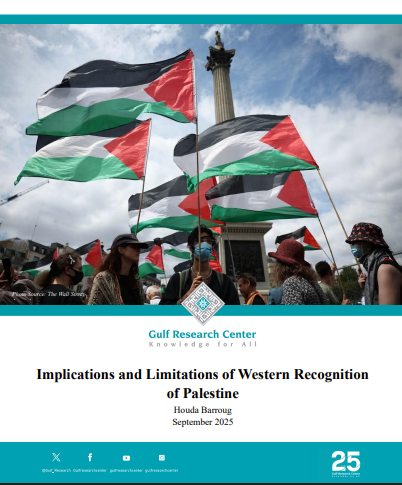
The international momentum recognizing Palestinian statehood reflects a growing acknowledgment of the dire situation in Gaza. With over 78 percent of UN member countries recognizing the state of Palestine, including the new Western allies, conventionally pro-Israel, this movement is indeed to be celebrated. Canada, Australia, the UK, France, and Portugal have always called for a two-state solution; but until now, they never actually recognized a Palestinian state. Since October 7th, 2023, it has become neither possible nor strategic to turn a blind eye to what is taking place in Gaza.
Where Recognition Makes a Difference
On the surface, the current wave of recognition matters because it highlights a first genuine attempt by some Western countries to close the gap between their continuous call for human rights and norms, and having bluntly disregarded the annexation, the human suffering in Gaza, and the abuse of international law that Israel has been carrying out. Pursuing such double-standard policies is increasingly untenable as criticisms have risen to the point that most governments have lost their credibility— both domestically and internationally. This shift, however, enables these countries to navigate moral expectations while preserving their diplomatic credibility.
This recognition also marks an institutional decision to tackle these governments’ political ambivalence: it represents a significant legal step that cannot be simply reversed. An example of such a development would be supporting the ICC investigations and not avoiding upholding its potential rulings against Netanyahu. Moreover, these governments’ distinction between recognizing the Palestinian statehood and rewarding terrorism, contrary to Netanyahu’s claims, marks a departure from narratives conflating resistance with terrorism.
However, Netanyahu’s government has been more and more vocal about its plan to take over Palestine and realize Greater Israel, which, despite Western recognition, still means null prospects for a potential Palestinian state. Israel has worked tirelessly to sabotage and continuously undermine any efforts to implement the two-state solution. The recognition movement puts Israel, and its biggest ally, the US, in complete isolation, especially on the diplomatic front.
The Limits of European Recognition
In reality, this recognition should be seen as neither a gift, nor a favor. It is simply a right longdenied by countries that are historically, politically, economically, militarily, and institutionally complicit in this genocide. This new wave of Western recognition does not make Palestine a state: first because the Palestinian state has already been recognized by 150 countries, and a few additional Western states will not necessarily make a difference, and second, because the United States will use its Veto power in the UN to block any further international joint efforts to change the reality on the ground.
More importantly, recognition by itself still will not change anything unless coupled with real substantive measures taken against the current Israeli government. This recognition does not guarantee the end of violence in Gaza and other Palestinian territories. It does not guarantee moving forward with ceasefire negotiations nor ending the war. It will only irritate Israel more.
Building the Foundations of Palestinian Statehood:
The aim of the recognition is to “revive the hope of peace and a two-state solution,” prerequisites of regional and global peace. To actually do so, various measures need to be taken. The most important one is a united front against Israeli harassment, threats, and entitlement. In the short term, the recognition, as a diplomatic stance, makes room for policy changes. But for changes on the ground, this new camp of pro-Palestinian statehood needs to revisit their trade and overall diplomatic packages with Israel, by exploring imposing sanctions and an arms embargo, and holding accountable Netanyahu and his accomplices. So far, the EU, for example, has been discussing suspending trade concessions with Israel, with Slovenia first to sanction Netanyahu. Other member states expressed their withdrawal from Eurovision and the upcoming World Cup if Israel participates- though it is doubtful that these withdrawals will carry any weight with Israel. These remain symbolic actions that will not be effective enough to convince the determined, hardline Israeli government.
The 1933 Montevideo Convention lists four criteria for statehood: a permanent population, a defined territory, a government, and the capacity to enter into relations with other states. For Palestine, one can arguably claim a permanent population and the capacity to enter into relations. However, Netanyahu’s government is targeting that first critical criterion, making it the first order of business for countries genuine about their recognition. The new camp of pro-Palestinian statehood needs to work with regional countries to ensure food and emergency supply delivery, leveraging cutting diplomatic ties, trade, and arms delivery to Israel. On the second criterion, Israel needs to be held accountable and forced to halt any further expansion projects in Palestinian territories, so as to uphold the internationally established and agreed-upon borders.
The third criterion is perhaps the most complicated, as it contains two fronts. Palestine has had more geographical separation and political division than any other country, and the need for new leadership has never been more critical. The agency of the Palestinian people should be a priority here, and the international community should focus on establishing a competent administration under some form of international governance that can concentrate on reconstruction and delivery of services – without it, no future government can function.
Where the EU and GCC Can Work Together
An important reality check, as this recognition momentum continues to grow, is that without meaningful pressure that only Washington can bring, Europe and the global community will struggle to act. The EU continues to face challenges in establishing coherent diplomatic leadership and strategic insight in the region, which is why it should closely follow the GCC’s lead on managing the way forward. Arab states’ meeting with Trump marks a direct engagement to outline the current state’s implications on the future of regional security. Moreover, the GCC, particularly the UAE’s direct messages to the S and Israel about potential red lines, convey that unilateral Israeli actions would bring about serious consequences in the region, primarily the collapse of the Abrahamic accord, and ultimately undermine the two-state solution prospects.
Moreover, the GCC is actively engaged in shielding regional countries from potential spillover effects. This includes providing political and economic assistance to Jordan, working to restore stability in Syria, maintaining a measured approach toward Iran to avoid further isolation and escalation, and assisting Lebanon in developing a functioning government to avoid a political collapse or vacuum. This shielding focuses on regional stability and avoiding humanitarian crises or security spillovers that could endanger both regional and international security and stability.
The GCC is also establishing objectives and concrete mechanisms for the foreseeable implementation of the two-state solution. This includes backing the Global Alliance framework to better coordinate global initiatives such as the Palestinian Authority reform, Gaza reconstruction, and overall political and economic stability. Rather than waiting passively for changes within Israeli leadership, GCC countries are aspiring to establish ready-to-deploy frameworks that support sustainable Palestinian statehood.
The goal of the EU is to engage on a more structural and institutional level to support existing regional and global efforts and frameworks that would actually allow for a Palestinian statehood. Recognizing Palestinian statehood without supporting its actual establishment is counterproductive, as expressed by Italian Prime Minister Giorgia Meloni. However, while at this initial stage, the recognition movement is merely symbolic, it should be used as a tool to create further momentum towards concrete steps to establish the state of Palestine.
*Houda Barroug is a Researcher at the Gulf Research Center (GRC)