
Commentary & Analysis
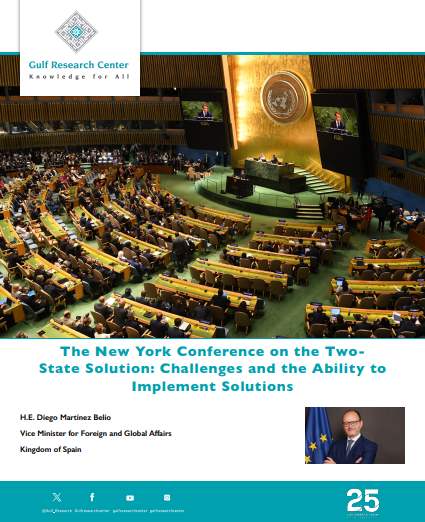
The New York Conference on the TwoState Solution: Challenges and the Ability to Implement Solutions
Today the Middle East is no longer the Middle East we use to know. Things have changed dramatically since the end of 2023 as many paradigms had fallen, creating an extreme volatile environment that threatens the whole stability and peace in the region. The region is being redrawn by the events and unilateral actions that challenge us all.
The abhorrent terrorist attacks perpetrated by Hamas against Israel on the 7th October 2023 and the following war in Gaza have triggered a deep shift in the region, as well as the conflict between Israel and Iran or, more recently, the Israeli attack against the territory of Qatar. All these events have escalated the tension in the region to unpredictable results, and are eroding the perspectives of reachingx a long lasting peace in the region and weakening the international order based on rules and principles.
In the most challenging times in the Middle East, we, Spain and closed allies as Saudi Arabia, have decided not to stay idle and fully assume our responsibilities, being proactive since we recognised that the formulas of the past have not worked, and that effective, results-oriented action is needed. That means to lead the only possible solution, and work for making it a reality: the implementation of the Two-State Solution, including the first essential step of recognizing of the State of Palestine. Only a solution in which an independent, sovereign, and economically viable Palestinian State, living side by side in security with the State of Israel would set solid foundations for peace and stability in the whole region. There is no alternative.
As Spain’s Foreign Minister José Manuel Albares stated at the Security Council in April 2024, the establishment of a Palestinian State is not only a matter of justice for the Palestinian people: it is deeply intertwined with the security of Israel and the stability of the entire region.
The current war in Gaza has overcome any level of tolerance: more than 63.000 dead victims, 2 million internally displaced people, 159.000 wounded, many thousands suffering famine, and an unseen level of destruction of civil infrastructure, included schools and hospitals.
This unbearable situation should be an urgent call for the whole international community, for those of us who defend International Law and international Humanitarian Law. Our credibility is at stake.
Since the beginning of the war, Spain called for an end to the conflict, for the immediate release of all the hostages in hands of the terrorist group Hamas, and for the unimpeded and illimited access to humanitarian assistance to the needed population of Gaza.
At the same time, we moved forward for the implementation of the two State solution by recognising in May 2024 the State of Palestine, together with Norway, Ireland and Slovenia, while calling at the same time for the recognition of the State of Israel and the normalisation of its relations with the Nations of the region and beyond.
But our decision was not an isolated oneshot. Our efforts to build consensus around the implementation of the two-State solution contributed to the launching of the Global Alliance for the implementation of the two-State solution, after the meeting of the Madrid Group in September 2024. And to the extension of its support, with the Madrid + meeting last May. The support of Saudi Arabia and all the GGC countries was key. We are now witnessing a new wave of announcements of future recognitions of the State of Palestine, by countries such as France, Canada, United Kingdom, Australia, Belgium, Luxembourg, Portugal or Malta, which showcase a major shift in the international community. This reversal of the terms breaks with a decades-long trajectory of an inertial management of status quo and of a failed peace processes. A process that, as UNSG Guterres has said, has been “far more process than peace” for many decades.
The New York Declaration, resulting from last July’s New York Conference, co-chaired by Saudi Arabia, was endorsed by a large majority of the UN General Assembly. Itis therefore the outcome of our joint efforts to overcome challenges and implement change. Since 2023, Spain has been advocating for an international conference for a long lasting peace in the Middle East. Moreover, in the High Level Conference on the Implementation of the two-State solution, we will witness the result of the forging a growing consensus on the need to move forward through tangible and irreversible steps towards a future of peace and security for the people of Palestine and Israel.
Reinforced by the announcement of recognition of the State of Palestine by many major partners, we advocate for 2025 UNGA, on the basis of the concrete measures included in the New York Declaration, to be the kick off of the actual implementation of the two-State solution. Advancing towards the next step, and as the Spanish Ministry of Foreign Affairs, José Manuel Albares, has reminded, the implementation must have a clear timeline, advocating for setting a near-term deadline, specifically twelve months, for Palestine to become a full member of the United Nations.
Besides our diplomatic and political action, there are urgent needs on the ground that require immediate action. The level of violence and destruction in Gaza, the challenges to International Law in the West Bank, are reaching unprecedented levels, and again, Spain will take a responsible, courageous stand, and will continue to act. That is why just a few days ago the Government of Spain adopted a battery of actions, effective immediately. We aim at ending the war and stop the violence, with an arms embargo. We also focus on alleviating the situation of the Palestinian population and strengthening the Palestinian Authority, with humanitarian and cooperation support, including additional funding for UNRWA. And we seek to enforce International Law in the framework of the two-State solution, with a national ban to entry our territory to those committing crimes against humanity or violating human rights, or the prohibition to import goods from the settlements, which are illegal.
In the same vein, Spain is also redoubling all its efforts to advocate in the European Union to step up and to respond to the crisis. We welcomed and supported the recent statement by the President of the EU Commission, Ursula Von der Leyen, in which she tabled further measures such as putting on hold the support to Israel, adopting sanctions on extremist ministers and violent settlers, applying the partial suspension of the Association Agreement on trade-related matters.
All our efforts come with a sense of urgency. The window of opportunity for an agreement between Israelis and Palestinians to live together, in peace and security, integrated in the region might be shrinking, and we must act fast and with determination.
We should all maintain our support to the Palestinian Authority, our partner for peace, and its institutional capacity to return to assume the governance of Gaza once the violence ends, by providing basic services and security to the Gazan population. In this very point, there are no nuances in our stance; Hamas has no role to play in the future of Gaza.
In parallel, and reacting to the unjustified decisions adopted by the Israeli government to freeze transfers of funds owed to the Palestinian Authority, Spain will not remain passive. We are facing a strategy that aims to threaten the future existence of the State of Palestine, placing the Palestinian Authority at the verge of financial collapse. We will present several initiatives with our partners to increase our financial commitments.
And we need to keep working with the region, aligned with key players such as Saudi Arabia, Egypt, Qatar or Jordan, with the Arab-Islamic Contact Group, to make a project of Peace in the region a reality. The excellent relations Spain nurtured with GGC Countries, particularly with Saudi Arabia, is the driver of the existing close concertation to advance in the implementation of the Two State Solution in New York. The diplomacy of Saudi Arabia has been instrumental in building the tangible and irreversible measures that will lead to crystalise the legitimate aspirations of the Palestinians.
The challenges we confront today in the Middle East are calling for great concertation and coordination among Nations. Much has to be learned by many, Europeans included, from our GGC allies’ coordination and swift response to crises as was seen in Syria, after the fall of the regime of Bashar al Assad, or more recently after the Israeli attack against Qatar.
In conclusion, today we have the collective obligation to open a new cycle of hope in the region. We need to act, now, to address the legitimate aspirations of peace and security of the people of Palestine and the people of Israel.
H.E. Diego Martínez Belío Vice Minister for Foreign and Global Affairs Kingdom of Spain