Commentary & Analysis
The New York Conference on the Two-State Solution: Challenges and the Ability to Implement Solutions.
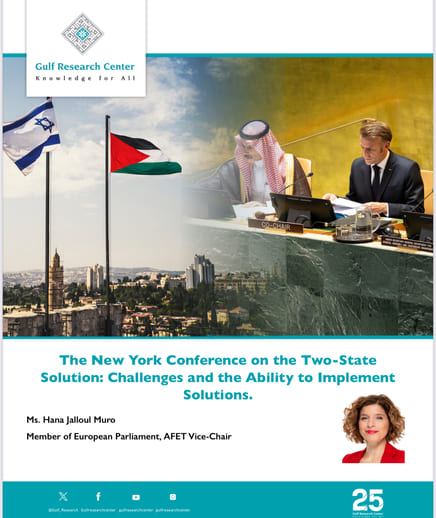
The New York Conference on the Two-State Solution co-hosted by Saudi Arabia and France last July represented one of the most relevant international attempts in years to map a path toward Israeli–Palestinian peace. Signed initially by seventeen states, the Arab League, and the European Union (EU), the “New York Declaration” was later adopted by the UN General Assembly on September 12 with 142 votes in favour and 10 against. It established a clear framework for resolving the ongoing conflict in Gaza and laid the foundation for durable peace prospects between the parties. Meaningfully, this marked the first occasion on which all 22 member states of the Arab League publicly condemned Hamas and called for its disarmament and the removal of its authority in Gaza.
Significant challenges remain for the construction of an autonomous and operational Palestinian state. At the European level, the greatest obstacle in addressing this dramatic situation and ultimately fulfilling the Two-State Solution has been the lack of a common consensus. The European Commission, Parliament, and Council had been very reluctant to implement substantive measures until last week’s Strasbourg plenary session, despite the ongoing genocide and humanitarian crisis in Gaza, where the death toll has reached almost 65,000. This hesitation and delay, stand in contrast to increasing international pressure, including actions by bodies such as the UN, ICJ with advisory opinions and the ICC with arrest warrants. Most recently, the UN Independent International Commission of Inquiry on the Occupied Palestinian Territory, in its September 16 report, explicitly characterized the crisis as genocide, underscoring the urgent need for coordinated action. Additionally, the limited recognition of a Palestinian state continues to block further progress, evidencing the big gap between declarations of support and real actions.
After all, the Two - State Solution cannot be fully implemented if one of the counterparts is not fully recognized. Recognition may be a necessary first step, yet it cannot stand alone: a financially and institutionally viable Palestinian state cannot emerge amid ongoingviolence. An urgent ceasefire and the release of hostages is imperative. At the same time, the continuous occupation and annexation policy of West Bank territories by extremist settlers, backed by Israel’s far-right government, must come to an end, and the 1967 borders be restored.
The EU’s most effective instrument to address this, while sending a clear message to the Netanyahu´s government, would be the full suspension of the EU–Israel trade agreement. Article 2 explicitly provides for suspension in cases of human rights violations.
On September 10, the President of the European Commission, Ursula Von der Leyen, addressed the debate on the State of the Union during the September Strasbourg plenary session. Taking a firm stand to preserve the political balance of her commission and, for the first time, the Commission promised to introduce significant measures regarding the critical situation in Gaza, while not fully suspending the Association Agreement. These measures included a proposal to the European Council for sanctions targeting extremist ministers and violent settlers, the partial suspension of such Agreement on trade-related matters, putting all bilateral help to Israel on hold, and the establishment of a Palestine Donor Group, which will include a dedicated instrument for the reconstruction of Gaza.
On 17 September, these measures were formally adopted, following an updated review of Israel’s compliance with Article 2 of the Agreement. The report finally found breaches including human rights violations, the worsening humanitarian crisis in Gaza, and settlement expansion in the E1 area, all undermining severely the prospects of the Two- State solution. Additionally, Commissioner for the Mediterranean Dubravka Šuica confirmed that the European Commission will support the Palestinian reform process with 1.6 billion euros over the next two years.
A day earlier Ursula Von der Leyen´s speech, on September 9, a resolution on Gaza was introduced for the first time under the plenary agenda. During the debate, HRVP Kaja Kallas took a weaker approach than President von der Leyen, and highlighted the EU’s ongoing efforts, noting that “things are getting done”. As examples, she referred to measures taken over the summer, after the initial review of Article 2 in late June. This mainly included a confidential humanitarian agreement she concluded directly with Israel which terms remain undisclosed to this day. The agreement clearly failed to address the severe food shortages in Gaza and continuous targeted civilian attacks in food distribution centres. This agreement contradicted the official EU position by stating that under no circumstances should the Gaza Humanitarian Foundation be permitted to manage said aid. Kallas further argued that the EU lacked consensus on stronger actions, insisting that this reflects how the Union functions and urging citizens to demand accountability from their prime ministers and national governments.
In contrast, Spain has shown great leadership on the matter. On September 8, Prime Minister Pedro Sánchez announced nine measures to counter the genocide in Gaza, including a permanent arms embargo on Israel, restrictions on Spanish ports and airspace for military transfers, and a ban on goods from illegal settlements among others. This set of actions follows Spain’s recognition of Palestine on 28 May 2024 along Norway and Ireland. A step that has since encouraged future recognitions from other EU and European countries such as Belgium, France, and the United Kingdom at the upcoming September 2025 UN General Assembly. Together with recognition, Spain already called for the suspension of the Association Agreement at the time. President Sánchez remains the only European leader invited to the 2025 Arab League Summit in Baghdad and has worked along Palestinian Authority on the protection of the civilian population and compliance with legal and humanitarian obligations in Gaza.
At the launch of Spain’s Foreign Action Strategy 2025–2028, the Foreign Minister confirmed that it will include specific measures for Gaza. Additionally, Teresa Ribera, Spain’s EC Executive Vice-President, became the highest-ranking EU official to describe Israel’s war on Gaza as genocide during a recent speech at Sciences Po University. Most recently, Spain´s executive has conditioned its participation in the Eurovision Song Contest on Israel’s participation, a significant move given Spain’s status as a major donor. Similarly, in the sports arena, following massive demonstrations during the “La Vuelta” cycling event, the Spanish Sports Council has formally requested to exclude Israel from international all sporting competitions, arguing that double standards are unacceptable and highlighting that Russia was previously expelled under similar circumstances.
Lastly, as Spain’s head of state, King Felipe VI recalled on September 17, Spain’s support for the creation of a Palestinian state, including Gaza, the West Bank, and East Jerusalem, following his meeting with President Abdel Fattah el-Sisi in Cairo.
Returning to the EU, delivering tangible results on Middle East peace and security requires strengthening its political, social, trade, and economic partnerships with the Gulf states. Over the past two years, the EU–GCC partnership has gained remarkable momentum.
The 2022 Joint Communication on a Strategic Partnership with the Gulf established a roadmap for deepening ties, followed by the first-ever EU– GCC summit in Brussels on 16 October 2024. The next summit is expected to take place in Saudi Arabia in 2026. More recently, the Council of the European Union authorized negotiations with all six GCC member states—Saudi Arabia, the United Arab Emirates (UAE), Qatar, Bahrain, Oman, and Kuwait—towards the conclusion of bilateral Strategic Partnership Agreements (SPAs).
Such momentum represents the interest for a strategic partnership based on common values. The six GCC countries have emerged as reliable and decisive partners in conflict resolution and regional stability. This leadership has revealed itself through its role regarding the dramatic situation in Gaza. A massacre characterized by atrocities, targeted attacks on journalists, and a humanitarian crisis and driven by the extreme policies of Israel’s far-right government. It should be remembered that the GCC was among the first to condemn the October 7 attacks in a joint statement with the EU. Additionally, during their recent Ministerial Council, the GGC states reiterated and praised both their shared commitment and the nationbased efforts toward advancing peace.
Saudi Arabia has taken great leadership by co-hosting The New York Conference on the Two-State Solution, while linking the normalization of relations with Israel with to the end of violence in Gaza. Parallelly, Qatar has taken a central role in facilitating ceasefire negotiations. Following recent developments in the country, the European External Action Service (EEAS) condemned Israel’s violation of international law following unlawful airstrikes targeting Hamas leaders. It should be recalled that the EU and partners designates Hamas as a terrorist group, and in 2024 imposed new sanctions on Hamas, Palestinian Islamic Jihad, and affiliated individuals.
The six GCC members are increasingly decisive regional actors, maintaining diplomatic channels with both Tel Aviv and Tehran, and exerting influence in global forums such as the G20 and OPEC+. Saudi Arabia and Qatar have taken steps to reintegrate Syria financially and diplomatically. Beyond the Middle East, the GCC has expanded its regional diplomatic reach to host peace talks on Africa and Europe´s conflicts, including RussiaUkraine talks in Saudi Arabia and Democratic Republic of Congo (DRC) and the M23 faction in Qatar. These actions underscore the GCC’s consistent commitment to promoting regional peace, making them indispensable partners for the EU in shaping a framework for Middle East security and coordinated action.
While the GCC countries have proven to be reliable and strategic partners, stereotypes and misconceptions remain a challenge for full engagement and effective cooperation. In addition to these perceptions, a limited understanding of the Gulf region’s history and the broader Middle East dynamics further complicates the process within the EU.
On October 4, I presented the draft of my Own Initiative Report (INI) in the Committee on Foreign Affairs (AFET), in my capacity as Vice-Chair and Rapporteur for Saudi Arabia. The report focuses on the relations between the EU and Saudi Arabia.
The initial feedback was very positive, with support from the present political groups in the AFET Committee. The final report will be presented during the upcoming month of December.
This report will play a key role in shaping future efforts, as we continue to work toward a broader, multi-institutional approach regarding EU-GCC cooperation. Such collaboration is central not only for the EU’s engagement in the Middle East but also for its broader strategy of cultivating reliable partners amid the shifting dynamics of the transatlantic relationship.
In conclusion, the GCC countries are indispensable partners in advancing the TwoState Solution and the EU’s Middle East peace and security strategy. Strengthening this partnership is crucial, particularly given the active role of Saudi Arabia and other GCC members in peace talks involving Palestine and broader regional peace, as well as their influence in Lebanon and Syria. Multilateral efforts through hosting regional peace negotiations, such as Ukraine-Russia and DRC-M23, are solid evidence for this commitment. Strong leadership is essential to ensure a fair and just solution for the long-lasting conflict, while providing a peace and security framework for both Israel, Palestine and the region. It is crucial to prevent further loss of life on the current genocide in Gaza, which has already reached nearly 65,000, and stop the brutal annexation policies pursued by Israel’s far-right government. Likewise, we shall not forget to support Israeli civil society, which continues to mobilize against Netanyahu’s brutality and its obstruction regarding the necessary hostage releases. By working together, the EU and GCC can foster conditions for regional progress, advance shared goals, and strengthen cooperation in areas such as peace, trade, technology, science, and culture.
Ms. Hana Jalloul Muro Member of European Parliament, AFET Vice-Chair