
Commentary & Analysis
The Road to Palestinian Statehood and Latin America’s Convergence with the Gulf
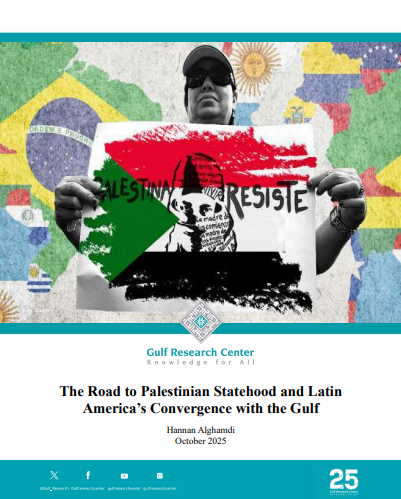
Latin America’s position on Palestinian statehood has evolved from symbolic recognition to legal, diplomatic, and institutional advocacy. Long a region supportive of anti-colonial movements, Latin America has emerged as one of the most assertive blocs in global diplomacy on Palestine, forging unexpected synergies with Arab Gulf states amid the 2023–2025 Gaza crisis. While early recognitions of Palestine dominated the 2010s, the violence in Gaza and the humanitarian catastrophe that followed in 2023 catalyzed a transformation in approach - one that shifted from rhetorical solidarity to practical statecraft and pressure mechanisms.
The turning point came during the 80th session of the United Nations General Assembly (UNGA) in 2025, where several Latin American nations not only reiterated their commitment to Palestinian statehood but deepened it through legal actions, diplomatic penalties against Israel, and alignment with international mechanisms such as the International Court of Justice (ICJ). The Community of Latin American and Caribbean States (CELAC) Summit in 2024 marked a milestone, as 24 member states condemned Israel’s actions and endorsed the Genocide Convention proceedings brought forth by South Africa.
Notably, countries like Brazil and Colombia took the lead. Brazilian President Lula da Silva supported ICJ jurisdiction over Israeli actions, referring to them as genocidal, while Colombia’s President Gustavo Petro went further by cutting diplomatic ties with Israel and suspending arms imports from Tel Aviv. Petro’s speech at UNGA 80 labeled the Assembly a "mute witness to genocide," illustrating a readiness to confront both Israel and its allies. Despite diplomatic backlash, including the revocation of Petro’s U.S. visa, Colombia’s stance symbolized a regional shift and willingness to pay political costs for upholding international law.
This Latin American assertiveness is not uniform. Countries such as Panama, Honduras, and Argentina either opposed or abstained from the 2025 UN vote on the "New York Declaration"- a joint Saudi–French initiative calling for a two-state solution, Hamas disarmament, and an internationally backed recognition of Palestine. Panama remains the only country in the region that has not recognized Palestine, in a strategic alignment with the United States and Israel, reinforced by economic and military partnerships, that positions it at odds with the broader Latin American consensus. Argentina and Honduras, while having previously recognized Palestine, refrained from endorsing the Declaration, likely to avoid antagonizing Washington amid shifting global dynamics.
Nonetheless, the broader trend is clear: Latin America has moved toward a position of strategic convergence with the Arab Gulf. While the former emphasizes normative and legal statecraft, the latter wields financial and diplomatic leverage, especially in forums tied to normalization with Israel. Together, they have forged a new coalition of influence, one that challenges traditional Western gatekeeping in global humanitarian and legal norms.
Although the Gulf and Latin American regions differ in their institutional affiliations - Gulf states being part of the Arab League and GCC, while Latin America operates through CELAC, MERCOSUR, and UNASUR - their responses to Gaza reflect a convergence on core principles: humanitarian law, sovereignty, accountability, and conditional engagement with Israel.
This convergence has practical implications. While Latin America brings normative credibility and legal advocacy to the table, Gulf states offer normalization leverage, economic influence, and regional access. Together, they form a transregional pressure network capable of challenging impunity and disrupting the diplomatic status quo traditionally dominated by Western powers.
The success of this model has drawn praise across the Global South and represents a broader shift toward multipolar diplomacy. It also complicates the posture of Western states attempting to remain "balanced" while maintaining military support and diplomatic cover for Israel. The transregional coalition, anchored by Latin American moral authority and Gulf institutional leadership, creates a difficult environment for ambiguity.
The complementarity between these efforts is important. The Saudi–French initiative supplies the political architecture for a post-conflict resolution. Qatar’s mediation provides the logistics and channels for implementation. Latin American nations, through legal avenues and diplomatic forums, validate the normative foundations of these efforts. In this way, the road to Palestinian statehood is not only being shaped by traditional Arab stakeholders but increasingly by Latin American states who are redefining what solidarity and accountability look like in a fractured international order.
Yet, Panama’s divergence, and the hesitancy of Argentina and Honduras, serve as reminders that strategic calculations still moderate universal consensus. Still, the broader picture is of a diplomatic geometry in which the Global South is no longer reactive. It is now designing initiatives, building coalitions, and shifting the normative baseline of what peace requires.
Latin America, in partnership with Gulf states, is playing a central role not only in advocating for recognition but also in building the institutional framework necessary to realize it, paving roads to Palestinian statehood through Brasília, Bogotá, Riyadh, and Doha, not just Washington, Brussels, or Tel Aviv.
*Hannan Alghamdi is a Researcher at the Gulf Research Center (GRC)