
Commentary & Analysis
From the Mediterranean to the South Caucasus – A Shifting Balance of Power between Russia and Turkey
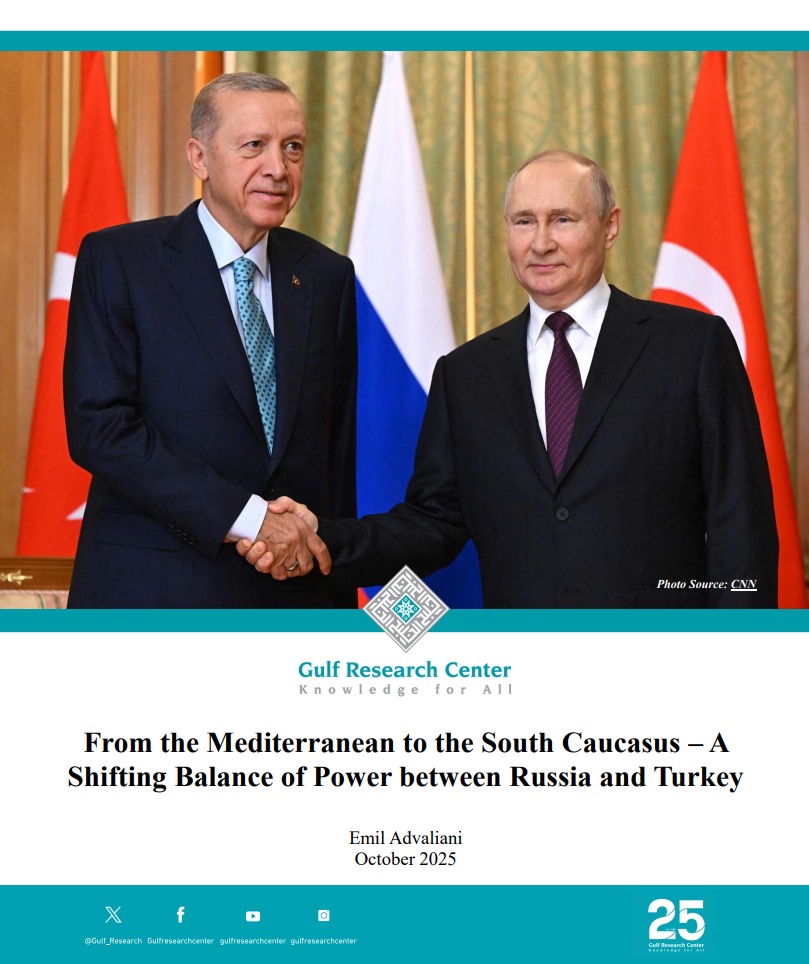
The current relations between Russia and Turkey are characterized by a multifaceted blend of competition and cooperation. From Libya to Syria and into the South Caucasus, Ankara and Moscow have built a complex amalgam of bilateral engagements ranging from economic and military cooperation to direct competition. The transactional manner of their bilateral relations has proved highly beneficial to both sides. Despite Turkey’s alignment with the West through membership in NATO and on broader issues such as Ukraine, Moscow and Ankara have managed to maintain overall good working relations. The mutual capacity to inflict substantial harm on one another has been a powerful incentive, pushing the two powers to prioritize cooperation over confrontation. Although the balance of power between Turkey and Russia has been historically shaped by geopolitical changes, the transformation that has taken place over the past year seems to be more fundamental, as it affects nearly all dimensions of their engagement--from the Mediterranean to the South Caucasus. Yet, Russia has had little room to maneuver, while Turkey has expanded its influence and involvement across the region.
Libya
A shift has taken place in Libya where since the onset of the second Libyan civil war of mid-2014, Russia and Turkey have supported opposing sides—Moscow supporting the eastern-based government in Benghazi and Ankara aligning with the internationally-recognized authorities in Tripoli. Nevertheless, the two powers have been able to maintain stable relations, largely due to the recognition that the costs of direct confrontation would far outweigh cooperation or even managed competition. Indeed, both countries see Libya as a springboard for greater geopolitical engagement across the Mediterranean and into the African continent.
The Libyan battlefield represents only one dimension of the expanding Russian and Turkish presence across the Middle East and neither side has sought a major escalation in Libya, as such a development could disrupt the delicate balance of power that they both seek to maintain across the region and beyond. For example, when the leader of the eastern-based government, Field Marshal Khalifa Haftar, wanted to seize Tripoli in 2019 and 2020, rather than confront each other, Russia and Turkey chose to maintain the status quo. This fit into their cooperation model elsewhere.
Recently, relations between the eastern-based government and Turkey have begun to improve, thereby altering the Russo-Turkish balance. The Benghazi government, which had previously opposed Tripoli’s attempts to ratify a maritime deal with Ankara, shifted its stance, and in June 2025, following Haftar’s son Saddam’s visit to Ankara where he met with Turkish officials, the announcement was made for potential ratification of the document. A month later, Haftar’s troops took part in joint drills with the Turkish military.
Libya’s eastern-based government has traditionally maintained close ties to Russia, largely due to the limited range of foreign actors willing to engage with Benghazi. For Haftar, Russia has represented a means of garnering international recognition, diplomatic support, and military cooperation to counterbalance Tripoli’s more expansive web of international connections. Benghazi’s recent outreach to Ankara is not necessarily driven by an anti-Russian turn, nor is Turkey’s move to develop closer ties with the eastern-based government an anti-Russian shift. Indeed, Ankara is more concerned with the competition with Greece which has claims on vast undersea territories for gas exploration south of Crete. Improved ties with Benghazi are therefore more motivated by Ankara’s strategic priorities vis-à-vis Athens than by delivering a blow to Moscow. Nevertheless, Benghazi’s expansive cooperation with Turkey will make a mark on the extent of its dependence on Moscow. The availability of a broader range of partners will serve as a powerful tool for Benghazi to enhance international legitimacy, thereby reducing its reliance on Russian support.
Syria
Nowhere has the shifting balance of power been more visible than in Syria where in December 2024, the Assad dynasty – Russia’s close ally – lost control over the wartorn country. The unexpected loss of its Syrian ally stripped Moscow not only of a key partner in the Middle East but also undermined the link between Russia and the African continent where Russian mercenaries have been actively engaged in economic and security spheres. While Russia’s influence in Syria was critical for balancing Turkey and Iran and positioned it as a valuable actor in the eyes of the influential Arab states of the Gulf region (who are particularly interested in keeping Iran’s influence in check), Moscow was deep in the trenches of its war with Ukraine.
Similar to in Libya, Turkish support for the new Syrian leadership is not necessarily about purposefully limiting Russian influence. Nevertheless, Ankara’s geopolitical activism has shifted the balance of power on the ground, and not in Russia’s favor. Yet, the shifting balance of power does not mean that Russia has irreversibly lost its position in Syria.
On the contrary, Moscow has been actively working to regain parts of its former geopolitical influence. Since the beginning of this year, it has sent two delegations to Damascus for negotiations over the fate of two Russian military bases on Syria’s seashore; Russian President Vladimir Putin held a phone call with the new Syrian leadership; and the Syrian Minister of Foreign Affairs visited Moscow just prior to Damascus’ decision to allow Russian military patrols into parts of the country. Ultimately, Syria continues to view Russia as a counterweight against Israel, whose growing regional dominance and preference for a weaker Syrian state require a safeguard against any potential future threat to Syrian security.
Yet, even if Russia manages to retain its military presence in Syria, its operational scope is unlikely to reach Assad-era levels. In contrast, Turkey has had an upper hand in Syria, with Damascus now enjoying Ankara’s full support in security and the development of economic ties for its reconstruction. Recent reports also indicate the potential deployment of Turkish military assets to Kuweires in eastern Aleppo Province, coupled with Ankara’s pledge to establish several military bases across the country. This growing Turkish footprint not only enhances Ankara’s leverage over Syrian decision-making but also reshapes the broader regional balance of power, diminishing Russia’s relative influence over the Levant.
South Caucasus
Further eastward, in the South Caucasus which Russia considers to be part of its sphere of influence, Turkey has made major inroads via infrastructure projects and development of bilateral ties with the region’s three countries – Armenia, Azerbaijan, and Georgia.
A key development took place on August 8, 2025, in Washington D.C., when the leaders of Armenia and Azerbaijan signed a document known as the TRIPP, that allows for further normalization of ties between Baku and Yerevan. The two countries had been in conflict since the late 1980s over the self-declared NagornoKarabakh enclave. With the dissolution of the enclave in September 2023 and Russia’s preoccupation with the war in Ukraine, the opportunity emerged for reconciliation between Armenia and Azerbaijan. More importantly, this track of normalization paved the way for parallel diplomatic activity between Turkey and Armenia, whose borders and formal diplomatic contacts had been severed since the 1990s. Since 2023, Yerevan and Ankara have been pushing for normalization of bilateral relations. In a latest effort, on September 12, 2025, a meeting between Armenia and Turkey's special representatives for the normalization process, Ruben Rubinyan and Serdar Kılıç, took place in Yerevan. The two sides reaffirmed their commitment to continuing the process of dialogue, emphasizing the importance of cooperation for the entire region.
Though Turkey does not directly feature in the TRIPP agreement, which stipulates easy overland access from Azerbaijan proper to its exclave of Nakhchivan via Armenia’s territory, Ankara is seen as the biggest winner. TRIPP is an opportunity for Ankara to diversify commercial routes across the South Caucasus. Until now, Turkey enjoyed only one transit route to the Caspian Sea – the Middle Corridor – passing through Georgia and consisting of roads, railways, and pipelines. Right after the signing of TRIPP, the Turkish side unveiled the start of construction of the KarsIğdır-Aralyk-Dilucu railway line, which will become a key element of the corridor. The project will cost up to €2.4 billion and is set to serve as yet another link for China-EU trade. More importantly, the corridor will sideline Ankara’s chief competitors--Russia and Iran-- in the South Caucasus.
Though the South Caucasus lies geographically closer to Russia than the Mediterranean, Moscow’s position seems to be increasingly challenged by Turkey’s growing engagement in the region. New infrastructure and improved relations with Armenia will allow Ankara to shift the status quo in its favor.
Looking Ahead
The region extending from Libya to Syria and into the South Caucasus represents a strategic area where the balance of power between Turkey and Russia is continuously contested. This balance has been fluid, with shifts in territorial control and political influence constantly in flux and fallbacks in one dimension often compensated with gains in another. What is happening now, however, is qualitatively different, signaling a potentially more profound realignment in the Ankara-Moscow power dynamic that seems to tilt toward Ankara. Of particular discomfort for Russia, is that its capacity to reverse this trend is limited, given its ongoing war effort in Ukraine.
The shifting balance of power in Russo-Turkish relations has an impact upon the broader Middle East as well, especially for the states of the Gulf Cooperation Council (GCC). This has been evident in the way Russia has moved to increase its engagement with the Gulf states as a means of alleviating the decline of its influence elsewhere in the region. Indeed, since early 2025 Moscow has actively engaged with Oman, Qatar, the UAE, and Saudi Arabia through bilateral visits and increased political and investment cooperation.
The upward trajectory in GCC-Russia relations is exemplified in the expanding cooperation between Russia and Oman. For instance, in April 2025, Oman’s Sultan Haitham bin Tariq Al Said visited Moscow to meet with Russian President Vladimir Putin, marking the first-ever visit by a head of state of Oman to Russia. During the visit, multiple cooperation agreements were signed, including one granting mutual visa-free travel for nationals of the two countries. Also in April, Qatar’s Emir Sheikh Tamim bin Hamad Al Thani paid a visit to Moscow where he met with President Putin to discuss bilateral economic relations and regional geopolitical developments. Relations between Russia and Qatar are characterized by pragmatism. Indeed, Moscow views Qatar not as a rival or a direct ally of the United States, but as an increasingly independent partner whose connections in the Middle East and Africa are strategically important for Russia as it seeks to expand its influence in these regions.
The GCC countries have their own, distinct motivations for cultivating closer relations with Russia. The war in Ukraine is seen by the Arab states as a distant conflict, prompting them to tread a middle path so as not to alienate either side. With that in mind, the GCC recognizes how Russia is increasingly pivoting toward the Global South. Russia’s economic reorientation thus presents an opportunity for the wealthy Arab countries, which are actively pursuing diversified economic relations as part of their broader post-oil development strategies. Such efforts require new partners and investments from major actors with relevant experience, and Russia is increasingly viewed as one such power.
To conclude, Russia and Turkey are neither allies nor partners. Rather, they are engaged in a blend of competition and cooperation when it comes to their involvement in Libya, Syria, and into the South Caucasus. This transactional type of relationship will remain a hallmark of their bilateral relations: short of direct confrontation but nevertheless able and willing to grasp the benefits of each other’s weaknesses.
Emil Avdaliani is a professor of international relations at the European University in Tbilisi, Georgia, and a scholar of Silk Roads. He can be reached on Twitter/X at @emilavdaliani.