
Commentary & Analysis
The Evolution of Saudi-Pakistani Security and Military Relations
From Bilateral Cooperation to the Engineering of New Balances in the Gulf and South Asia
Introduction
Security and military relations between the Kingdom of Saudi Arabia and the Islamic Republic of Pakistan are key strategic pillars of their alliance network. These ties originated in the wake of Pakistan’s independence in 1947, when the Kingdom was quick to recognize it and extend political and economic support. This relationship was not circumstantial but developed over decades into a partnership based on shared Islamic identity, mutual interests, and common regional challenges. With the signing of the Strategic Defense Agreement in 2025, relations are expected to enter a new phase—one that could redefine the concept of Islamic collective security within a balanced framework, encompassing deterrence, mutual dependence, and geopolitical flexibility. This paper examines the details that have been revealed about the agreement, as well as its merits and future implications, by tracing the historical trajectory of Saudi-Pakistani relations, and the history of joint security and military agreements and maneuvers.
The Historical Path of the Saudi-Pakistani Partnership
Saudi-Pakistani relations are a model of deeprooted strategic ties, having developed in successive stages from the mid-20th century to the present day to encompass political, economic, security, and military dimensions. The historical context of this partnership can be traced as follows:
1. The Founding Phase (1947–1960) Saudi Arabia was one of the first countries to recognize the independent state of Pakistan, extending political and moral support in international forums. From the outset, the relationship was linked to a shared Islamic identity, with Pakistani leaders viewing Saudi Arabia as the guardian of the Islamic world. The first phase saw diplomatic and economic cooperation that paved the way for subsequent security convergence in the face of early regional challenges.
2. Deepening Cooperation (1960–1979) With regional threats escalating, especially following the India–Pakistan wars, Saudi Arabia deepened its military cooperation with Islamabad. Pakistani military experts participated in training Saudi forces, particularly in the areas of aviation and air defense. A defense cooperation agreement was signed in 1967, which established the exchange of military personnel and laid the institutional foundation for defense cooperation.
Pakistan’s role was highlighted during the occupation of the Grand Mosque in Mecca in 1979, when Pakistani special forces helped restore control, thereby strengthening political and security trust between the two countries.
3. Strategic Partnership Phase (1980–2001) The 1980s was a golden decade for defense cooperation between Saudi Arabia and Pakistan. The Soviet invasion of Afghanistan and the Iran-Iraq War led to the institutionalization of cooperation through the 1982 Joint Defense Protocol, which resulted in the establishment of the Saudi-Pakistani Armed Forces Organization (SPAFO). More than 20,000 Pakistani soldiers were stationed in the Kingdom, mainly in Tabuk and the Eastern Province, for training and operational roles. At Riyadh’s request, Pakistan also deployed more than 11,000 soldiers to safeguard its borders and holy sites during the Gulf War (1990–1991). Furthermore, Saudi Arabia supported Pakistan economically in the face of Western sanctions following its 1988 nuclear tests, supplying it with oil at preferential prices.
4. The Counterterrorism Phase (2001–2010) Following the events of September 11, 2001, counterterrorism emerged as a key pillar of bilateral relations, through intelligence sharing, security training, and countering al-Qaeda and other similar organizations. The Pakistani military also continued to send advisers to the Kingdom to enhance border security and protect vital installations.
5. Regional Alliances Phase (2011–present) Pakistan joined the Islamic Military Counter Terrorism Coalition, which was announced in Riyadh in 2015. Pakistani General Raheel Sharif took command of the Islamic coalition in 2017, signaling Saudi confidence in Pakistan’s capabilities.
Although the Pakistani parliament refused to
send troops to fight in Yemen, the two countries
continued their security coordination and joint
training exercises. Saudi and Pakistani forces
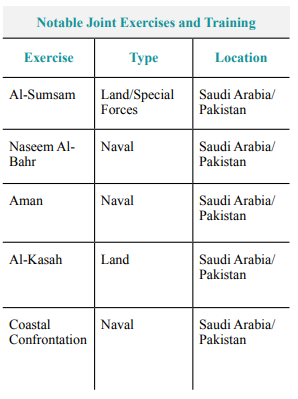
participated in multiple exercises such as
Samsam, Naseem al-Bahr, and Aman, laying the
foundation for a joint operational culture.
The Institutional Structure of Joint Security
and Military Agreements
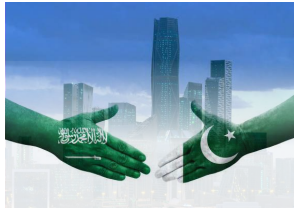
The security and military cooperation system between Riyadh and Islamabad includes a set of supporting agreements, most notably:
- Treaty of Friendship
- Air Services Agreement
- Extradition Agreement
- Defense Cooperation Protocol/Defense Agreement
- Scientific and Technological Cooperation Agreement
- Technical and Vocational Training Agreement
- Strategic Agreement on Joint Defense (2025)
These agreements function as an interconnected system covering traditional security, air defense, maritime cooperation, countering unmanned aerial vehicles, joint training, and the development of defense industries.
The Key to Growing Security and Military Relations Saudi diplomacy also helped defuse a conflict that was escalating over the disputed region of Kashmir. The year 2025 saw the culmination of this process with the signing of a joint strategic defense agreement, which stipulated that any attack on one party would be considered an attack on the other. This confirmed the transition of the relationship from defensive coordination to a joint deterrence alliance, with continued Saudi economic support for Pakistan through concessional loans and oil supplies, reinforcing the integrated nature of the partnership.
The key behind the strength of Saudi-Pakistani relations lies in the convergence of their strategic interests across multiple domains. Saudi Arabia has found in Pakistan a reliable military and nuclear power of strategic weight in South Asia- -one capable of contributing to regional balance and deterrence. Conversely, Pakistan has found in Saudi Arabia an economic and political partner that provides financial support, energy resources, and diplomatic cover in international forums. The shared Islamic dimension was also evident in Saudi Arabia’s leadership of the Islamic Military Counter Terrorism Coalition, headed by a retired Pakistani commander, giving the relationship a broader dimension that transcends bilateral ties.
Thus, it can be said that the basis to the growth of these relations lies in the intertwining of religion, politics, security, and economics. Saudi Arabia represents the spiritual and economic foundation, while Pakistan serves as the military arm with nuclear capability. The fusion of these two dimensions has given rise to a unique strategic alliance that goes beyond the framework of traditional cooperation and is poised to further expand in response to emerging regional and international challenges.
Reading the Strategic Defense Agreement (2025) The Saudi-Pakistani defense agreement of 2025 represents a strategic shift in regional security architecture. But it is not a military alliance in the same sense as NATO. Rather, it is a flexible deterrence agreement based on interoperability and defense integration without entanglement in foreign wars.
2. In South Asia The agreement does not translate into a nuclear umbrella, as Pakistan’s nuclear doctrine is primarily directed towards India, while Saudi Arabia is committed to a policy of nuclear nonproliferation and the development of conventional and missile deterrence. The practical dimensions of the agreement focus on readiness, air defense, maritime security, countering drones, and the exchange of operational expertise. In addition, the agreement sends a message to New Delhi that Riyadh is seeking regional stability rather than alignment, aiming to protect its economic interests with India while avoiding direct involvement in the Pakistan-India conflict.
Strategic Implications and New Balances
1. Calculated deterrence without escalation: The
agreement reinforces regional deterrence and
encourages the Gulf states to diversify their
defense partnerships, as this diversification
raises the cost of aggression against any
Gulf state without dragging the region into
complex formal alliances.
2. Sharing the defense burden: Saudi-Pakistani
cooperation fills gaps in manpower, training,
air defense, and logistics, reducing complete
dependence on Western forces.
3. Strategic flexibility: Saudi Arabia maintains
its balance between Washington and Beijing,
while Pakistan balances its ties to China with
its openness to the Gulf, creating a network
of intersecting interests.
4. Enhancing Gulf self-security: The agreement
reframes the concept of collective defense in
the Gulf on Islamic and Asian foundations,
not just Western ones.
5. Calculated strategic independence: The
agreement enables Riyadh to maintain its
growing economic relations with India
while keeping a safe distance from regional
tensions, contributing to a more stable and
pragmatic foreign policy.
Challenges to the Continuity of SaudiPakistani Security and Military Relations
Despite the depth of Saudi-Pakistani relations,
their continuity faces some challenges that may
affect their momentum, most notably:
1. The balance between divergent
international alliances: Pakistan is linked
to China, while Saudi Arabia seeks to
diversify its partnerships between the
West and the East.
2. Pakistan’s internal economic and political
situation and the accompanying volatility
that may limit its foreign commitments.
3. Differing security priorities: Saudi Arabia
focuses on Gulf security, while Pakistan is
preoccupied with India and Afghanistan.
4. Sensitivity towards Riyadh’s growing
relations with India and the apprehension
this may provoke in Islamabad.
5. Parliamentary restrictions and Pakistani
public opinion on sending troops to
participate in foreign conflicts.
The Future of Saudi-Pakistani Security and Military Relations The future of Saudi-Pakistani relations is heading into a more mature and sustainable phase, transcending the traditional nature of military cooperation to a comprehensive strategic partnership that extends to security, defense, military industries, and advanced technology.
With the signing of the 2025 Strategic Defense Agreement, the relationship is moving from bilateral coordination to an institutional defense alliance grounded in the principles of collective security and deterrence of regional threats. This development opens the door to the establishment of an integrated security architecture in the region—one that leverages Pakistan’s military capabilities and Saudi Arabia’s growing technical expertise. Although some observers question its full practical applicability for various reasons, the agreement nonetheless represents a qualitative development in the framework of Islamic defense cooperation. Its gradual implementation through joint coordination and planning mechanisms establishes a flexible structure that enhances deterrence and enshrines the concept of collective security, without compromising the national sovereignty of either party.
Saudi Arabia and Pakistan also seek to localize defense industries and exchange knowledge in the fields of military manufacturing, unmanned aerial vehicles, and smart systems, thereby enhancing self-sufficiency and reducing dependence on external suppliers. In this context, Saudi-Pakistani companies are expected to be established to design and produce defense equipment and train national cadres. At the regional level, the Saudi-Pakistani alliance is likely to play an increasingly important role in maintaining stability in the Gulf and South Asia, especially given escalating terrorist threats and cross-border challenges.
In connection to Saudi Arabia’s Vision 2030, defense cooperation with Pakistan could serve as a successful model for integrating investment and security into a single system that advances shared interests. It also lays the groundwork for a balanced Islamic alliance combining Saudi economic depth with Pakistani military capabilities, making this alliance one of the most important pillars of security and stability in the Arab and Islamic worlds.
Conclusion
The historical trajectory and strategic analysis of
Saudi-Pakistani relations show that the alliance
has evolved from a bilateral cooperation, to
a cornerstone of emerging security systems,
reinforced by religious dimensions and a shared
Islamic identity--perhaps even the nucleus
of a joint Islamic peacekeeping alliance. The
2025 Strategic Defense Agreement doubles
capabilities, promotes self-reliance, and
establishes diverse defense partnerships in the
face of a rapidly changing global order. While
the United States remains the primary security
partner for Saudi Arabia, cooperation with
Pakistan introduces a new model of calculated
deterrence and intelligent integration, positioning
this alliance as a potential paradigm for regional
security in the 21st century.
Dr. Abdulaziz Sager Founder & Chairman of the Gulf Research Center (GRC)