Commentary & Analysis
Gulf–East Asia Synergies: Qatar, Saudi Arabia, Japan, and South Korea as Emerging Peace Mediators in Gaza and the Middle East
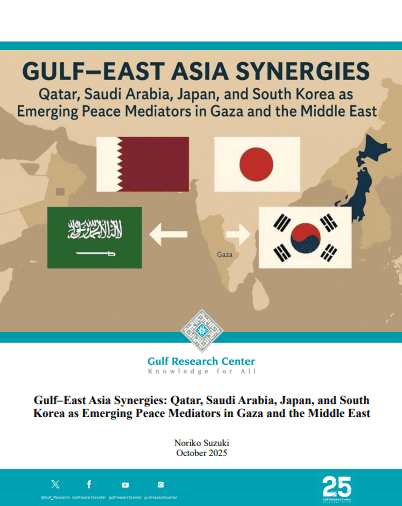
The recurrence of violence in Gaza and the wider Middle East has exposed the limits of traditional, Western-dominated peace frameworks that have long attempted to manage the region’s crises. Despite repeated ceasefires, reconstruction pledges, and the engagement of global powers, the region continues to experience cyclical instability. The collapse of the early 2025 ceasefire— brokered by the United States, Qatar, and Egypt—after renewed Israeli airstrikes in March underscored both the fragility of existing diplomatic arrangements and the urgent need for new coalitions capable of combining legitimacy, neutrality, and technical capacity. Uncertainty also surrounds the current ceasefire, as tensions remain high and mutual trust between parties is still fragile.
In this context, a partnership among Gulf and East Asian middle powers—with a focus on Qatar, Saudi Arabia, Japan, and South Korea—offers a potentially transformative approach to mediation and post-conflict recovery. Their collective experience in diplomacy, financial support, and developmental assistance provides an alternative model for conflict resolution in Gaza and the wider Middle East—one grounded not in power projection but in credibility, cooperation, and pragmatic implementation.
In October 2025, cautious optimism emerged as Israel and Hamas agreed to a phased ceasefire following months of indirect negotiations facilitated by Qatar, Egypt, and the United States. The new arrangement includes a large-scale prisoner–hostage exchange, under which Israel began releasing Palestinian prisoners in exchange for Israeli captives held in Gaza. This development marks a tentative step toward de-escalation, though the situation remains fluid as further exchanges and negotiations continue.
As part of the ceasefire’s first phase, Israeli forces have initiated a gradual withdrawal from parts of Gaza, while maintaining observation and limited security control over key border areas. The pullback, verified by international observers, has allowed tens of thousands of displaced Palestinians to begin returning to their homes in the northern Gaza, though they are confronted by widespread devastation and shortages of food, water, and medical supplies [5]. International organizations, including the United Nations and the Red Crescent, have intensified aid delivery under the truce, yet logistical constraints and the extensive destruction of infrastructure continue to hamper relief efforts.
Diplomatically, Egypt announced a high-level peace summit in Sharm el-Sheikh, inviting more than thirty world leaders to consolidate the ceasefire and coordinate reconstruction commitments [6]. The summit, held on 13 October 2025, marked a tentative shift toward multilateral burdensharing, even as Israel and Hamas declined to participate directly. Discussions centered on stabilizing the truce, structuring humanitarian access, and creating a transitional authority for Gaza. Notably, the United Nations reported that over thirty countries had signaled willingness to contribute to Gaza’s estimated US $70 billion reconstruction, underscoring both the scale of devastation and the growing global recognition that rebuilding Gaza is a collective responsibility.
The humanitarian situation in Gaza has reached unprecedented levels of devastation since the resumption of hostilities in early 2025. Airstrikes and ground incursions have displaced hundreds of thousands, destroyed vital infrastructure, and pushed the population to the brink of famine and medical collapse. Internally, the legitimacy of Hamas has eroded as residents express growing frustration over governance failures. Protests erupted across Gaza by mid-2025, with demonstrators demanding transparency, leadership accountability, and a resolution to the endless conflict. These rare displays of public dissent reflect both exhaustion and a deep desire for political transition within Palestinian society. Yet these demonstrations have been met with repression, further illustrating the fragmentation of Gaza’s political structure, resulting in a territory divided not only by physical destruction but by competing centers of authority, social disillusionment, and localized governance. Such conditions render conventional peace diplomacy ineffective; traditional mediators often seek to negotiate with unitary actors, but in Gaza, authority itself has become diffuse and contested. Hence, new mediation models must be adaptive, inclusive, and technically grounded—capable of addressing both governance fragmentation and urgent humanitarian realities.
Qatar, Saudi Arabia, Japan, and South Korea together embody a unique blend of capabilities and credibility that could underpin a new model of middle-power diplomacy. Qatar’s niche strength lies in its agility and access to non-state actors. Over the past decade, Doha has built a reputation as an effective and trusted intermediary, facilitating communication between groups that refuse to engage directly with Western powers. Its mediation in hostage releases, humanitarian pauses, and prisoner exchanges has earned it recognition even among rivals. Saudi Arabia, by contrast, brings religious legitimacy, political weight, and financial capacity. As the custodian of Islam’s two holy sites and a key member of the G20, Saudi Arabia’s engagement lends both symbolic and material support to any regional initiative. Its ability to convene broad Islamic and Arab coalitions, coupled with its financial influence, positions Riyadh as an anchor for collective reconstruction financing.
Japan contributes a distinctive form of diplomacy rooted in neutrality and long-term development. As a civilian power, Japan has cultivated credibility as an impartial donor focused on capacitybuilding, human security, and good governance. Its decades-long support for Palestinian statehood—through the Japan International Cooperation Agency (JICA), United Nations agencies, and multilateral trust funds—demonstrates both consistency and effectiveness. Tokyo’s involvement adds a stabilizing, non-political dimension to any peacebuilding framework. South Korea, meanwhile, complements these strengths with advanced technological and engineering capabilities. Its experience in digital governance, rapid infrastructure restoration, and disaster response is precisely what Gaza will need in post-conflict reconstruction. Moreover, Seoul’s aspiration to act as a global pivotal state reflects its growing ambition to contribute proactively to global stability through practical cooperation rather than ideological alignment. Together, these four states represent a cross-regional partnership grounded in shared values of pragmatism, noninterference, and developmental responsibility.
These complementary capacities can be institutionalized through a coordinated framework—what may be termed a Gulf–East Asia Mediation Axis (GEMA). Such a coalition could address three structural weaknesses that have long impeded peace in Gaza. First, it would reduce the perception of bias associated with Western-led initiatives by introducing mediators viewed as neutral and nonhegemonic.
None of the four countries have colonial or military legacies in the region, and their engagement would be perceived as cooperative rather than coercive. Second, it would integrate diplomacy with development, linking ceasefire negotiations to immediate reconstruction efforts. The ability to deliver tangible improvements—such as restored electricity, water, and healthcare—would lend credibility to political agreements and sustain local trust. Third, it would reflect and reinforce the emerging multipolar order in global governance. Instead of relying on singular hegemonic mediators, the Gulf–East Asia partnership would represent a pluralistic model of shared responsibility—one that aligns with current global trends emphasizing cooperation among middle powers rather than dependency on great powers.
In practical terms, this model could unfold in two interlinked phases. The first phase would prioritize ceasefire stabilization and humanitarian coordination. Qatar, leveraging its ties with both Western actors and Hamas, could serve as a primary facilitator of ceasefire maintenance and humanitarian corridors. Saudi Arabia could rally support through the Organization of Islamic Cooperation and the Arab League to ensure regional legitimacy and mobilize financial backing. Simultaneously, Japan could coordinate multilateral aid efforts, ensuring that assistance is delivered transparently and efficiently through established international mechanisms. South Korea could deploy technical teams for emergency infrastructure repair, restoring essential utilities that signal to Gaza’s population a visible improvement in daily life. These activities would not only alleviate immediate suffering but also demonstrate that peace yields measurable dividends—an essential element in sustaining public confidence.
The second phase would focus on institutional reconstruction and governance reform. A Gulf–East Asia reconstruction facility could be established, co-financed by Qatar and Saudi Arabia and supported by Japan and South Korea through concessional finance and technical oversight. Funds would be disbursed according to governance benchmarks, ensuring accountability and preventing corruption or diversion of aid. Japan’s well-established auditing mechanisms and South Korea’s digital transparency tools could serve as the backbone of this system, while Saudi and Qatari financing would guarantee its operational viability. This structure would avoid the pitfalls of previous reconstruction cycles, in which billions of dollars of aid were pledged but either delayed, misused, or politically manipulated. By combining Gulf resources with East Asian oversight and technology, this new framework could achieve both credibility and efficiency—two qualities that past efforts have often lacked.
Moreover, the involvement of Japan and South Korea would depoliticize the aid process. Both countries are perceived as impartial, developmental actors with no direct geopolitical stakes in Middle Eastern rivalries. Their participation would help rebuild donor confidence, attract additional international funding, and reduce the perception that reconstruction is being driven solely by Arab or Western agendas. The Gulf states, for their part, would gain from this partnership by reinforcing their international reputation as responsible, peace-oriented powers under the broader narrative of middle-power diplomacy. For Saudi Arabia and Qatar, this framework complements their wider foreign policy evolution: from regional competition to global partnership, aligned with their respective visions for diversification, modernization, and soft-power projection.
A critical component of the Gulf–East Asia partnership is its potential to engage a broader range of local stakeholders beyond the Hamas–Israel binary. Gaza’s fragmented governance requires multi-actor engagement that includes municipal authorities, NGOs, private sector representatives, and community organizations. These entities, often overlooked in elite diplomatic processes, are essential for both legitimacy and implementation. The Gulf–East Asia coalition could institutionalize these linkages through Track 1.5 dialogues—forums that bring together policymakers, academics, and civil society actors from Doha, Riyadh, Tokyo, and Seoul. Such platforms could serve to exchange best practices in governance, reconstruction, and conflict mitigation, while also embedding inclusive principles into long-term peacebuilding. Involving women’s organizations, youth groups, and local business networks would not only diversify participation but also promote community resilience and local ownership of reconstruction projects.
In this sense, the proposed Gulf–East Asia Mediation Axis is not only a diplomatic innovation but a normative shift. It challenges the traditional model of peacebuilding that relies exclusively on political elites or foreign envoys and replaces it with a multi-dimensional approach combining financial capacity, technical know-how, and moral credibility. It also reflects the growing influence of middle powers in global governance. As the traditional architecture of international mediation— dominated by great powers and constrained by geopolitical rivalries—struggles to deliver results, middle powers are stepping into the vacuum with pragmatic, results-oriented diplomacy. Qatar’s agile mediation, Saudi Arabia’s convening power, Japan’s developmental neutrality, and South Korea’s technological sophistication together represent a template for a new kind of international engagement that is less ideological and more focused on problem-solving.
For Gaza, this model could transform the logic of peace itself—from a fragile political bargain to a process rooted in tangible reconstruction and economic renewal. The sequencing of humanitarian aid, governance reform, and infrastructure recovery ensures that peace is reinforced by visible progress. A functioning reconstruction fund governed by transparent auditing and digital oversight could restore donor trust and demonstrate to Palestinians that the dividends of peace are real and equitable. The Gulf–East Asia coalition could also coordinate closely with established institutions such as the United Nations, the World Bank, and regional development funds, ensuring that its efforts complement rather than compete with existing mechanisms. Over time, this hybrid model could evolve into a standing framework for crisis response across the Middle East, capable of adapting to other conflict zones such as Yemen or Sudan.
However, the path toward operationalizing such cooperation will not be without obstacles. Renewed conflict could quickly undermine progress, and accusations of bias might arise from both local and external actors. To mitigate these risks, the Gulf–East Asia partners would need to maintain a high degree of transparency and inclusive communication. Regular consultations with Western, regional, and multilateral stakeholders would prevent the perception of exclusivity or geopolitical competition. Each partner could assume a defined role in risk management: Japan overseeing financial integrity, South Korea ensuring technical compliance and security protocols, Saudi Arabia guaranteeing funding continuity, and Qatar mediating political impasses or local tensions.
Another risk lies in donor fatigue and shifting political priorities. Sustaining long-term engagement requires demonstrating success through measurable outcomes—repaired schools, functioning hospitals, restored water systems, and visible improvement in daily life. Communicating these achievements domestically within each partner country would reinforce public support for continued involvement. Collaborative outreach, including academic exchanges, humanitarian volunteer programs, and cultural diplomacy, could further institutionalize the partnership beyond governmental cycles. The coalition’s credibility will depend on its ability to show that middle powers, when united, can deliver concrete progress where great powers have failed.
The geopolitical implications of this emerging partnership extend beyond Gaza. The Gulf–East Asia synergy illustrates a broader reconfiguration of global diplomacy. In a multipolar world, the capacity to mediate, rebuild, and sustain peace no longer resides solely with traditional Western powers or regional hegemonies. Instead, legitimacy and influence increasingly derive from a combination of neutrality, financial credibility, and technical excellence. The Gulf states, leveraging their energy wealth and global networks, are redefining their role from passive donors to active architects of international stability. East Asian countries, for their part, are expanding their soft-power footprint by translating developmental expertise into diplomatic influence. Together, they embody the convergence of material capability and normative purpose—a partnership rooted in shared interest rather than shared ideology.
This cross-regional cooperation also signals a conceptual shift in international mediation: from hegemonic frameworks to hybrid coalitions. It demonstrates that peacebuilding in the 21st century requires distributed leadership, where actors from different regions and systems collaborate according to their comparative strengths. The Gulf–East Asia Mediation Axis represents this ethos of shared responsibility. It unites financial capital from the Gulf with East Asia’s institutional competence and technological precision, forming a balanced and credible force for stability. Its potential success in Gaza could establish a replicable model for other contexts where traditional diplomacy has failed.
Ultimately, sustainable peace in Gaza will depend not only on the cessation of hostilities but on rebuilding governance, economy, and public trust. The proposed Gulf–East Asia partnership offers a multidimensional path toward this goal. It bridges legitimacy with capacity, aligning moral credibility with pragmatic innovation. By anchoring reconstruction in transparency and local inclusion, it ensures that peace is not imposed from outside but built from within. In doing so, it reimagines the role of middle powers—not as peripheral supporters of great-power agendas but as central architects of a more inclusive and cooperative world order.
In an era when the failures of conventional diplomacy have become routine, the Gulf–East Asia synergy offers a vision of mediation grounded in humility, competence, and shared human responsibility. It embodies a pragmatic hope that collaboration across regions and traditions can yield new pathways to peace. Gaza, long emblematic of international paralysis, may yet become the testing ground for a new paradigm of global cooperation—one in which middle powers like Qatar, Saudi Arabia, Japan, and South Korea demonstrate that diplomacy, when guided by legitimacy and action rather than rhetoric, can still change the course of history.
References
1. The Washington Post, “Gaza ceasefire holds; sides await release of hostages and prisoners,” October 11, 2025.
2. Associated Press, “Israel estimates 22 hostages remain alive amid ongoing exchange,” October 2025.
3. Reuters, “Israel cuts agreed aid into Gaza over slow release of hostage bodies,” October 14, 2025.
4. Associated Press, “Hamas hands over four more bodies of Israeli hostages,” October 2025.
5. Le Monde, “Mass return of displaced people to northern Gaza amid ruins,” October 11, 2025.
6. Reuters, “Egypt to convene world leaders in Sharm el-Sheikh to consolidate Gaza peace deal,” October 2025.
7. Reuters, “UN says states willing to fund Gaza’s $70 billion rebuild,” October 14, 2025.
*Noriko Suzuki is Senior Advisor, Gulf Research Centre (GRC), focusing on Gulf–Asia relations.