Commentary & Analysis
The Aegean–Gulf Axis: How Greece and Saudi Arabia Are Redrawing the Map of Power
Introduction: A Strategic Reawakening
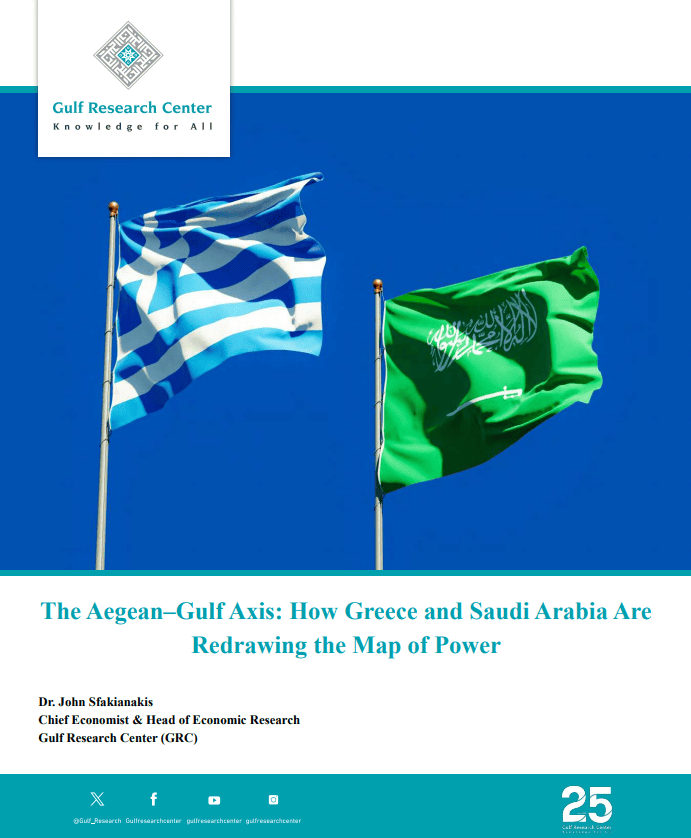
As the Saudi–Greek Business Council convenes in Riyadh, it is timely to revisit the foundations, and the future, of one of the Eastern Mediterranean’s most dynamic partnerships. The relationship between Greece and Saudi Arabia, long anchored in commerce and maritime exchange, is rapidly evolving into a strategic alliance spanning energy, investment, technology, and defense. Across centuries, Greek ships have carried not only goods but ideas, grain, oil, and influence. Today, the most consequential of those routes runs between Athens and Riyadh. What began as merchant pragmatism has matured into a strategic compact built on connectivity, capital, and security.
From Maritime Commerce to Strategic Alliance
While the twentieth century linked Greece to the Gulf through tankers, shipyards, and engineering contracts, the 2020s are adding new layers. The old currents of energy and trade are now joined by high-voltage cables, digital corridors, and cross-border investments. A relationship once defined by maritime commerce is becoming a diversified alliance—with institutions, capital, and strategic intent to match.
That evolution took form with the launch of the Supreme Strategic Cooperation Council, cochaired by Prime Minister Kyriakos Mitsotakis and Crown Prince Mohammed bin Salman. It is Greece’s first such mechanism with a Middle Eastern state, a clear signal that the partnership has moved from cordial diplomacy to structured strategy. The council now anchors cooperation in energy, investment, defense, and education.
Energy and Connectivity: The New Arteries of Partnership
Energy remains the backbone, though its meaning has shifted. The Saudi–Greek Interconnection, a planned 3-gigawatt electricity link, will carry competitively priced power, first gas-generated, later renewable, from the Arabian Peninsula to Europe. With an estimated cost exceeding €1.5 billion, it could become the first direct energy bridge between the Gulf and the EU. For Greece, it strengthens its role as Europe’s southeastern energy gateway; for Saudi Arabia, it channels Vision 2030 into Europe’s clean-energy markets. Saudi investment in Greece’s renewables, already surpassing €400 million in announced projects, underscores this shared ambition.
Digital infrastructure is emerging as the new trade route. The East-to-Med Data Corridor (EMC)—a joint venture between Greece’s telecom operators and Saudi Arabia’s STC— will connect Gulf data hubs to European markets through undersea cables. Due for completion in 2026, it complements Saudi investments in cloud infrastructure and Greece’s ambition to serve as the EU’s digital bridge. Once operational, it will transmit more than 180 terabits per second, transforming geography into bandwidth and reviving the ancient logic of the Aegean and the Red Sea as conduits of exchange.
As of 2025, political and security ties have intensified significantly. Following reciprocal high-level visits between Athens and Riyadh, the two nations established a political and security dialogue to institutionalize consultations on counterterrorism, maritime domain awareness, and regional stability. Greece and Saudi Arabia now coordinate positions within the UN, G20, and IMF, with Greece supporting Saudi-led mediation in Sudan and Yemen, and Riyadh backing Athens’ EU initiatives in the Balkans and Eastern Mediterranean.
Security cooperation has deepened alongside it. Since 2021, Greek air-defense units have been stationed in Saudi Arabia to help protect critical energy facilities from aerial threats—an unprecedented deployment underscoring mutual trust. Defense collaboration now includes joint exercises and training programs, integrating Greek expertise with Saudi modernization. In 2024, both nations launched the Falcon–Aegean framework for joint naval, air, and cyber exercises. Athens views Gulf stability as integral to Europe’s own security; Riyadh sees Greece as a dependable partner with NATO experience and Mediterranean reach.
Expanding Economic and Financial Ties
Diplomatic progress has been matched by growing economic interdependence. Athens was among the first European capitals to back Riyadh’s successful Expo 2030 bid and has championed Saudi Arabia’s deeper integration into Europe’s energy and logistics networks. Economic ties have matured beyond episodic deals into a structured partnership defined by capital, expertise, and long-term strategy. Bilateral trade reached $1.5 billion in 2024, nearly doubling since 2020, while Saudi investment in Greece has accelerated across infrastructure, energy, and digital sectors.
Greek financial institutions have been instrumental in reinforcing this momentum. Eurobank, the National Bank of Greece, and Piraeus Bank have expanded trade-finance and advisory services for Greek and Saudi firms in energy, transport, and technology, translating political goodwill into tangible projects and institutional depth.
Saudi capital is also flowing the other way. Beyond sovereign and institutional channels, private Saudi capital has deep roots in Greece. The Olayan Group, one of Saudi Arabia’s most distinguished family conglomerates, has maintained a sustained presence in the country since the 1970s through strategic holdings such as Chipita and a longstanding partnership with the Konstantakopoulos family, the founders of TEMES S.A. and visionaries behind the Costa Navarino development. Their collaboration stands as a leading example of Gulf– Greek cooperation in sustainable tourism and real estate, blending long-term vision, environmental design, and cross-generational trust. Together, these initiatives complement public-sector investment and underscore the multi-generational, strategic nature of Saudi engagement in Greece.
Under the Strategic Cooperation Council, the Public Investment Fund (PIF) and leading Saudi groups are pursuing opportunities in Greek infrastructure, tourism, logistics, and renewables. The first formal Greek–Saudi Business Forum was held in Athens on March 29, 2022, during the visit of the Saudi Minister of Investment, Khalid AlFalih, accompanied by a large delegation of Saudi companies, produced a pipeline of projects worth over €2.8 billion, spanning port development, hospitality, and energy storage. Companies such as STC and ACWA Power have already established a presence, signalling Riyadh’s intent to treat Greece as a stable, EU-based platform for expansion.
This expanding web of institutional and private capital reflects a deeper transformation: Saudi and Greek firms are no longer engaging in isolated transactions but are building a long-term ecosystem of trust, joint investment, and shared diversification. These efforts are knitting together the financial, energy, and technological infrastructures of the Aegean and the Gulf, laying the foundations for an enduring economic partnership anchored in mutual resilience and opportunity.
Greece’s Eastward Vision: Aligning with Global Growth
For Greece, looking Eastward is no longer a matter of heritage but of strategic adaptation. The global center of economic gravity has decisively shifted toward Asia, with the Gulf now firmly within its orbit of growth and innovation. Asia alone accounts for the majority of global expansion, contributing between 55% and 70% of global GDP growth over the past decade, while the Gulf Cooperation Council (GCC) economies have become pivotal drivers of energy transition, logistics, and capital diversification. By contrast, the European Union’s share of global growth has fallen below 10%, with average annual expansion of roughly 1–2%, underscoring why Greece’s strategic reorientation toward the East has become both logical and necessary.
Saudi Arabia, at the heart of this transformation, has attracted more than $80 billion in foreign direct investment since 2018, reflecting the scale of its Vision 2030 reforms. The GCC’s combined sovereign wealth now exceeds $4.5 trillion, channeling long-term capital into energy, infrastructure, and technology worldwide. For Greece, aligning with these growth engines is not a departure from Europe but a recalibration of economic geography—anchoring itself where liquidity, innovation, and diversification are accelerating.
The East is also where technological and financial innovation now converge. In 2023, Asia generated nearly 60% of global patent applications and 65% of green-technology investments, while the Gulf has emerged as an expanding digitalfinance and logistics hub. This momentum offers Greece a strategic opening: to serve not only as Europe’s southeastern gateway but as its bridge to the Indo-Arabian world. Through data cables, energy interconnectors, and investment flows, Athens is positioning itself as the conduit through which Gulf and Asian capital, technology, and ideas enter Europe. The Aegean, long a maritime crossroads, is evolving into a digital and energy corridor—linking Europe’s mature markets with the world’s new centers of dynamism and growth.
* Through data cables, energy interconnectors, and investment flows, Athens is positioning itself as the conduit through which Gulf and Asian capital, technology, and ideas enter Europe. *
Historical Continuity and Modern Ambition
Skeptics may call this a convenient alignment, Europe seeking energy security, Saudi Arabia diversification, and Greece investment. Yet the roots of this partnership run far deeper. Greek entrepreneurs were active in the Kingdom as early as the 1950s, when Aristotle Onassis, Stavros Niarchos, and John Latsis signed landmark tanker deals with ARAMCO, tying the fortunes of the Greek merchant fleet to Saudi oil and reshaping global energy trade. By the oil boom of the 1970s, firms with strong Greek links—such as Consolidated Contractors Company (CCC), a Lebanese-Palestinian enterprise headquartered in Athens, and Archirodon, were among the first foreign contractors to build Saudi ports, desalination plants, and highways from Jeddah to Dammam and Yanbu. Greek engineers, shipbuilders, and entrepreneurs became integral to the Kingdom’s modernization drive, while thousands of professionals from Greece settled in Saudi Arabia, forming a diaspora that connected Piraeus to the Gulf long before globalization made such exchanges routine.
This shared history has evolved from mercantile pragmatism into institutional partnership. Shipping remains the backbone of this continuity, with Greek shipowners, commanding the world’s largest commercial fleet and carrying nearly one-fifth of global seaborne oil trade, continuing to transport Saudi crude across the world. Greek port operators, including the Piraeus Port Authority, have hosted Saudi delegations exploring logistics and free-zone partnerships, reflecting Riyadh’s ambition to transform NEOM and the Red Sea Project into global maritime hubs. What began as a private initiative has matured into a structured framework of cooperation, proof that the foundations laid by merchants and engineers generations ago are now being institutionalized through modern alliances and shared strategic vision.
Today, the Olayan–Konstantakopoulos partnership and similar ventures stand as heirs to that legacy, translating historic trust into contemporary collaboration. The long arc of Greek–Saudi engagement—from oil tankers to tourism, from shipyards to smart cities, illustrates how commerce, culture, and strategy have intertwined across decades. The enduring success of these ties rests on their ability to adapt: to evolve from transactional exchange into a shared pursuit of diversification, sustainability, and resilience. In this sense, the Greek– Saudi partnership is not a rediscovery—it is a reinvention of an enduring story of cooperation between two trading civilizations linked by history and renewed by purpose.
The Emerging Geometry of Regional Power
The region’s evolving strategic geometry gives this partnership new weight. Greece’s expanding network of energy and data links, to Egypt, Israel, and Cyprus—is transforming it into the switchboard of the Eastern Mediterranean. A Saudi connection extends that network eastward, creating a corridor of energy, information, and trade that bridges Asia and Europe. It is an ambitious yet increasingly tangible vision: Greece as Europe’s southern gateway; Saudi Arabia as the Arabian Peninsula’s innovation engine.
For Riyadh, partnership with an EU and NATO member provides both geopolitical credibility and access to Europe’s most critical debates on energy transition and digital sovereignty. For Athens, alignment with Saudi Arabia amplifies its influence in a region where the architecture of Europe’s energy and digital future is being redrawn. The Supreme Strategic Cooperation Council formalizes what business leaders and policymakers have long recognized: that the Greek–Saudi axis is not transactional, but structural—a long-term commitment to diversification, connectivity, and regional stability.
This emerging axis is more than diplomacy or commerce. It represents a new organizing principle for a fragmented world—one where connectivity, resilience, and shared economic architecture define influence more than geography alone. In this sense, the Aegean–Gulf partnership offers a blueprint for how mediumsized powers can leverage cooperation and complementarity to shape regional order from the ground up. By fusing Greece’s European and maritime networks with Saudi Arabia’s financial and technological dynamism, Athens and Riyadh are quietly redrawing the lines of influence across three continents.
Conclusion: A Structural Axis for a Fragmented World
The logic is clear. Greek forces helping defend Saudi energy infrastructure serve both European and Saudi interests, reinforcing a shared sense of security and interdependence. The cables and interconnectors binding the two nations do more than transmit energy and data—they transmit trust, mutual recognition, and the foundations of a lasting strategic partnership. In an era defined by fractured supply chains, contested transitions, and digital rivalries, Athens and Riyadh are betting on connectivity as power.
There is also a softer dividend. Greece will mount a national pavilion at Expo 2030 Riyadh, a symbolic affirmation of the cultural symmetry between two ancient civilizations rediscovering common purpose in the modern world. Tourism, education, and investment exchanges are expanding rapidly; direct flights are operating at capacity, and Saudi visitors to Greece have nearly doubled since 2022. Greek universities are forging research and exchange partnerships with Saudi institutions, deepening the social fabric of the relationship beyond commerce and policy.
The historic grammar of the relationship— Greek ships and Saudi oil—was never wrong, only incomplete. The new chapter adds interconnectors, fiber cables, and defense cooperation to that vocabulary. Just as Greek merchants once sailed the Red Sea in search of spices and silk, their successors now trade in electrons, algorithms, and ideas. Two trading civilizations that once met on the sea are again shaping the channels of global exchange. In an age that prizes resilient networks over nostalgic alliances, the Aegean and the Arabian Peninsula have rediscovered each other’s strategic edge—and this time, they intend to keep it.
* Greek forces helping defend Saudi energy infrastructure serve both European and Saudi interests, reinforcing a shared sense of security and interdependence *
* Dr. John Sfakianakis is Chief Economist & Head of Economic Research Gulf Research Center (GRC)