Commentary & Analysis
The Belt and Road Initiative 2.0: Balancing Opportunities and Risks for the Gulf States
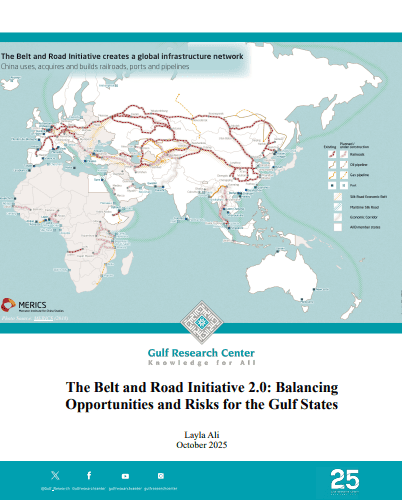
A decade after its inception, China’s Belt and Road Initiative (BRI) has entered its second phase, often referred to as BRI 2.0. The early years, defined by rapid expansion and large-scale infrastructure projects, have evolved into a more pragmatic, disciplined model centered on sustainability, financial viability, and digital transformation. This recalibration reflects Beijing’s growing emphasis on quality over quantity and on shared, rather than unilateral, benefits. For Gulf states, this evolution coincides with a crucial moment of transformation under their respective national visions, offering new avenues for cooperation while also requiring careful management of associated risks.
Strategic Alignment and Economic Synergies
The Gulf region occupies a central position at the intersection of Asia, Europe, and Africa, making it a natural partner in China’s efforts to enhance transcontinental connectivity. Within the framework of BRI 2.0, Gulf countries can leverage their strategic geography, advanced infrastructure, and investment capacity to expand ports, logistics corridors, and industrial ecosystems that integrate manufacturing, energy, and services.
For instance, Saudi Arabia’s participation in the BRI aligns with its Vision 2030 through projects such as the King Abdullah Port and the Jeddah Islamic Port modernization, both of which are becoming major nodes in the Red Sea maritime network connecting to China’s westward trade routes. The UAE’s Khalifa Port, home to COSCO’s largest overseas terminal, exemplifies how Gulf ports serve as key logistics and re-export hubs bridging Asia, Africa, and Europe. Similarly, Oman’s Duqm Special Economic Zone and Kuwait’s Silk City and Mubarak AlKabeer Port initiatives underscore how Gulf states are building industrial corridors that complement China’s Maritime Silk Road.
Chinese partners contribute engineering expertise, technological capabilities, and access to Asian supply chains, while Gulf states provide capital, regulatory predictability, and a stable investment environment. The focus is increasingly on creating integrated economic platforms that link ports, rail networks, and logistics hubs through efficient customs frameworks and smart digital systems. Fo example, the Etihad Rail Network will connect 11 cities and regions across the UAE, and eventually, when completed, run across a 1,200-kilometre track that will connect all of the emirates, from Ghweifat in the western region of Abu Dhabi to the emirate of Fujairah on the eastern coast, and then link with Saudi Arabia’s planned Land Bridge Railway, a rail corridor connecting Jeddah on the Red Sea coast to Dammam on the Arabian Gulf via Riyadh. These projects collectively transform physical infrastructure into engines of regional connectivity and trade facilitation, positioning the Gulf as a critical hub in the evolving Belt and Road 2.0 architecture.
Energy cooperation, long the foundation of Gulf–China relations, is also being reshaped by the global transition toward sustainability. The Green Silk Road initiative aligns seamlessly with the Gulf’s long-term strategies to diversify energy portfolios, expand renewable capacity, and advance low-carbon economic transitions. It reflects a convergence between China’s pursuit of a greener Belt and Road and the Gulf states’ drive to integrate sustainability into their national transformation agendas. Under frameworks such as Saudi Arabia’s Vision 2030, the UAE’s Net Zero by 2050 initiative, and Qatar’s National Environment and Climate Change Strategy, the region is prioritizing large-scale investments in clean hydrogen, solar, wind, and carbon capture technologies. For China, partnering with Gulf countries offers both an opportunity to demonstrate its global leadership in green innovation and a reliable avenue for energy security and technological cooperation. The Green Silk Road thus provides a shared platform where economic diversification, climate action, and energy transition intersect, transforming traditional oil partnerships into forward-looking collaborations centered on sustainability, innovation, and resilience.
China’s competitive edge in solar, wind, and hydrogen technologies offers concrete opportunities for collaboration in clean energy development, grid modernization, and carbon management. Saudi Arabia’s partnership with China’s CEEC and Huawei in the Red Sea solar energy project, the world’s largest microgrid energy storage facility with a capacity of 1.3 GWh, powered by Huawei’s FusionSolar Smart String ESS technology, exemplifies the scale and ambition of this cooperation. Likewise, NEOM’s green hydrogen project, supported by Chinese engineering and equipment, underscores the Kingdom’s drive to position itself as a global leader in sustainable energy under Vision 2030. Similarly, the UAE–China collaboration between Masdar and JinkoSolar has reinforced joint efforts in expanding large-scale solar projects across Asia and Africa, reflecting a shared commitment to advancing renewable energy and achieving long-term climate goals.
While China continues to be the largest importer of Gulf crude, the assertion that it sources nearly 40 percent of its oil from the GCC requires updating based on recent trends. According to 2023 data, the share of China's crude oil imports from Gulf Cooperation Council (GCC) countries was closer to 36%. This slight decrease is largely due to a significant shift in global oil trade, which has seen Russia become China's single largest supplier, accounting for nearly 20% of its total crude imports in 2024.
Despite this shift in market share, the strategic interdependence between China and the Gulf remains robust and is arguably deepening. This is reinforced by Saudi Aramco’s long-term supply agreements and expanding joint ventures with Chinese giants like Sinopec and CNPC. These partnerships now extend beyond simple crude supply to include multi-billion dollar investments in integrated refining and petrochemical projects, both in China and Saudi Arabia. Saudi-Sinopec Yanbu refinery and UAE’s ADNOC–Wanhua Chemical partnership in petrochemicals represent key examples of industrial integration beyond traditional energy exports. Meanwhile, QatarEnergy’s multi-decade LNG supply deals with Sinopec and CNPC, signed in 2023 and 2024, underscore how Gulf states are anchoring their energy security relationships with Asia’s largest economy.
Together, these ventures illustrate the shift from a linear oil-based relationship to a multidimensional partnership encompassing renewable energy, digital innovation, and sustainable industrial development, making the Gulf indispensable to the evolving Belt and Road 2.0 landscape. However, for these partnerships to remain balanced and beneficial, Gulf countries must ensure that technology transfer, local capacity building, and transparent governance are integral components of project design. The long-term goal should be to complement traditional hydrocarbon trade with innovation-driven partnerships across the renewable energy value chain, enhancing both energy security and industrial competitiveness.
Digital Transformation and Strategic Resilience
A defining feature of BRI 2.0 is its growing digital dimension. Investments in data centers, artificial intelligence, e-commerce, and smart port systems are becoming cornerstones of the initiative’s next phase. Gulf states, with their advanced digital transformation strategies, stand to benefit considerably from Chinese technological expertise and cost-effective solutions that can accelerate the development of smart cities, fintech ecosystems, and digital public services.
For instance, Huawei has established major partnerships across the Gulf, building cloud data centers in Saudi Arabia, the UAE, and Kuwait, including Huawei Cloud’s first regional data center in Riyadh in 2023, which supports AI and government cloud services. Similarly, Alibaba Cloud, the digital technology and intelligence backbone of Alibaba Group, announced the launch of its second data center in Dubai at GITEX Global 2025, responding to the growing demand for cloud computing and AI services from local businesses. This milestone builds on Alibaba Cloud’s first foray into the region in 2016, when it launched its initial Dubai data center, and reflects the deepening digital interdependence between China and the Gulf.
In the logistics sector, the Khalifa Port in Abu Dhabi, jointly developed with China’s COSCO Shipping Ports, integrates AI-driven automation and digital twin technologies, setting new standards for smart port management. Meanwhile, Saudi Aramco’s cooperation with Chinese technology firms in industrial AI and predictive analytics given their cooperation to a Development Framework Agreement with Rongsheng Petrochemical Co. Ltd. (Rongsheng) and a Strategic Cooperation Agreement with Hengli Group Co., Ltd., continues to enhance operational efficiency and sustainability in the energy sector.
At the same time, the digitalization of critical infrastructure introduces new sensitivities related to data governance, interoperability, and cybersecurity. Gulf governments are therefore adopting balanced digital strategies, for example, the UAE’s National Data Strategy and Saudi Arabia’s Cloud First Policy, that safeguard data sovereignty, promote interoperability between Chinese and Western systems, and preserve open access to global digital standards. This “dual-track” approach ensures technological resilience while maintaining strategic neutrality amid intensifying global competition in the digital domain.
The evolution of the BRI toward a more financially disciplined model presents Gulf countries with an opportunity to advance joint investments on stronger institutional footing. Rather than relying on debt-heavy structures, BRI 2.0 encourages diversified co-financing arrangements. Gulf sovereign wealth funds, development banks, and private investors can work alongside Chinese financial institutions and multilateral development partners to design projects that are bankable, transparent, and aligned with national priorities.
Local-currency financing, blended capital models, and shared risk frameworks can all contribute to sustainable outcomes while reducing exposure to exchange-rate fluctuations and fiscal pressures. By embedding strong governance and due diligence mechanisms, Gulf states can ensure that BRI engagement enhances, not undermines, their long-term financial stability and policy autonomy.
Managing Risks with Strategic Foresight
Despite its promise, BRI 2.0 is not without its challenges. Poorly structured or politically driven projects may expose states to contingent liabilities and reputational risks. Overdependence on a single external partner, particularly in sensitive sectors such as technology or energy infrastructure, could constrain strategic flexibility in an increasingly multipolar world.
To mitigate these risks, Gulf states should maintain a balanced approach anchored in transparency, diversification, and strong institutional oversight. Embedding local content and knowledge transfer into BRI projects transforms foreign capital into domestic capability, ensuring that critical infrastructure remains manageable within national borders. Furthermore, alignment with international best practices, particularly environmental, social, and governance (ESG) standards, strengthens credibility and investor confidence, reinforcing the Gulf’s reputation as a trusted global partner.
Engagement with BRI 2.0 should not be viewed as an exclusive geopolitical alignment but rather as part of a broader strategy of constructive multi-alignment. For Gulf states, the key is to integrate the opportunities offered by the BRI with other global and regional initiatives, including partnerships with Europe, India, Japan, and multilateral institutions. Maintaining multiple corridors of connectivity and diverse technological partnerships provides valuable redundancy, an essential form of strategic insurance in a world of shifting power balances.
The development of the BRI’s second phase, from a Gulf perspective, will depend on prudent governance, clear strategic prioritization, and effective risk management. If approached with foresight and diplomacy, the Belt and Road Initiative 2.0 can evolve from a platform of external engagement into a catalyst for the Gulf’s own vision of sustainable, globally connected development, enhancing the region’s role as a bridge between continents and as a pivotal actor in the emerging multipolar order.
Layla Ali is the Senior Research Associate at the Gulf Research Center (GRC