

Commentary & Analysis
France’s Political Paralysis: A Stress Call for Europe’s Core Stability
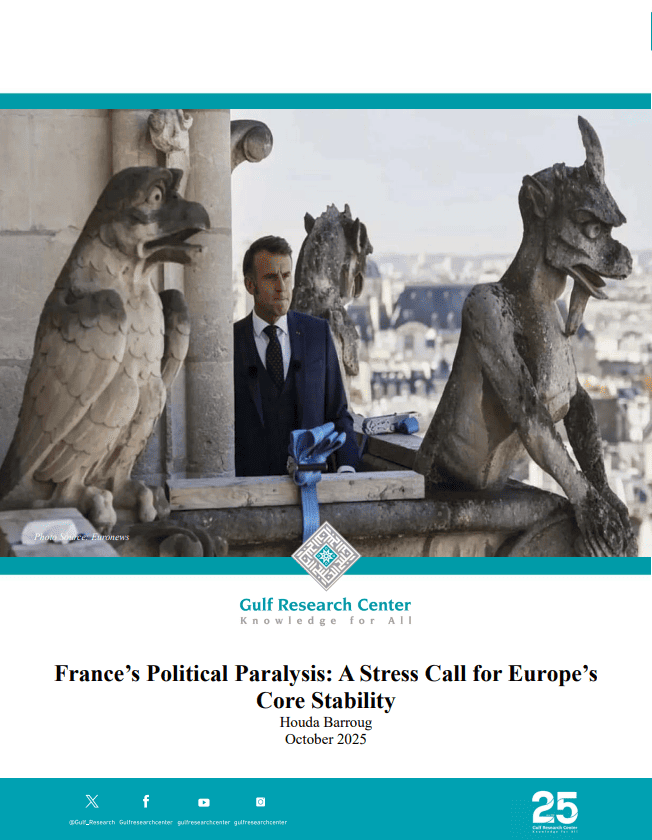
France's ongoing political crisis is culminating into one of the most significant EU's core domestic crises in recent memory. Since early 2024, French administrations have faced no-confidence votes and legislative gridlock, undermining President Macron's position and trapping France in a cycle of minority alliances and technocratic survivalism. Five prime ministers in less than 21 months have failed to enact basic legislation, particularly the national budget, while nationalist groups on all sides of the political spectrum strengthen their position in the National Assembly. For a country that has long been seen as the EU's powerhouse of political pragmatism and strategic autonomy, the current state of instability also undermines the bloc's governance structure, geopolitical hand, and international credibility.
This dilemma extends beyond domestic dysfunction. The imminent demise of executive authority in Paris threatens France's capacity to co-lead the Franco-German alliance, which has traditionally anchored EU foreign and defense policy. Brussels, without an operational French government, risks losing one of its most indispensable power brokers that empirically balanced German fiscal restraint with political ambitions. The impasse also stymies efforts to develop prominent programs like the EU's new strategic autonomy agenda and joint Future Combat Air System. Furthermore, France's budget deadlock and falling credit rating reduce fiscal flexibility throughout the eurozone, as risk premiums increase and proposals for collective military financing become more uncertain.
As such, the Republic’s current crisis is a structural warning. This marks the end of a hyper-presidential regime that seems no longer able to balance executive authority with a fractured political base. France’s political instability serves as a stress test for European and global resilience. The bloc’s political core is in ambiguity, and its leadership’s credibility both domestically and internationally (on issues such as Ukraine, industrial policy, and efforts on the two-state solution) are dependent on France’s ability to regain momentum domestically.
Anatomy of the Political Crisis
The framework of France's current political crisis shows a trend of rapid government collapses caused by entrenched legislative division and profound polarization. The July 2024 snap elections divided the National Assembly into three major camps: the left-wing New Popular Front, the farright National Rally (RN) and Macron’s centrist Renaissance. With no majority for any of the camps, efforts to form a coalition and governance faced unprecedented structural challenges.
Presidential efforts to ensure stable governance have often failed. Michel Barnier was Macron’s first attempt at restoring order, appointing him as Prime Minister in September 2024. However, Barnier’s use of Article 49.3 to impose social sector reforms without the parliament’s approval prompted a no-confidence vote, eventually leading to the collapse of his minority government in December.
Francois Bayrou’s and Sebastien Lecornu’s minority governments met similar fates. Bayrou's cabinet was deposed in September 2025, following budgetary disagreements and parliamentary resistance, particularly from left-wing and far-right forces unified against budget cuts. Lecornu, a key Macron ally, resigned after only 27 days primarily due to his ability to neither gain backing for the country's reform and budget plan nor negotiate with opposition parties. His brief tenure highlighted the political divisiveness and fragmentation that paralyzed the National Assembly. Although, only few days after his resignation, Lecornu was reappointed by President Macron and survived two no-confidence votes, the future of the government's stability remains precarious.
This chaos stems from systemic issues. Governmental fragmentation reflects highly polarized political dynamics: centrists falling behind far-right and far-left parties to gain power. Macron's reliance on emergency measures and cabinet decisions to avoid parliamentary debate undermined the conventional Fifth Republic balance of presidential authority and legislative administration. The political system is displaying symptoms of stress as legislative and public confidence wanes, challenging governance under urgent economic restrictions, including a rising budget deficit and declining fiscal credibility.
The run of short-lived governments reveals France's tremendous institutional exhaustion. The failure to create long-term coalitions, achieve crucial budgetary changes, and maintain coherent leadership destabilizes domestic politics. It also raises major concerns about the country's role in the bloc's political core and its potential to successfully influence EU governance trends.
Institutional Fatigue and Macron’s Struggle to Govern in a Divided France
Emmanuel Macron's grip on executive power has deteriorated significantly as a result of France's fractured political landscape and repeated administration failures. Traditionally, the French presidency has wielded significant power, including appointing prime ministers and directing national policy in international affairs and national security. However, Macron's repeating record of short-lived cabinets demonstrates a major erosion of his power in domestic politics.
The June 2024 snap elections resulted in a hung parliament that continues to limit Macron’s capacity to appoint prime ministers with parliamentary majorities. Macron's conventional tactic of reshuffling cabinet members to protect himself from political backlash has proven ineffective. Unlike in earlier periods, when prime ministers served as buffers, the escalating turnover now subjects the president to direct scrutiny and undermines the presidential office's perception of stability. This institutional fatigue is exacerbated by looming economic issues, such as staggering public debt and a budget deficit reaching 5.4% of GDP. This necessitates budget cut measures opposed by numerous parties. Macron is faced with a difficult decision: seeking wide concessions with opposition and central-left factions, or risking unpredictable snap elections that can bolster populist forces. With Paris's central role in European affairs, both alternatives pose considerable risks to Macron's presidency, the country's political stability, and the bloc's strategic coherence.
France’s Dysfunctionality and the Limits of EU Governance
In addition to its domestic repercussions, the unrest in Paris jeopardizes coordinated EU responses to critical, pressing concerns such as security, strategic autonomy, military, and energy transition. Without a secure French administration, Germany, for example, may find itself in a position to act more independently or even explore alternative partnerships, thereby further limiting the EU's capacity to present a united front across the world.
Financially, this political instability has increased fiscal uncertainty and borrowing costs in the eurozone, putting pressure on common economic governance structures. The failure to adopt sustainable budget changes raises concerns about France's long-term economic performance and undermines trust in the EU's collective budgetary stability. This also reduces EU-wide expenditure in defense and innovation, both of which are important to Europe's security and competitiveness.
Politically, the gridlock fuels the emergence of populist and Euroskeptic forces in France, raising the possibility that the 2027 presidential elections would produce a candidate unfriendly to EU cooperation and integration. Such an alteration would have internal consequences for France. It would also pose a substantial challenge to the EU's cohesiveness and strategic autonomy, deepening differences and hampering joint efforts on foreign policy, economic reforms, and climate goals.
France's dysfunction thus indicates a rising fragility at the heart of the European project, which has immediate, and to some extent, predictable consequences for the EU's ability to govern efficiently and respond to geopolitical instability. It emphasizes the critical necessity for Brussels and member states to anticipate eventual shifts in leadership dynamics while also strengthening European unity and resilience.
Navigating France’s Political Gridlock and European Repercussions
France's odds for political equilibrium remain questionable as it endures one of the most difficult periods in the history of the Fifth republic. President Macron's latest decisions indicate a strategic aim to "muddle through" the political deadlock rather than calling snap legislative or presidential elections before the 2027 elections. This approach is strongly reliant on electing a new prime minister capable of garnering some parliamentary support, potentially preferring technocratic candidates who are unconcerned by political rivalry and looming electoral calculations.
However, this approach confronts substantial challenges. The legislative landscape remains profoundly fractured, with no faction close to a majority, implying that any newly formed administration will be a minority battling to achieve necessary fiscal measures. While a fallback, snap elections remain unlikely to secure an overwhelming majority considering polling patterns indicating persistent backing for far-right and far-left parties, as well as declining centrist popularity. This increases the risk of ongoing parliamentary gridlock and policy drift after 2027.
Additionally, fiscal concerns amplify these political vulnerabilities. France's fiscal deficit is currently well beyond the EU's 3% limit.
Political stalemate undermines the government's ability to implement viable consolidation measures, jeopardizing economic growth and trust. The uncertainty undermines the entire eurozone, considering that France continues to be a critical pillar of European financial stability. Moreover, prolonged instability in the country’s political landscape could potentially create a power vacuum for European government at a time when strong leadership is required. This makes the impending 2027 presidential election consequently critical.
* Houda Barroug is a Researcher at the Gulf Research Center (GRC)