Commentary & Analysis
The Normalization Narrative: A Misleading Interpretation of Saudi–U.S. Relations
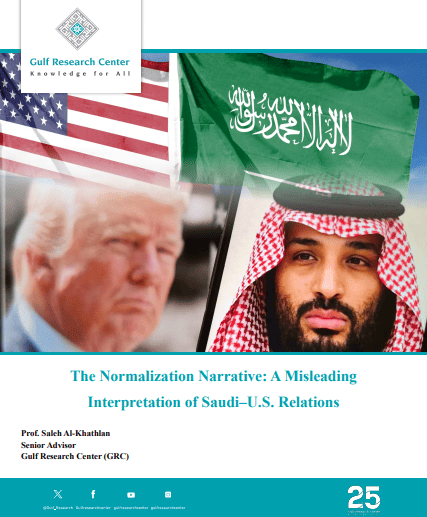
Since the declaration of the ceasefire in Gaza on October 9, a series of American and Israeli statements have appeared, promoting the notion of an “inevitable normalization” between Saudi Arabia and Israel. This narrative seeks to create the impression that normalization is imminent, while deliberately ignoring the clearly and oft stated Saudi position, one that has reached the highest level of clarity through Crown Prince Mohammed bin Salman’s address at the opening of the first session of the ninth term of the Shura Council, on behalf of the Custodian of the Two Holy Mosques. In that speech, His Royal Highness affirmed that “the Kingdom will not cease its diligent efforts to establish an independent Palestinian state with East Jerusalem as its capital, and it will not establish diplomatic relations with Israel without that.”
This statement encapsulates the Kingdom’s official position and reflects the unwavering consistency of Saudi policy toward the Palestinian issue. This stance has not been altered by changing circumstances or shifting regional and international dynamics. Saudi Arabia has consistently reaffirmed that the two-state solution remains the only path to resolving the conflict, and that peace can only be achieved through the establishment of a Palestinian state, an assertion repeated in Riyadh’s statements, meetings, and diplomatic engagements since the outbreak of the Gaza war.
During this period (October 2023-October 2025), Saudi discourse has been marked by both force and clarity in condemning Israeli crimes against the Palestinian people, killings, displacement, starvation, and siege, demonstrating a remarkable degree of consistency and firmness. The Saudi position has not been confined to condemnation or official statements; it has extended into intensive and active diplomacy. The Kingdom has led broad efforts that have contributed to expanding the circle of international recognition of the State of Palestine to nearly 157 countries, including influential powers such as France, the United Kingdom, and Canada. These efforts reveal that Saudi Arabia does not merely uphold a principled position; it actively works to entrench it on the international stage through practical and effective means.
An analysis of the content of the statements regularly issued by the Ministry of Foreign Affairs since October 8, at a near weekly pace, shows a notably advanced position within the context of Saudi policy toward the Arab–Israeli conflict. These statements represent a qualitative development in both tone and transparency, a development inseparable from the brutality of the crimes committed by Israel in Gaza which have compelled Saudi Arabia to adopt its most explicit and forceful position to date. At the same time, this assertive posture aligns with the broader transformation that has characterized Saudi diplomacy over the past decade, one marked by firmness and the affirmation of the Kingdom’s pivotal role in regional affairs.
Hence, any attempt to interpret Saudi actions regarding the Palestinian question must begin with a deep understanding of this clearly articulated and repeatedly affirmed position as expressed in its official statements, for it represents the truest expression of the Kingdom’s orientation and its political and humanitarian principles alike.
Saudi Arabia’s position is rooted in the wellestablished principles of its foreign policy. Chief among them is the principle of profound solidarity with the Palestinian people and with all just causes, an essential component of the Kingdom’s values and founding ethos since its establishment. This stance is also grounded in a rational and pragmatic vision that lasting peace, security, stability, and prosperity in the Middle East cannot be achieved without a final just and comprehensive resolution to the Palestinian question. Any attempt to bypass this fundamental condition will only perpetuate conflict, defer additional crises, and reproduce violence in new forms.
In contrast, the Israeli position has shown no substantive change; it has instead grown more rigid in rejecting the establishment of a Palestinian state. Prime Minister Benjamin Netanyahu and members of his government have repeatedly and explicitly declared that “there will never be a Palestinian state.” On that basis, talk of an imminent Saudi-Israeli normalization disregards the political reality and contradicts the Kingdom’s clearly stated conditions. For Saudi Arabia, normalization without the establishment of a Palestinian state would constitute a betrayal of justice and a blow to the credibility of the international consensus supporting Palestinian statehood.
The real obstacle to any normalization process is not the Saudi position, but Israel’s refusal to accept the two-state solution. Should Israel alter this stance and demonstrate a genuine desire for a fair settlement, only then could the prospect of normalization be discussed, within a framework that ensures actual peace rather than transient political gains.
Nevertheless, it should be emphasized that normalization of relations between the Kingdom and Israel, if the conditions laid down by Saudi Arabia are met, namely the creation of an independent Palestinian state with East Jerusalem as its capital, would constitute a historic and transformative event. In its symbolism and impact, it might equal the declaration of Israel’s own establishment, given its deep implications for questions of recognition and regional acceptance across the Arab and Islamic worlds and for Israel’s integration into its regional environment.
Accordingly, those promoting the narrative of “inevitable normalization” must recognize that progress on this front depends entirely on fulfilling the requirements of peace. The compass should be directed toward Tel Aviv, urging it to meet these obligations, rather than wasting time in propagating narratives that neither alter facts nor contribute to peace.
Some observers attempt to link the question of normalization with the strengthening of Saudi– U.S. relations, as though Riyadh or Washington need this issue to prove the depth of their partnership. This is an inaccurate and misleading notion that disregards a history stretching back nearly nine decades. The relationship between the two nations is far too deeply rooted to be reduced to a single issue. The Saudi–U.S. partnership is a strategic one, built on shared interests encompassing security, energy, and regional stability.
Despite well-known differences in their respective positions on the Arab–Israeli conflict, the partnership has persisted and evolved across various domains. It is telling, for instance, that President Donald Trump chose Riyadh as his first foreign destination at the start of his inaugural international tour in 2017, and again in 2025, reflecting the Kingdom’s central place in U.S. strategic calculations. Even former President Joseph Biden, despite his initial hostility toward Saudi Arabia, ultimately recognized its strategic importance and the necessity of engaging with Riyadh on critical matters that affect U.S. interests.
A striking paradox emerges here: The Saudi– U.S. partnership appears to strengthen regardless of how wide the gap on the Palestinian issue becomes. The more firmly the Kingdom upholds its principles regarding Palestine, the greater Washington’s appreciation becomes for Saudi Arabia as a reliable and steadfast strategic partner.
One of the defining features of Saudi–U.S. relations is their capacity to weather profound disagreements without compromising their core foundations. The Kingdom has consistently adhered to its principles concerning the Palestinian cause, while the United States has maintained its traditional pro-Israel stance. Yet both sides have continued coordination in defense, security, counter-extremism, and energy, while expanding cooperation in numerous other fields. Even during moments of great tension, such as after the events of September 11, the two countries did not retreat from their shared commitment to a strategic relationship that serves the stability of the region and the world.
This paradox demonstrates that normalization with Israel offers no additional value to Saudi– U.S. relations. In fact, one might argue that the bilateral relationship could continue to grow and flourish even without normalization (if its conditions are unmet), as the Kingdom’s remaining outside this trajectory makes it a decisive actor in the regional peace equation and grants it a unique position within the Middle East’s strategic balance.
Moreover, in its efforts to further consolidate and deepen its relationship with Washington, Riyadh continues to possess multiple influential cards that can be leveraged amid global competition and the reconfiguration of the international order. These are not limited to energy, but extend to the Kingdom’s civilizational and moral dimensions within the ongoing contest of values among major powers. This is evident in how China and Russia increasingly define themselves as “civilizational states,” and in the growing prominence of religious identity in the Western world, reflected in the rise of right-wing movements across Europe and in the rhetoric of Project 2025, a manifesto associated with Donald Trump.
At the heart of this global identity struggle (one need only examine Vladimir Putin’s speeches to discern its contours) the Kingdom’s international value continues to rise, given its spiritual significance to roughly 25% of the world’s population. This amplifies its moral authority and increases global efforts to court its favor amid competing ideological narratives.
Thus, proponents of the “inevitable normalization” narrative should realize that Saudi Arabia holds a multitude of cards to preserve its status and strengthen its partnerships with the United States—without the need for normalization with an entity whose actions and crimes are widely rejected and increasingly condemned by the international community.
In this context, President Donald Trump’s remark during his visit to Riyadh is particularly revealing. Speaking about the normalization issue, he said:
“But [the Kingdom] will do it in your [its] time— and that’s what I want, and that’s what you want, and that’s how it will be.”
This statement clearly reflects an American acknowledgment that the decision on Saudi-Israeli normalization is a sovereign Saudi decision, to be taken at the time and under the conditions that the Kingdom deems appropriate, in line with its national priorities rather than external pressures or political calculations. This remark stands as a reference point that invalidates the narrative of “inevitable normalization.”
At the same time, the United States itself is witnessing a marked shift in its perception of Israel. Its once-unquestioned and unconditional support for Tel Aviv is eroding noticeably in the wake of Israel’s war crimes in Gaza. This shift extends beyond public opinion to include political elites in think tanks, the media, academia, and even within Congress, where several members have refused funding from the pro-Israel lobby AIPAC and begun voicing open criticism of Israel’s actions in Gaza. Even within the Christian right, traditionally among Israel’s staunchest supporters, voices have emerged arguing that Israel’s conduct violates basic humanitarian and Christian values.
As a result of this shift, Saudi–Israeli normalization is no longer a central issue in the American domestic debate, except for a small number of actors who pursue it for narrow political gain or out of unequivocal loyalty to Israel. For Trump, his insistence on promoting normalization can be interpreted as part of his desire to portray himself as a peacemaker worthy of the Nobel Peace Prize, he often boasts of having “stopped eight wars.” Completing the normalization process with Israel would, indeed, constitute a major achievement in any U.S. president’s record. Yet, an examination of Trump’s behavior suggests that this ambition can be redirected toward other accomplishments, or at least that discussion of normalization can be prolonged until the end of his term in the White House.
In Europe as well, the positions of some traditional Western allies of Israel have begun to shift. Several European states have adopted the Saudi view that a just political solution requires the establishment of an independent Palestinian state. The Saudi position has, consequently, become a growing source of respect and admiration among Western officials and diplomats, who see in it a model of coherence, steadiness, and moral responsibility. This is evident in frequent meetings with visiting Western officials and members of the diplomatic corps in Riyadh, who openly praise the Kingdom’s clarity and firmness regardi ng the Gaza war.
Thus, Riyadh has succeeded in transforming its principled stance into an influential diplomatic reference point that guides how other states frame their approaches to the Arab–Israeli conflict. Western recognition of the Saudi position is not merely a political or diplomatic gain; it stands as evidence of the moral soundness and justice of that position. At the same time, this growing acknowledgment reinforces the Kingdom’s responsibility to uphold this humanitarian stance as an expression of its enduring values and leadership role in the Arab and Islamic worlds. The greater the world’s appreciation for Riyadh’s principled approach, the more vital it becomes for the Kingdom to continue defending this balanced and moral path.
Saudi Arabia, like much of the world, has observed that the so-called “Abraham Accords,” hailed as peace agreements, have in fact failed to deliver any real peace since their signing more than five years ago. Instead, they were followed by one of the worst genocidal atrocities in modern Middle Eastern history. This reality should prompt reflection among those still promoting the myth of “inevitable normalization.” Are they truly concerned with peace?
The aftermath of those accords provides clear evidence that normalization was never a path to peace; rather, Israel used it as a cover for policies of power and domination. Those who continue to push the illusion of imminent normalization do so not out of a genuine desire for peace or stability, but as part of an effort to whitewash Israel’s image after its atrocities in Gaza and to rebrand it internationally as a “normal” regional actor.
In conclusion, those promoting the “near normalization” narrative must acknowledge that Saudi Arabia’s position is conditional upon the establishment of an independent Palestinian state with East Jerusalem as its capital. This declared condition governs any discussion of normalization. In the absence of a fundamental change in Israel’s stance toward the two-state solution, talk of imminent normalization remains without objective basis. The pillars of Saudi–U.S. relations remain sufficient, vital, and dynamic— independent of this issue.
They must also recognize that the trajectories of Saudi–U.S. relations and that of Saudi policy toward the Arab–Israeli conflict are parallel by nature—and will not converge unless and until the conditions set by the Kingdom are fulfilled.
Prof. Saleh Al-Khathlan Senior Advisor Gulf Research Center (GRC)