

Commentary & Analysis
Shifting Global Dynamics, Steady U.S.-Saudi Ties
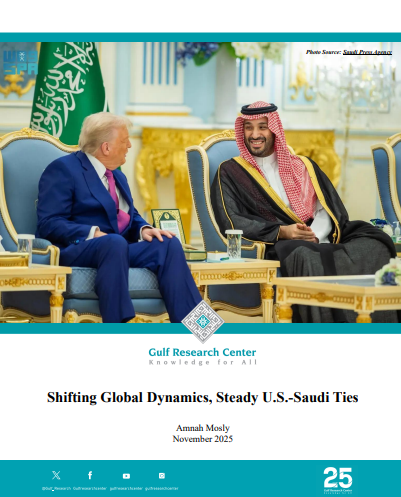
The scheduled visit of His Royal Highness Prince Mohammed bin Salman, Crown Prince and Prime Minister of the Kingdom of Saudi Arabia, to Washington, D.C., on November 18 marks a significant moment in the bilateral relationship, as it will be HRH’s first official visit to the United States since March 2018. More than a diplomatic formality, this high-level engagement is intended to reaffirm the enduring Saudi-U.S. partnership. The meeting follows President Trump’s “historic” Middle East tour in May 2025, during which Riyadh was the first foreign visit of his second term as U.S. President. This sequence of corresponding visits suggests a mutual commitment to strengthening the alliance between the two sides.
One of the core premises of this visit is the sustained relevance of Saudi Arabia within U.S. foreign policy, a necessity underscored by the Kingdom’s evolving role in global and regional diplomacy. In recent years, Saudi Arabia has leveraged its influence to position itself as a partner capable of bridging divides across an increasingly fragmented international landscape. The Kingdom’s recent diplomatic initiatives extend far beyond its immediate neighborhood, to include active roles in de-escalation efforts regionally as well as mediation efforts in conflicts such as those in Ukraine and Sudan. This proactive diplomatic posture has fundamentally altered the international perception of Riyadh from a purely transactional partner to a strategic actor with a vested interest in global governance.
The defense and security dimension remains the bedrock of the U.S.-Saudi alliance, framed by a shared commitment to deterring threats to Gulf stability and ensuring freedom of navigation in critical maritime chokepoints on the Red Sea and in the Arabian Gulf. Building upon the $142 billion defense package announced during President Trump’s visit to Riyadh, dubbed the “largest defense sales agreement in history,” new agreements focusing on advanced defense technologies, cybersecurity cooperation, and joint military training will allow for a continued deepening of the security relationship between the two countries.
A key Saudi priority, as articulated by Ambassador Michael Ratney, former ambassador of the United States to Saudi Arabia, is a bilateral defense agreement. For Riyadh, a formalized security framework would offer predictability and enhanced deterrence against threats and maritime disruptions and thus is seen as a major strategic gain if agreed to.
For the broader Gulf Cooperation Council (GCC), this would reinforce collective defense postures and signal a renewed American willingness to engage more substantially in promoting regional stability. It may also set a precedent for future U.S. security arrangements with other GCC partners, potentially enhancing interoperability, intelligence-sharing, and joint defense procurement across the Gulf.
Through this lens, Saudi Arabia is seeking a comprehensive and binding arrangement that ensures its national security amid uncertain regional dynamics. Anything short of such guarantees may prompt the Kingdom to continue diversifying its defense partnerships and supplementing a potential U.S. deal with other partners. Therefore, it is now up to Washington to provide as much clarity as possible regarding the scope of its commitments, as Riyadh weighs its long-term security options in an increasingly multipolar environment.
Another aspect is the perceived linkage between a potential defense agreement between the Kingdom and the United States, to normalization with Israel. The current prevailing view in Riyadh is that a potential defense agreement and normalization with Israel are distinct tracks that should not be interlinked. Saudi Arabia has consistently emphasized that its national security priorities must be addressed independently of broader political developments. In addition, for over two years, Riyadh’s stance on normalization has remained consistent: progress is contingent only on tangible movement toward Palestinian sovereignty and the establishment of an independent state with East Jerusalem as its capital. This principled position, reaffirmed at the highest levels, reflects Saudi Arabia’s enduring commitment to the two-state solution as the only viable path to lasting peace.
While previous U.S. approaches have sought to connect a defense pact with Riyadh’s potential recognition of Israel as part of a wider regional framework, such a linkage is no longer viable given the extent of the ongoing war in Gaza and the uncertain prospects for a two-state solution. This reflects a pragmatic understanding of current geopolitical realities and underscores that, for Saudi Arabia, a formalized security arrangement with the United States represents a core strategic priority for its national security. Not only has this position remained unaltered by shifting regional and international dynamics, but recent developments have further underscored the urgency of addressing the Palestinian question as an indispensable element of regional stability.
In this context, Saudi Arabia’s diplomacy has intensified, with the Kingdom playing a central role in advancing broader international recognition of the State of Palestine and mobilizing global support for a just and lasting peace process.
Accordingly, framing the depth of the U.S.-Saudi partnership around the issue of normalization is misleading. Suggesting that the partnership between the two countries and its depth hinges on this singular issue disregards the decades of history, cooperation, and collaboration between the United States and Saudi Arabia, built on shared, enduring interests encompassing security, energy, and regional stability. In other words, reducing the alliance to the outcome of normalization negotiations overlooks the multidimensional and institutionalized nature of the cooperation that has long defined the relationship.
Therefore, the concept should be seen as a component of, not a prerequisite or indicator for the strength of the U.S.-Saudi relationship, as the partnership has never been contingent on a single issue. Over the course of eight decades, the relationship has evolved through successive global shifts, with the foundation resting on converging strategic interests rather than transactional calculations. Both countries have demonstrated the capacity to navigate differences, whether in regional crises or global policy priorities, while preserving their strategic partnership and cooperation.
Thus, as the Crown Prince’s visit approaches, the emphasis will likely remain on translating this long-standing partnership into renewed strategic understandings that reflect the priorities of both nations in a rapidly shifting global landscape. Both sides are expected to focus on institutionalizing cooperation mechanisms that go beyond traditional security ties, encompassing emerging domains such as artificial intelligence, clean energy, critical minerals, and advanced manufacturing. These areas align with Saudi Arabia’s Vision 2030 transformation agenda and the United States’ interest in fostering resilient supply chains and stable energy markets.
Beyond the bilateral framework, the visit carries regional implications. A revitalized U.S.-Saudi partnership would serve to reaffirm Washington’s commitment to Gulf stability at a time when the regional security environment remains fluid, shaped by escalating tensions in the Red Sea, the ongoing war in Gaza, and Iran’s regional posture. Riyadh’s growing diplomatic engagement, coupled with its diversified partnerships with Asian and European powers, underscores the Kingdom’s emerging role as a stabilizing and mediating force across multiple fronts.
Moreover, for Saudi Arabia, the objective is not only to strengthen its bilateral alliance with Washington but also to encourage greater U.S. alignment with the Kingdom’s regional policy approach, one that prioritizes de-escalation, dialogue, and conflict management over confrontation. Saudi Arabia’s current strategy, reflected in its diplomacy in Syria, Lebanon, Yemen, and even Iran, seeks to reduce regional tensions and build conditions for sustained stability. Thus, the U.S. joining the Kingdom’s de-escalatory agenda would mark an important convergence in regional strategy and signal a shift toward a more coordinated and pragmatic U.S. approach to regional security.
At its core, this visit represents the continuation of a partnership that has adapted to new global realities while maintaining its essential purpose. It is less about redefining the relationship and more about anchoring its traditional pillars of cooperation within a broader, forward-looking agenda of shared security. In doing so, both Riyadh and Washington signal that their partnership continues to evolve, grounded in the shared objectives of security, stability, and economic transformation.
*Amnah Mosly is a Researcher at the Gulf Research Center (GRC)