Commentary & Analysis
Resolution 2797: Reframing Sovereignty and Reconfiguration of Regional Diplomacy
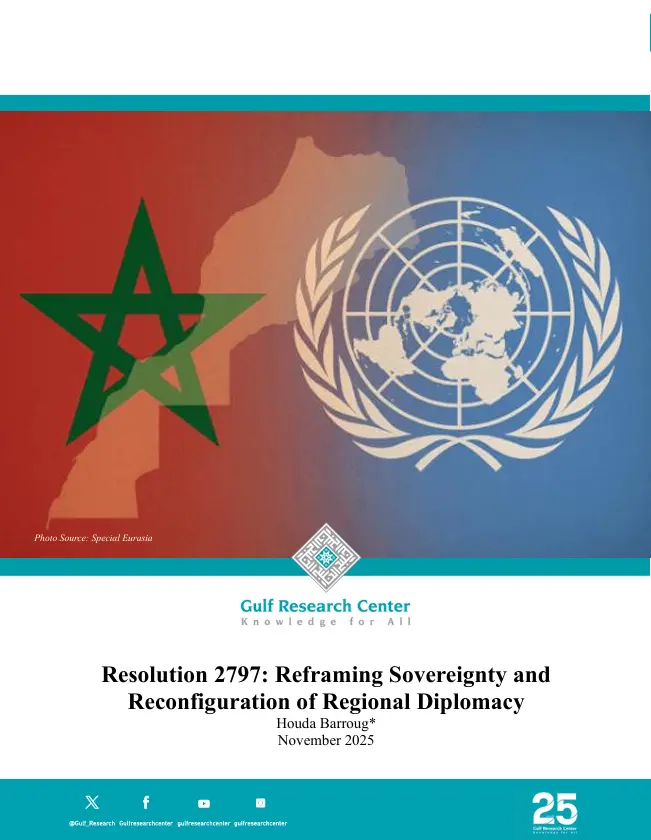
The UN’s endorsement of US-backed Resolution 2797 on Morocco’s autonomy plan on “Western Sahara” marks initial steps toward solving one of the long-standing territorial disputes on the African continent. For over five decades, the battle over Western Sahara has been at a diplomatic standstill, pitting Morocco against the Polisario Front, supported by Algeria, and which calls for sovereignty for the region's Sahrawi people. While the greater part of the territory has remained effectively under Moroccan administration since Spain's departure in 1975, the international community has previously oscillated between ambiguous commitments to a negotiated settlement and calls for a self-determination referendum.
This new momentum marks the strongest indication of intern4ational support for Morocco's position. By characterizing "genuine autonomy under Moroccan sovereignty" as the "most feasible solution" to the crisis, the Security Council has placed Rabat's proposal at the heart of future negotiations. The Resolution garnered strong support with the US, the UK, and France, and the majority of Council members voting in favor. Russia, China, and Pakistan abstained, while Algeria declined to participate.
The approval of the UN Resolution is the product of Morocco’s political, diplomatic and on-theground efforts. Morocco has responded appropriately, adopting a combination of triumphalism and strategic framing, but also one of realism and pragmatism. The government designated October 31 as Unity Day to commemorate the "national unity and territorial integrity" and connect national identity formation to the kingdom's foreign policy accomplishments. Amidst the momentum, the King launched high-level national consultations to update and detail the autonomy plan, a framework in which he emphasizes inclusive national dialogues and the country’s intention to achieve a win-win solution for all parties involved.
The UN's policy neither precludes dialogue nor completely rejects the notion of self-determination. The Security Council tasked the parties to engage in resumed negotiation, which remains challenging given the objection of Polisario, highlighting the complexities yet to be negotiated and resolved.
Moroccan Foreign Policy and Diplomatic in Action
The dossier of the Moroccan Sahara has been the driving force of the country’s foreign policy approach for the past decade, demonstrating significant evolution, adaptability, sophistication over the years. The autonomy plan proposed in 2007 signaled a key shift from a more traditional territorial defense stance to a forward-thinking diplomatic and strategic engagement aimed at securing international legitimacy and long-term sovereignty over the contested region. Instead of depending primarily on military or unilateral approaches, the new approach prioritized incremental diplomacy, coalition building, and harnessing geopolitical currents.
Morocco's aptitude to form and strengthen strategic ties, particularly with the United States, has been critical to this strategy. Initially ignited in 2020 by the US's formal recognition of Moroccan sovereignty over Western Sahara, a milestone intertwined by the normalization of Moroccan-Israeli ties under the Abraham Accords, the support for the autonomy plan gained momentum and was supported by the Biden administration as well. The plan has always been sustained across the different political spectrums, regardless of the administration.
In 2002, when the UN’s position was to force a referendum, James Baker, the UN’s special envoy at the time, called for autonomy under Moroccan sovereignty under what is known as the initial “Baker Plan.” The proposal was rejected by the Polisario, and Baker suggested a referendum, which Morocco rejected. The Bush Administration supported Morocco’s position, urging the country to develop and substantiate an actual plan, which the Kingdom did in 2007.
Beyond Washington, Morocco's drive to legitimize its claim to disputed territory started with deliberate coalition building across the Gulf and Africa. The Gulf countries were some of the first to recognize the legitimacy of the claim, with UAE and Bahrain opening consulates in Laayoune in November and December 2020, respectively. Saudi Arabia issued a royal edict in early 2024 prohibiting the use of the term "Western Sahara" within its territory, insisting on referring to Morocco as a complete, undivided territory. The GCC reaffirmed on various occasions its steadfast support for Morocco’s claim, describing this position as a matter of principle inherent to the strategic ties between both parties.
On the African continent, the King's diplomatic outreach emphasized pan-African solidarity, capitalizing on the country's 2017 reintegration into the African Union, after a 33-year absence. The outreach also prioritized forging strong institutional, economic, and regional development initiatives, capitalizing on Rabat's promise of regional infrastructure investment and increased trade. The ambition to build a commercial corridor connecting the Sahel to Dakhla's new Atlantic port drew significant interest from landlocked states such as Mali, Chad, and Niger, bolstering Rabat's power in West Africa. Morocco has been leading a proactive, win-win strategy across the continent that enabled it to reconstruct its autonomy plan and gain support from over 70% of the continent.
Morocco’s early coalition building in the Gulf and Africa legitimized the country’s autonomy plan prior to Western capitals’ formal recognition. It changed the balance of international legitimacy well before the recent wave of European support, particularly from Spain, France, and the UK. On a bloc-level, Morocco’s engagement with the EU has been practical and comprehensive, including economic incentives such as trade treaties and fisheries agreements, as well as alignment with EU concerns about border security, migration, and regional stability.
For long, France’s ambiguous stance on the question of the Sahara and its attempt to strike a balance between the Kingdom and Algeria have strained the Moroccan-French relations. President Macron’s long-awaited visit in October 2024 and his subsequent clear endorsement marked the beginning of a new era of rapprochement and cooperation between both countries. Relations between Spain and Morocco deteriorated significantly after Spain permitted Brahim Ghali, the Polisario leader, for receive medical treatment in 2021, resulting in diplomatic implications and migratory concerns. Spain changed its stance in 2022 to support Morocco's autonomy proposal, resulting in the restoration of diplomatic connections and collaboration by late 2024, bringing an end to a year-long freeze and alleviating bilateral tensions.
By the time EU endorsements joined those of African and Arab nations, Morocco was also able to share its vision of autonomy with Russia and China, although both countries abstained from voting on the Resolution. Minister of Foreign Affairs Nasser Bourita attributed this decision to the two countries’ power dynamics with the US, rather than actual opposition to the Moroccan plan per se. Bourita also credited the King’s direct engagement and diplomacy with managing to tip the balance in favor of the Kingdom amid “one of the most complex compositions the Council has ever seen.” The UN resolution of 2025 serves as a precedent for Morocco's complex and constantly evolving diplomatic approach, one that has made steady success by strategically aligning with global political trends and forming critical relationships at crucial moments when dealing with complex international legal and regional issues.
Significance and Implication of the Resolution
Resolution 2797 first provides a new road to political resolution by centering Morocco's Autonomy Proposal in UN negotiation procedures. The adoption of the autonomy plan under Moroccan governance as the formal starting point for negotiations shifts the focus away from independence and separatist ambitions. The new international governance norm strengthens Morocco's internal and international positions by demonstrating that long-term peace necessitates an operational framework for talks and a structured system of government.
Second, Resolution 2797 reduces the political scope for regression and tensions into a fixed status quo. The Resolution creates various sources of influence by allowing parties to discuss without preconditions while accepting increased involvement in global and regional affairs. Algeria and Polisario are under increasing international pressure to actively participate in negotiations, while Morocco gets support from a growing number of African, Gulf, and European countries that have a common interest in sustaining Maghreb stability. The Resolution's extension of the UN Mission for the Referendum in Western Sahara (MINURSO) keeps a peacekeeping apparatus in place to monitor the situation and prevent violations while also supporting critical dialogue-building operations.
The resolution also represents an implicit shift in regional dynamics. The Kingdom's autonomy framework is now the legitimate regional settlement reality, which is believed to further nudge neighboring countries to rethink their approach to Rabat and its wider strategic and economic moves. While Algeria remains a strident opponent, the rising international emphasis on a dialogue and realistic compromise could eventually result in its diplomatic and regional isolation.
The adoption of the Resolution carries significant economic implications. The endorsement of Morocco's autonomous framework is anticipated to shift the national and regional investor confidence and economic stability, particularly in southern provinces with mining, fishing, and renewable energy prospects. The subsequent construction plan of a clear governance and implementation horizon carried by the King is to focus primarily on port development, increased infrastructure financing, and regional logistics initiatives to better connect neighboring landlocked countries to the Atlantic routes. However, this would depend on ensuring regional stability, competent resource governance, and revenue transparency and sharing to prevent disparities within the different regions of the country or potential disputes over phosphates, future hydrocarbons, and fishing rights.
Challenges and Next Steps
Resolution 2797 marks indeed a new beginning for the national and international communities, but the challenges on the ground remain significant enough to potentially impede the prospects of a durable settlement in Western Sahara. Algeria and the Polisario represent the most immediate challenges, as their opposition to the Resolution and to genuine, effective, diplomatic dialogue could lead to political paralysis. Moreover, although MINURSO’s mandate has been extended for one year in the hopes of “give[ing] yet another chance to the peace process,” the mission will most likely continue to face key security and operational challenges, diplomatic and humanitarian concerns, and political and mandate-related challenges.
The international efforts to ensure the sustainability and effectiveness of the Resolution should first and foremost focus on re-energizing UN mediation and credibility. The UN should be reinforced as the main platform for facilitating dialogue and negotiations between the concerned parties, ensuring calls for concessions with covenants for Sahrawi participation. Moreover, Algeria and the Polisario are central to the political dialogue, but their refusal to negotiate with Morocco will eventually revert the historical process to a stalemate. Algeria, exhausted in its defense of the Polisario, calls the Resolution a “dangerous precedent” and “a text that does not faithfully reflect the UN doctrine on decolonization..” There should be joint international efforts to bring Algeria and the Polisario to the discussion table, perhaps led by France, Spain, and/or the United States.
All in all, Resolution 2797 provides a pragmatic base for a genuine path towards regional cooperation, stability, and economic development. Its effectiveness remains contingent upon institutionally structured and diplomatic efforts to promote dialogue, inclusion, cooperation, and transparency between all parties.
*Houda Barroug is a Researcher at the Gulf Research Center (GRC)