

Commentary & Analysis
Maritime Security and Trade Corridors - Connecting the Red Sea to the Indo-Pacific and the Relevance to the Gulf
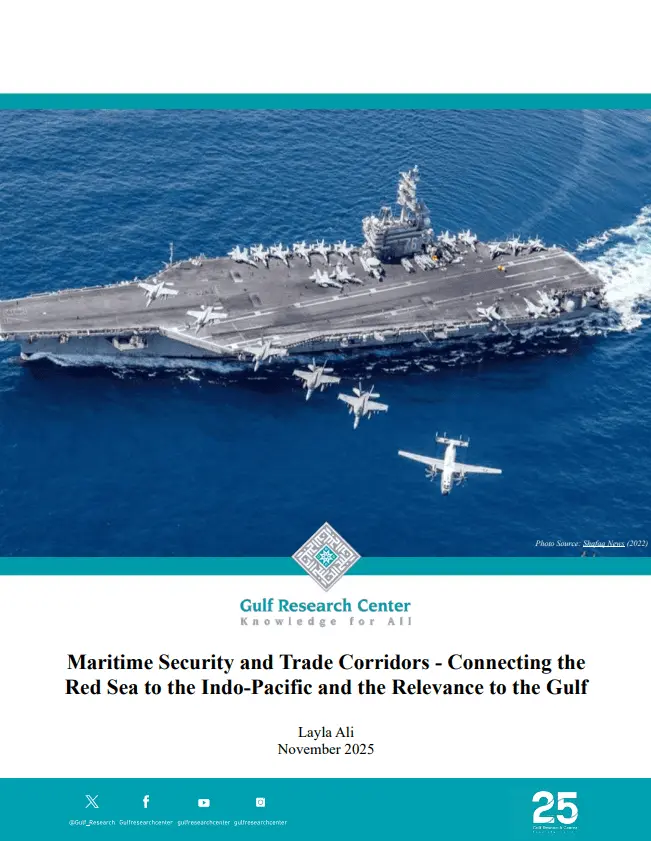
The maritime corridor connecting the Red Sea to the Indo-Pacific is one of the world’s most vital arteries of global commerce and a key arena of geopolitical competition. Anchored by the Suez Canal and the Bab al-Mandab Strait, it forms the main link between Asian production hubs and European consumer markets. Carrying roughly 12% of global trade and 8% of global liquefied natural gas (LNG) flows, this route is essential to the functioning of global supply chains. For the GCC states, whose economies rely heavily on energy exports, imported goods, and maritime logistics, the security of this corridor is a strategic priority. Recent attacks on commercial shipping in the Red Sea have underscored both its vulnerability and its growing importance to Gulf security planning and foreign policy.
The Corridor’s Global Significance and Emerging Security Challenges
The Red Sea-Indo-Pacific corridor is a strategic shortcut linking Asia, Africa, and Europe, anchored by the Suez Canal and the Bab al-Mandab Strait, two of the world’s most critical and vulnerable chokepoints. The Bab al-Mandab alone is the fourth most important chokepoint for global oil flows, making it central to international energy security.
Security conditions have deteriorated sharply due to Houthi attacks on commercial vessels, including the Galaxy Leader (seized in 2023), the Rubymar (sunk in 2024), and container ships operated by Maersk, MSC, and Hapag-Lloyd. These threats have forced major carriers to halt Red Sea transits and reroute around the Cape of Good Hope, reducing traffic through the Suez Canal and Bab al-Mandab by nearly 50% and causing 10–14-day delays, soaring insurance premiums, and higher fuel costs. The crisis has also affected digital infrastructure, with damage to subsea cables such as AAE-1 and EIG disrupting roughly 25% of regional data traffic.
In response, the U.S. launched Operation Prosperity Guardian and the EU deployed Operation Aspides, escorting ships and intercepting drone and missile threats. These international missions underscore how Red Sea security is inseparable from the wider Indo-Pacific and highlight the corridor’s role as a strategic bridge linking Gulf interests with global power rivalries.
Gulf States and the Reorientation Toward Maritime Strategy
Recognizing the centrality of maritime routes to their national security and economic prosperity, Gulf states are increasingly reorienting their strategies toward the sea. This shift reflects a broader understanding that maritime domains, from the Red Sea to the Arabian Sea and the Indo-Pacific, serve as lifelines for trade and as arenas of strategic influence. This reorientation can be observed through three interlinked trends: strategic investment, naval modernization, and international cooperation.
1. Strategic Maritime Investments
Economic diversification efforts across the Gulf are increasingly anchored in logistics and maritime connectivity. Saudi Arabia’s Vision 2030 positions the Red Sea as a key driver of the Kingdom’s global logistics ambitions. Projects such as NEOM, and its port city Oxagon, alongside the King Salman International Complex for Maritime Industries and Services in Ras Al-Khair, illustrate Saudi Arabia’s intent to establish itself as a global maritime hub connecting the Mediterranean to the IndoPacific. The Jeddah Islamic Port, one of the busiest in the region, is undergoing expansion to handle larger vessels and greater volumes.
The UAE has emerged as a global leader in port management and logistics. DP World, headquartered in Dubai, operates more than 80 terminals in over 40 countries, including Sokhna (Egypt), Berbera (Somaliland), and Bosaso (Somalia), strategic locations that extend Emirati reach along the Horn of Africa and secure alternative trade routes. Meanwhile, Abu Dhabi Ports Group has expanded into Tanzania, Pakistan (Gwadar), and India (Mumbai), strengthening the Gulf’s commercial integration with the Indo-Pacific.
These investments not only diversify Gulf economies but also expand their geopolitical influence across key trade arteries. By integrating logistics, shipbuilding, and maritime services into national development plans, Gulf states are transitioning from energy-dependent economies into connectivity powerhouses at the crossroads of global trade.
2. Naval Modernization and Maritime Power Projection
Alongside major infrastructure investments, Gulf states are upgrading their naval forces to protect key sea lanes and secure their expanding maritime interests. The rising risks of piracy, terrorism, and regional instability, from the Bab al-Mandab to the Strait of Hormuz, have accelerated military modernization programs across the region.
Saudi Arabia is undertaking one of the region’s most ambitious naval modernization programs, including the Royal Saudi Naval Forces’ acquisition of Al-Jubail–class (Avante 2200) corvettes and additional vessels under the Sarawat program, supported by a growing partnership between SAMI and Navantia. Saudi Arabia has also reinforced its Western Fleet, enhancing its ability to protect Red Sea trade routes. These vessels, supported by a growing domestic shipbuilding partnership between SAMI and Navantia, enhance Saudi Arabia’s maritime reach.
The UAE Navy has emerged as one of the Gulf’s most capable forces, with Baynunah-class corvettes, advanced mine-countermeasure systems, such as the UMIS unmanned suite from France, and expanded surveillance capabilities. Its operations off Yemen and the Horn of Africa, supported by logistical facilities in the Red Sea, highlight its growing power-projection capacity.
Oman and Qatar have likewise strengthened their fleets. Qatar’s US$5.6 billion Fincantieri program, introducing Doha-class corvettes, OPVs, and an LPD, and Oman’s Khareef-class corvettes enhance exclusive economic zones (EEZs) protection and counter-piracy roles. Collectively, these upgrades reflect how Gulf states are moving away from reliance on external naval protection toward greater self-reliance, burden-sharing, and the development of credible maritime deterrent capabilities.
3. Regional and International Partnerships
Gulf states are expanding their eastward security diplomacy, reflecting a broader shift toward diversified strategic partnerships across the Indo-Pacific. The UAE and India have conducted multiple joint naval exercises, most notably Zayed Talwar (Exercise Gulf Waves), and increased interoperability through coordinated patrols, port visits, and officer-training exchanges. There is a strong focus on forging partnerships and joint ventures between defense manufacturers, with the second India-UAE Defence Industry Partnership Forum held in July 2025. This initiative aims to explore co-production and technology sharing in areas like unmanned systems, AI, and naval platforms.
Saudi Arabia and Japan have strengthened maritime cooperation through defenseindustrial agreements and regular joint training activities, while the Japan Maritime Self-Defense Force (JMSDF) continues to conduct port calls in Jeddah and Fujairah as part of its long-running anti-piracy mission in the Gulf of Aden. This mission has been repeatedly extended by the Japanese government, with the latest extension announced in November 2025 to run until November 2026.
South Korea has also intensified its engagement with Gulf partners: the deployment of the Cheonghae Unit to protect merchant shipping in the Strait of Hormuz, along with growing defense-industrial cooperation with Riyadh and Abu Dhabi in February 2025, underscores Seoul’s expanding security footprint in the region.
Collectively, these expanding partnerships position the GCC as an emerging strategic bridge between the Red Sea, the Arabian Gulf, and the wider Indo-Pacific. As Gulf states strengthen ties with India, Japan, South Korea, and Southeast Asian partners, they are increasingly shaping the contours of a new, interconnected maritime-security architecture that extends far beyond their immediate neighborhood.
Strategic Implications for the Gulf
The growing interdependence between the Red Sea and the Indo-Pacific carries significant strategic implications for the Gulf, requiring a reconceptualization of regional security as part of a broader Indian Ocean continuum rather than a set of isolated maritime spaces. As external powers, including the United States, China, Europe, and India, expand their presence across these waters, Gulf states must carefully balance deepening economic integration with Asia and longstanding security partnerships with the West through a pragmatic posture of strategic neutrality that protects national interests while avoiding entanglement in greatpower rivalries.
Despite the accelerating global energy transition, Gulf hydrocarbons will continue to flow through these sea lanes for decades, meaning the protection of maritime corridors remains an enduring priority; at the same time, emerging sectors such as green shipping, hydrogen transport, and subsea digital infrastructure are reshaping the maritime domain and require adaptive policies and new technological investments.
As Gulf states evolve from security consumers to increasingly capable security providers, leveraging enhanced naval capabilities, growing diplomatic engagement, and participation in regional frameworks, they are positioning themselves as key contributors to stability across the Red Sea-Indo-Pacific corridor.
Consolidating this role will demand the development of a Gulf Maritime Security Framework that integrates naval, coast-guard, and intelligence cooperation; strengthened partnerships with Asian and African littoral states through joint training, capacity-building, and port development; investments in advanced maritime-domain awareness technologies such as satellite and AI-driven surveillance; the institutionalization of a Red Sea–Indo-Pacific dialogue to align trade, energy, and security strategies; and a commitment to sustainable maritime governance rooted in the blue economy and environmental protection.
The Gulf’s reorientation toward maritime strategy marks a multidimensional shift combining economic ambition, security modernization, and global partnerships. As trade corridors linking the Red Sea to the Indo-Pacific expand, the Gulf’s ability to safeguard and shape these routes will define its future strategic relevance. Through visionary infrastructure projects, advanced naval capabilities, and diversified international cooperation, Gulf states are emerging as pivotal actors in the evolving maritime order that connects Africa, Asia, and Europe.
* Layla Ali is the Senior Research Associate at the Gulf Research Center (GRC)