Commentary & Analysis
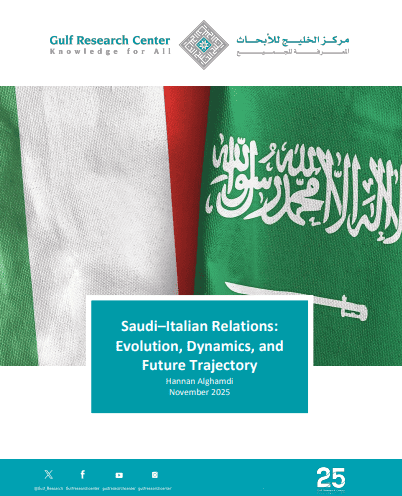
Saudi–Italian Relations: Evolution, Dynamics, and Future Trajectory
Executive Summary
This paper examines the evolution, current dynamics, and future trajectory of Saudi– Italian relations, tracing their origins from the establishment of diplomatic ties in 1932 to their deep institutionalization under the Custodian of the Two Holy Mosques, King Salman bin Abdulaziz Al Saud. It highlights how the relationship has expanded beyond traditional trade and energy cooperation into a comprehensive strategic partnership encompassing defense, investment, culture, and development.
Under King Salman’s leadership and the framework of Vision 2030, Saudi Arabia and Italy have advanced cooperation in key sectors including energy transition, manufacturing, infrastructure, and cultural exchange. The landmark visit of Italian Prime Minister Giorgia Meloni to Al-Ula in January 2025 marked a turning point, resulting in the establishment of the Saudi–Italian Strategic Partnership Council, the signing of 26 memoranda of understanding, and a $6.6 billion package of agreements led by Italy’s SACE, including a $3 billion facility for NEOM.
Despite occasional divergences on regional issues, both nations continue to strengthen their economic and political alignment. Looking ahead, the partnership is poised to play a pivotal role in linking Europe and the Gulf through sustainable energy, defense cooperation, and cultural diplomacy, reflecting shared aspirations for stability and prosperity.
Historical and Diplomatic Foundations
Formal relations between Italy and the government of Najd and Hejaz were rooted in extensive diplomatic communication and complex negotiations during the early twentieth century. Archival correspondence and reports exchanged between Italian representatives and British diplomats stationed in Jeddah and Rome reveal Italy’s and France’s persistent interest in establishing formal ties with King Abdulaziz bin Saud, whose leadership was reshaping the Arabian Peninsula. These early exchanges reflected a convergence of strategic interests and laid the groundwork for future recognition and cooperation.
The process culminated in April 1932, when the Kingdom of Italy and the government of Najd and Hejaz signed the Treaty of Friendship and a Trade Treaty, marking Italy’s official recognition of the new Saudi state and opening the door to structured diplomatic relations. Italy soon elevated its representation to the level of a commission, underscoring its commitment to a durable partnership. Throughout the 1930s, diplomatic discussions went beyond trade and recognition to include the Kingdom’s stance during the Italo– Ethiopian conflict (1935–1936), a test of the Kingdom’s neutrality and emerging foreignpolicy identity.
Following the founding of the Kingdom of Saudi Arabia in 1932, these early ties matured into enduring diplomatic relations that survived moments of strain, such as Italy’s brief support for Yemen during the 1934 Saudi–Yemeni war.
Archival telegrams from this period record meetings regarding Saudi–Italian relations, as well as detailed notes on Italian diplomatic gifts to the Saudi government, including weaponry and aircraft, that symbolized growing trust and practical cooperation. By the late 1930s, official visits and the establishment of the Saudi–Italian Joint Business Council had become consistent features of bilateral engagement, intertwining governmental and commercial interests.
The diplomatic archive from 1930 to 1938, encompassing 182 pages of correspondence, attests to the early evolution of this relationship and the substantive political and material exchanges that formed its foundation.
Both nations rebuilt and strengthened their connection after World War II: by the 1950s, Saudi Arabia had established a legation in Rome, while Italy deepened its engagement in the Kingdom as its post-war industrial economy expanded. Over subsequent decades, embassies, trade missions, and institutional mechanisms, including the Saudi– Italian Joint Business Council, reinforced the partnership.
By the latter half of the twentieth century, cooperation extended well beyond oil and trade to include education, construction, and security, reflecting both countries’ growing global roles. Italy, as a major Mediterranean industrial power, found in Saudi Arabia a stable and strategic partner in the Middle East. For Saudi Arabia, Italy represented a key European counterpart and a gateway to the broader European Union (EU).
Today, this relationship, rooted in the 1932 Treaty of Friendship, stands as a long-term model of diplomatic endurance and adaptive cooperation, linking Europe and the Arabian Peninsula through shared economic interests, cultural dialogue, and strategic vision.
Saudi–Italian Relations under the Custodian of the Two Holy Mosques, King Salman bin Abdulaziz
The accession of King Salman bin Abdulaziz Al Saud in 2015 marked the beginning of a transformative period in Saudi Arabia’s foreign and domestic policy. Guided by Vision 2030, the Kingdom embarked on a comprehensive reform program aimed at diversifying its economy, localizing industries, and expanding its global partnerships. Within this framework, Italy emerged as a natural ally, being an advanced industrial nation with expertise in energy, infrastructure, manufacturing, and cultural preservation.
Under King Salman’s leadership, bilateral cooperation expanded in scope and intensity. The two countries held a series of high-level meetings and sectoral dialogues that institutionalized cooperation across energy, investment, defense, and culture. Riyadh viewed Italy as both a trusted European partner and a bridge to the EU, while Rome recognized the Kingdom as a central pillar of stability and reform in the Arab world.
The Saudi approach under King Salman combined economic openness, cultural diplomacy, and strategic cooperation, aligning well with Italy’s ambition to increase its role in the Gulf. The result has been a decade of tangible outcomes, reflected in rising trade, expanding joint ventures, and the establishment of new forums for sustained dialogue.
Diplomatic Engagements and High-Level Visits: Italian Prime Minister’s Visit to Al-Ula
In January 2025, Italian Prime Minister Giorgia Meloni conducted an official visit to Al-Ula for a meeting with Crown Prince and Prime Minister Mohammed bin Salman. This encounter represented an important advance in Saudi–Italian relations and solidified both countries’ commitment to strengthening their bilateral partnership.
The discussions during the visit covered a comprehensive set of priorities central to both nations’ interests, including economic collaboration, regional security, energy transition, the Israeli–Palestinian issue, and initiatives for cultural and educational exchange. The outcome of these high-level talks was the signing of agreements collectively valued at $10 billion, demonstrating the two countries’ intention to cooperate in fields such as technology, infrastructure, renewable energy, and industrial development. Through these agreements, Italy affirmed its support for Saudi Arabia’s Vision 2030 framework, while Saudi Arabia positioned Italy as a principal European partner for future-facing sectors.
Complementing this progress, the Saudi– Italian Roundtable convened government officials and private sector leaders from both sides, leading to the signing of twenty-six memoranda of understanding in areas including construction, renewable energy, culture, and digital innovation. This phase reflects a shift from traditional diplomatic engagements to a multidimensional collaboration that emphasizes technology transfer, sustainability, and mutual investment.
A major institutional development of the visit was the creation of the Saudi–Italian Strategic Partnership Council. This council is designed to oversee and coordinate cooperation across political, economic, defense, and cultural fields, providing a formalized framework to monitor joint efforts and ensure alignment on shared priorities.
Further reinforcing bilateral cooperation, Italy’s export-credit agency SACE concluded several agreements with Saudi partners during the visit in early 2025. The agreements include a significant financing arrangement for the NEOM megaproject and the signing of a memorandum of understanding between the Saudi Fund for Development and Italy’s Cassa Depositi e Prestiti established a basis for joint activity in socio-economic development initiatives, indicating both countries’ commitment to supporting growth and sustainability beyond their borders.
Altogether, these outcomes highlight the transition of Saudi–Italian relations from formal diplomatic interactions to a structured and strategic alliance. Institutional frameworks, major project agreements, and a broadening agenda of cooperation now define the relationship, providing a strong and flexible foundation for further advancement and mutual benefit.
Economic Relations, Trade, and Investment
Economic relations are a main pillar of the Saudi–Italian partnership. Italy consistently ranks among Saudi Arabia’s ten largest European trading partners, and Saudi Arabia is a strategic energy supplier and increasingly attractive market for Italian exports and investment.
In 2024, bilateral trade volume reached USD 9.04 billion, which counts to about 1.7% of Saudi Arabia’s global trade. Italian exports to Saudi Arabia totaled USD 8.06 billion, dominated by machinery and mechanical appliances (USD 2.48 billion), pharmaceuticals (USD 861 million), electrical and electronic equipment (USD 658 million), vehicles (USD 287 million), and iron/steel articles. Saudi exports to Italy were valued at USD 976 million, concentrated in plastics (USD 285 million), organic chemicals (USD 157 million), aluminium (USD 108 million), aircraft parts (USD 75 million), and precious metals.
The corporate footprint is expanding: more than 150 Italian firms now operate in the Kingdom. Newly issued investment licenses to Italian entities grew by 110% in 2024, with 63 new permits granted. By year-end, Italy’s foreign direct investment stock in Saudi Arabia exceeded SAR 6.27 billion (approx. USD 1.67 billion), 14.2% higher than the previous year, and the annual net FDI inflow grew by 24%.
Joint ventures and localization initiatives are central, with major Italian firms such as Saipem, Webuild (Salini Impregilo), Ansaldo Energia, Prysmian Group, and Leonardo active in energy engineering, infrastructure, advanced manufacturing, and aerospace. Technology transfer, local job creation, and the alignment with Vision 2030 underpin these projects.
The Saudi–Italian Investment Forum and roundtables in early 2025 resulted in 26 memoranda of understanding covering renewable energy, infrastructure, digital innovation, healthcare, and creative sectors. Italian economic engagement is visible in gigaprojects like NEOM, supported by SACE’s USD 3 billion export credit guarantee, and a new MoU with the Public Investment Fund for up to USD 3 billion in additional joint financing by 2027.
Italian involvement now encompasses energy contracts with Saudi Aramco, agri-food ventures, hospitality, tourism, and digital partnerships, which demonstrate the deepening convergence between Saudi diversification priorities and Italy’s global outreach. A notable recent development is the partnership with Arsenale S.p.A., the Italian luxury hospitality and rail company behind the revival of the Orient Express–style trains. Arsenale is developing a high-end luxury train experience in Saudi Arabia that aligns with Vision 2030’s tourism ambitions and complements major destinations such as AlUla, NEOM, and the Red Sea. The project not only brings Italian design and craftsmanship into the Kingdom’s emerging luxury tourism sector but also symbolizes the expanding cultural-economic dimension of bilateral cooperation.
This diverse economic portfolio highlights not only the comprehensive nature of Saudi– Italian economic collaboration but also a shared commitment to sustainable development, technology localization, and bilateral prosperity.
Strategic Relationship and Security Cooperation
The security dimension of Saudi–Italian relations has deepened in recent years, marked by strong defense trade and expanding institutional cooperation. Between 2019 and 2024, Italian arms exports to Saudi Arabia averaged over €400 million annually, placing Italy among the Kingdom’s top suppliers of advanced military equipment. Saudi procurement from Italy includes naval vessels, aircraft components, electronic warfare systems, and air defense technology—making firms like Leonardo, Elettronica, and Fincantieri key partners in developing Saudi armed forces.
Security cooperation now encompasses far more than transactional weapons sales. Italian firms have entered joint ventures with Saudi entities to promote localized manufacturing, technology transfer, and operational support, all of which are core objectives for the Kingdom under Vision 2030’s plan to localize fifty percent of its defense procurement by 2030. These agreements facilitate not just direct equipment provision, but also knowledge exchange, co-production, and personnel development.
The Saudi Ministry of Defense routinely sends officers and specialists to Italy for advanced training in naval operations, air defense, counterterrorism, and cyber security. Italian academies have opened pathways for Saudi participation in select NATO-standard courses and exercises, providing access to EuroAtlantic expertise and enhancing interoperability. This supports Riyadh’s goal of aligning its procedures with established international standards and fostering longterm institutional capacity.
Maritime security represents a particularly robust area of bilateral activity, with cooperation in safeguarding Red Sea and Mediterranean shipping routes—both central to Saudi export flows and to Italy’s energy supply chain. Fincantieri’s contribution goes beyond shipbuilding, extending to collaborative projects in maritime infrastructure and freshwater management with Saudi partners.
Despite these achievements, notable challenges persist. The localization of defense production requires not only technical expertise but also regulatory reform and sustainable human capital development. Full absorption of advanced technologies, institutional continuity in joint ventures, and the creation of enduring local industries are ongoing challenges that demand long-term commitment from both nations.
Furthermore, while Saudi Arabia’s engagement in NATO-aligned training and exercises signals progress toward interoperability, the absence of formal partnership status and the shifting landscape of European security politics impose limits. Political changes, diverging priorities, and regional crises may restrict the depth and continuity of this cooperation.
Maritime collaboration, while significant, remains vulnerable to external pressures including regional instability, piracy, and competing interests among Gulf and EU actors. Effective coordination requires balancing bilateral priorities with wider multilateral frameworks, which may not always align.
Overall, Saudi–Italian security cooperation has evolved into a multidimensional partnership characterized by advanced technology transfer, training, and institutional engagement. Nonetheless, practical challenges in localization, regulatory frameworks, and the regional security environment underscore the importance of continued policy attention and adaptive strategies to ensure its depth and sustainability.
Socio-Cultural Partnerships and People-toPeople Exchange
Cultural and educational cooperation between Saudi Arabia and Italy has flourished alongside economic and political engagement. Italian architects, archaeologists, and cultural institutions are active in Saudi heritage preservation, particularly in Al Ula, Diriyah, and the Jeddah Historic District. Italian universities and design institutes have also expanded their footprint in the Kingdom. A major milestone is the opening of Istituto Marangoni in the King Abdullah Financial District in Riyadh, which brings one of Italy’s leading fashion and design schools to Saudi Arabia and strengthens the Kingdom’s creative economy. This initiative complements a wide range of academic partnerships supporting talent development in architecture, fashion, design, the arts, and heritage management.
Exchanges in the fields of art, heritage, fashion, and tourism deepen mutual understanding and project both countries’ soft power. Italian Saudi collaborative exhibitions, joint masterclasses in design, archival and restoration workshops, and fashion and tourism themed events all help build bridges between citizens and students, not only between governments. Cultural diplomacy has therefore become an essential complement to political and economic collaboration and reinforces the long-term sustainability of the relationship.
Tourism flows and improved connectivity now provide a concrete underpinning of the people-to-people pillar. In 2024, more than 322,000 Saudi tourists visited Italy, which represents a 65 percent year-on-year increase. Their spending exceeded half a billion euros according to the Italian minister. On the Saudi side, international tourist arrivals reached about 29.7 million in 2024, reflecting the Kingdom’s growing attractiveness as a destination and the impact of ongoing Vision 2030 tourism reforms. Although recent official data on the number of Italian visitors to Saudi Arabia is limited, Italian tourism authorities and airlines have noted rising interest and growing demand for travel to the Kingdom, supported by new direct flight connections and easier travel arrangements.
As more Italian travelers explore Saudi cultural sites and heritage tours, including Al Ula’s archaeological landscape, design and fashion circuits in Riyadh and Jeddah, and luxury tourism experiences along the Red Sea coast, people-to-people linkages continue to deepen. Meanwhile, Saudi visitors to Italy gain wider exposure to Italian cultural heritage, design education, and tourism experiences in cities such as Rome, Milan, and Venice. These flows support the tourism and hospitality sectors in both countries and create networks of alumni, designers, researchers, and returning visitors that enrich sociocultural ties beyond official channels.
Political Convergences and Divergences
From a political perspective, Saudi Arabia and Italy share substantial common ground. Both countries support energy-market stability, promote multilateral engagement through platforms such as the G20, and place a strong emphasis on counterterrorism and deradicalization cooperation. Dialogue and moderation are frequently highlighted as essential tools for resolving disputes in both the Mediterranean region and the broader Middle East.
Despite this foundation of shared values, several differences persist. On the Palestinian issue, Saudi Arabia continues to champion the Arab Peace Initiative, maintaining that progress toward a two-state solution is essential before considering normalization with Israel. Italy, however, has historically adopted a cautious stance in its public statements on the conflict, particularly after October 7, due to its close bilateral relations with Israel and the European Union’s evolving yet ultimately noncommittal approach to advancing a two-state framework.
While Italy has supported humanitarian assistance to Gaza and emphasized the need to protect civilians, it has refrained from recognizing Palestinian statehood. These divergences are reflected in diplomatic messaging and voting patterns, though both countries continue to coordinate relief efforts and preserve an open and constructive dialogue.
Additional divergences exist in their respective approaches to regional hotspots. On Libya, Italy has advocated for active European diplomatic engagement and stabilization initiatives, often coordinating closely with EU partners, while Saudi Arabia’s role in Libyan affairs remains more restrained and sometimes aligned with alternative regional actors. Regarding Iran, Italy participates within the broader EU effort to negotiate and maintain frameworks such as the Joint Comprehensive Plan of Action, whereas Saudi policy is characterized by skepticism and a more security-centric posture focused on countering Iranian regional influence.
Human rights concerns in Europe also introduce periodic points of friction. In Italy, domestic debates over arms exports to Gulf states, driven by civil society groups, media, and parliamentary oversight, can at times complicate otherwise stable defense and security cooperation. From a Saudi perspective, these pressures often reflect internal Italian politics rather than the realities of bilateral engagement, yet they still have the potential to delay agreements or introduce an element of volatility. These sensitivities tend to intensify following high-profile episodes that prompt broader European calls for stricter export controls.
Despite these differences, the overall relationship has proven resilient. Regular diplomatic consultations, economic interdependence, and practical cooperation on shared security priorities provide the foundation for managing disagreements. The ability to coordinate in multilateral forums and to compartmentalize sensitive issues reflects the maturity of Saudi–Italian relations and its capacity to pursue shared interests even in the presence of policy variation.
Future Trajectory: Opportunities and Challenges
Looking ahead, the prospects for Saudi Italian relations appear highly positive. The institutional architecture established in Al Ula provides a stable foundation for long-term growth. Cooperation in energy transition, particularly in hydrogen, renewables, carbon management, and advanced grid systems, is expected to become the next major frontier, with Italy well positioned to serve as a European gateway for Saudi clean energy exports. Joint industrial ventures in smart manufacturing, sustainable mobility, and green technologies offer additional areas of potential expansion.
In the defense and security sector, localization initiatives and technology transfer are likely to deepen, including the possibility of Saudi participation in European aerospace and dual use technology programs. Italian firms will continue to play major roles in Saudi mega projects such as NEOM, Red Sea Global, Diriyah, and Qiddiya, where Italian expertise in architecture, design, engineering, sustainability, and tourism management strongly aligns with the Kingdom’s Vision 2030 priorities.
Think tanks and research institutions are also emerging as central drivers of the relationship. The Gulf Research Center (GRC), as a Saudi based think, has expanded its cooperation with Italian and international research centers such as the Istituto Affari Internazionali, ISPI in Milan, the LUISS Center for Strategic and International Studies, and The European House Ambrosetti. These partnerships support joint research, Track II diplomacy, expert exchanges, and shared analysis on regional security, energy transitions, transport corridors, and Euro Gulf policy coordination.
Alongside this research cooperation, major Italian strategic industries reinforce the bilateral partnership. Fincantieri, one of Italy’s largest shipbuilding and defense engineering groups, plays a growing role in maritime and naval cooperation with Saudi entities. Its expanding presence complements broader research initiatives and strengthens the longterm strategic dimension of the relationship.
Nevertheless, the relationship faces several practical challenges. Global economic uncertainty may slow investment and delay major projects, while differing positions on regional conflicts can complicate political and defense cooperation, particularly when European public opinion or parliamentary concerns influence decisions on arms exports or Gulf regional diplomacy. Domestic political pressures in Europe, including changing governments, scrutiny of Gulf related agreements, and shifting priorities on migration and energy security, can limit continuity and predictability in bilateral engagements. Effective implementation on the Saudi side also requires sustained institutional coordination and alignment with foreign partners. Converting memoranda of understanding into concrete projects will depend on rigorous oversight, clear execution timelines, and mutual trust. Strengthening people to people exchange, cultural outreach, and public diplomacy will further reinforce the long-term resilience of the partnership.
Overall, the direction is clear. Saudi Arabia and Italy are moving from a transactional relationship to a strategic, multidimensional partnership anchored in shared interests, complementary strengths, and a forwardlooking vision.
Conclusion
The relationship between the Kingdom of Saudi Arabia and the Italian Republic is today stronger and more diversified than at any point in its modern history. From Italy’s recognition of the Kingdom in 1932 to the launch of the Strategic Partnership Council in 2025, both countries have cultivated a relationship built on continuity, mutual respect, and expanding cooperation across strategic sectors.
Under the leadership of the Custodian of the Two Holy Mosques, King Salman bin Abdulaziz Al Saud, and His Royal Highness Crown Prince Mohammed bin Salman, Saudi Italian relations have advanced across trade, investment, defense, culture, and education. The Al Ula agreements, the SACE financing package, the SFD and CDP development initiatives, and the expanding landscape of joint ventures reflect not only deepening economic links but also a growing alignment in strategic outlooks. The increasing engagement of think tanks and academic institutions, including the partnerships facilitated by the Gulf Research Center with leading Italian and international research bodies, adds an important layer of policy dialogue and intellectual exchange that reinforces official efforts.
Although policy differences persist, particularly in relation to certain regional issues or European domestic debates, the direction of travel is clear. Saudi Arabia views Italy as a key point of access to Europe’s industrial, technological, and cultural ecosystems. Italy, in turn, sees the Kingdom as an essential partner in the Gulf, with increasing relevance for energy transition, regional diplomacy, and global connectivity.
As both countries operate in a rapidly shifting international environment, the depth and diversity of their cooperation offer significant potential for further growth. What is emerging is not simply a set of shared projects, but a partnership with the capacity to influence broader Euro Arab engagement and contribute meaningfully to stability, innovation, and economic opportunity on both sides.
*Hannan Alghamdi is a Researcher at the Gulf Research Center (GRC)