

Commentary & Analysis
The Disappointing Outcome of COP30
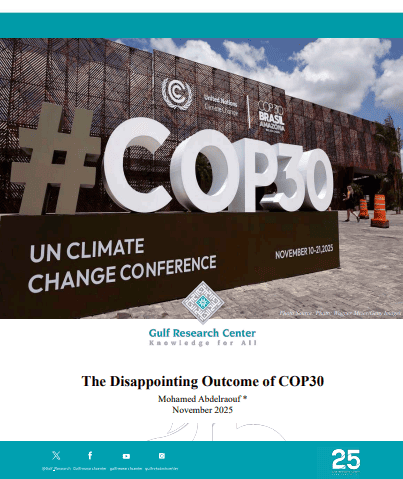
The 30th session of the Conference of the Parties (COP30) in Belém, Brazil, in November 2025 was billed as the "COP of Truth" by its host. But overall, COP30 turned out to be quite chaotic, following a fire-related evacuation, which disrupted negotiations, persistent infrastructure difficulties, and an atmosphere defined by dramatic disagreements and unusual diplomatic exchanges. The host city's location in the Amazon may have been symbolic, but its urban realities also presented unusual logistical challenges.
Ultimately, COP 30 delivered an outcome widely considered weak and disappointing by climate activists, scientists, and many nations. The main source of this disappointment stemmed from a critical omission in the final agreement of a clear, binding commitment to phase out fossil fuels, identified as the leading driver of the climate crisis. Instead of a decisive global shift and despite calls from many nations, COP 30 produced merely a compromising text reflecting deep geopolitical divisions and the powerful lobbying efforts of many petrostates. The primary outcomes focused on climate finance and adaptation, aiming to implement existing goals rather than establish new, ambitious ones.
Key Outcomes of COP30
In terms of outcome, the following conclusions can be drawn from COP 30:
Omission of Fossil Fuels: A deep divide emerged between two main blocs of countries over the fundamental issue of phasing out fossil fuels.
The "Ambitious Group": comprising more than 80 countries, including the United Kingdom, Germany, Spain, France, Chile, Kenya, and Colombia, called for a roadmap for the transition away from fossil fuels to be included in the final agreement. This group demanded specific language and a clear plan that aligns with the Paris Agreement's goal of limiting global warming to 1.5 degrees Celsius.
The "Petrostates Group”: An opposing group of over 80 countries, including Saudi Arabia, Russia, and others with economies dependent on the production and use of fossil fuels, blocked this ambition. This alliance insisted on national autonomy in determining energy pathways and successfully ensured that any mention of a fossil fuel phase-out or roadmap would be omitted from the final formal agreement.
Considered a victory for the second group, the final agreement did not include a specific roadmap or timeline for abandoning fossil fuels. Instead, the COP30 President, André Corrêa do Lago, personally committed to creating separate roadmaps for transitioning away from fossil fuels and ending deforestation outside the main text of the agreement.
Climate Finance: A central focus was placed on scaling up financial support for developing countries. The "Global Mutirão" decision —a high-level political text proposed by the COP Presidency and approved by 195 Parties—was adopted on November 22, 2025, during the final plenary session. The Mutirão decision aims for a $1.3 trillion per year trajectory by 2035 for developing nations to address climate change impacts. Countries agreed to accelerate climate action and to work toward tripling adaptation finance. In addition, guidance was given to existing climate funds (Special Climate Fund, Global Environment Facility, Adaptation Fund, the new Loss and Damage Fund, etc.) to simplify procedures and enable faster access to funding.
Adaptation Finance Tripled: The Mutirão resolution also called for tripling adaptation finance by 2035. This new target is a welcome continuation of the previous goal agreed upon at COP26 in Glasgow. It sends an important political signal about the need to close the growing adaptation finance gap and helps to maintain pressure on developed countries to increase their support. Despite that, the goal to triple adaptation finance was pushed to 2035, which vulnerable developing nations felt did not address their immediate needs. The conference also focused on establishing indicators to measure progress on the Global Goal on Adaptation, agreed upon at a previous COP 28. In addition to efforts to build resilience for cities, infrastructure and water were integrated into the COP30 Action Agenda.
Just Transition Mechanism: The agreement included the establishment of a formal UN-mandated Just Transition mechanism, which aims to secure the interests of workers and communities as economies move away from high-carbon industries.
Forest Protection: While a specific roadmap was not in the main text, the "Tropical Forest Forever Facility" was launched as a separate initiative, which aims to provide funding to countries to preserve standing forests.
Trade and Climate Dialogue: For the first time, trade was included as a pillar of the final text, launching a new dialogue process to examine how trade policy can better support climate action and avoid becoming a disguised restriction on international trade.
Despite the many COP30 challenges, weak language, and division between nations, COP30 generally succeeded in retaining the Paris Agreement and the UNFCCC process as foundational minimal goals, emphasizing the importance of continued multilateral cooperation despite the disagreements. This sets the stage for future COPs and national action plans, ensuring the global conversation moves from theoretical targets to concrete implementation strategies. The attention now is on COP 31, which will convene in Turkey with Australia playing a role as “President of Negotiations.” Ultimately, delegates agreed to a compromise in an arrangement that was achieved after many months of stalemate between the two potential hosts.
Yet, the global community placed great hopes on a strong outcome for COP30, given that it is currently not on track to meet the Paris Agreement goals. The gap between national emissions reduction plans and the actions needed to keep global warming below 1.5°C is vast, and the window for effective intervention is rapidly closing. By failing to secure strong, binding agreements on fossil fuels and finance, the multilateral process under the UNFCCC risks becoming an arena of "delay rather than a catalyst of action." The ultimate measure of success for a COP is not the survival of the diplomatic process, but whether it secures a manageable future for humanity. On that front, Belém fell short.
* Dr. Mohamed Abdelraouf is the Director of the Environmental Security and Sustainability Research Program at the Gulf Research Center.