

Commentary & Analysis
Two Pillars, One Gulf: China’s High-Stakes Balancing Act between Iran and the GCC
I. Introduction
China’s policy in the Middle East is characterized by a "dual-pillar" approach, simultaneously cultivating deep, political ties with the Islamic Republic of Iran and pursuing expansive, highvalue economic partnerships with the member states of the Gulf Cooperation Council (GCC). This strategy is driven by Beijing’s overarching geopolitical imperatives: securing stable energy resources, furnishing Chinese enterprises with access to two substantial external markets, and advancing political alternatives to the Western-led order.
The core tension in this strategy is inherent: how to maintain a balanced relationship with a highly sanctioned, security-critical partner (Iran) without alienating the major source of high-value trade, finance, and future technological investment (the GCC) — given the historically rooted tensions and mutual distrust that have long shaped relations between Tehran and the GCC states. This analysis argues that Beijing navigates this tension through a strategy of selective and transactional engagement, utilizing diplomatic ambiguity and a preference for facilitation over outright mediation. Because this balancing act is ultimately a mechanism for preserving a minimum level of regional stability needed for China’s interests, the management of these bilateral ties is inseparable from the broader security environment. The objective is to safeguard China’s core interests by ensuring just enough stability to secure trade and energy flows, while carefully avoiding the political and military costs associated with acting as a true regional security guarantor.
II. The Iran Pillar: Geopolitical Buffer and Sanctions Arbitrage
The depth of China's present relationship with Iran is largely an unintended outcome of Western policy shifts. Following the signing of the Joint Comprehensive Plan of Action (JCPOA) in 2015, Iran signalled a clear preference for re-engagement with the West, seeking cooperation with European companies in its car manufacturing and oil industries, despite multiple Chinese offers.1 This direction was dramatically reversed by the 2018 U.S. withdrawal from the JCPOA and the subsequent reimposition of unilateral sanctions, which effectively pushed Tehran back into antiWest orbit out of economic necessity and regime survival concerns.
Sino-Iranian engagement culminated in the 2021 signing of the 25-year agreement, a proposal first floated by President Xi Jinping during his 2016 visit to Tehran. The accord outlines substantial Chinese investment, reportedly $400 billion, directed toward Iran’s critical national sectors, including energy, banking, telecommunications, transportation, and other basic infrastructure development, often integrated into the BRI. In return, China secures a steady, and presumably discounted, supply of Iranian oil, effectively leveraging Tehran’s sanctions-induced isolation to facilitate arbitrage. The accord also explicitly provides for the deepening of military cooperation between the two states.
While the commitment of $400 billion suggests Iran holds a vital role in China’s economic planning, energy trade data reveals a significant contradiction that defines the opportunistic nature of the relationship. Due to international sanctions and Beijing's strategy of energy diversification, the economic reliance on Iranian oil has severely diminished over the last decade. Chinese imports of Iranian mineral fuels dropped precipitously from $23 billion in 2011 to only $165 million by 2021.
The huge gap between China’s stated commitments and the limited volume of actual trade underscores that the Iran pillar serves primarily as geopolitical insurance and a source of strategic leverage, rather than as a core component of China’s stable energy supply. The relationship is fundamentally one of convenience, enabling Beijing to access discounted oil while avoiding structural dependence. Crucially, this opportunistic arrangement is deliberately calibrated: China must continuously signal its reluctance to become too deeply entangled with Tehran, wary that any over-alignment could jeopardize its increasingly significant partnerships with Arabian Gulf states, notably Saudi Arabia and the UAE.
Despite China’s economic and investment ties with Iran being modest compared to its expansive engagement with the GCC states, Iran’s significance for Beijing lies primarily in the political and strategic domains. As one of the world’s most resolutely anti-American regimes, Tehran provides China with a critical layer of strategic depth and political insulation across Central Asia and the broader Middle East. A potential regime change in Iran would expose China’s western frontier to the possibility of a government far less aligned with Beijing’s interests, a scenario that Chinese policymakers regard as unacceptable. Thus, Iran’s value to China extends beyond economic considerations and is rooted in its role as a geopolitical buffer and a dependable strategic partner in a region where great-power competition increasingly shapes the security landscape.
III. The GCC Pillar: Broad-Based Economic Partners
In contrast to the Iran relationship, China’s ties with the GCC states rest on far more substantial and diversified forms of engagement, encompassing trade flows, financial integration, and emerging technological cooperation. For China, the GCC is indispensable: it provides not only stable and reliable energy supply chains but also expanding markets for high-value exports.4 Conversely, Gulf states increasingly view China not merely as a purchaser of hydrocarbons but as a pivotal partner in advancing their ambitious national development agendas—most notably Saudi Arabia’s Vision 2030—and in driving their broader transitions toward industrial and technological diversification.
The bilateral economic engagement extends deep into the high-tech sector. Saudi Arabia and the UAE, in particular, have sourced a substantial portion of their imports of semiconductors and related goods from Chinese firms, crucial for building out nascent domestic tech ecosystems.
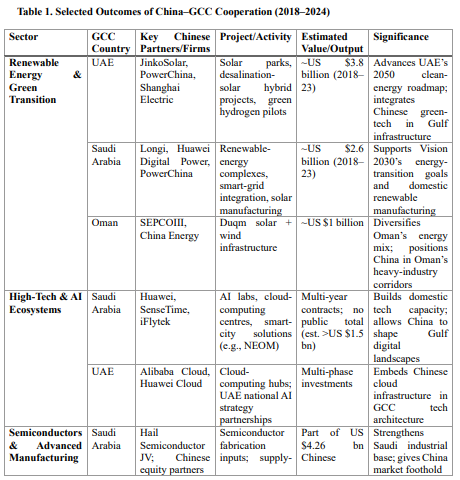
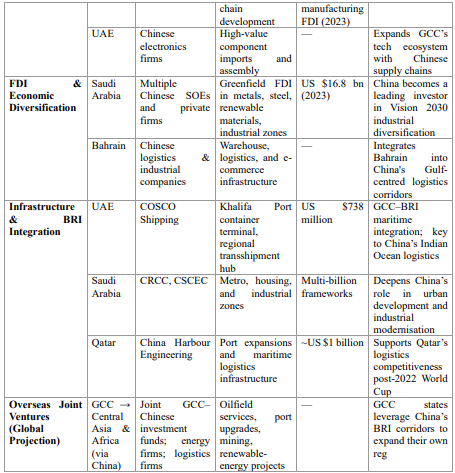
These collaborations include integrating technological solutions such as AI and renewable energy infrastructure, deepening economic interdependency.6 For China, translating this political engagement into concrete Free Trade Agreements, robust infrastructure projects, and consistent capital flows is critical to sustaining foreign investment confidence.
These projects demonstrate that China–GCC cooperation has already moved well beyond hydrocarbons into high-value domains—including advanced manufacturing, digital infrastructure, renewable energy, and global joint ventures. Chinese firms are now embedded in the Gulf’s longterm industrial and technological transitions, while GCC states increasingly leverage the BRI to expand their influence into Central Asia and Africa. Collectively, this deepens structural interdependence between China and the Gulf and positions the GCC pillar as a central vector of China’s global economic projection.
IV. Points of Friction and the Fragility of Neutrality
The inherent tension between the two pillars occasionally manifests as diplomatic friction, forcing China to engage in active damage control to maintain its delicate balance. The most significant recent test occurred during President Xi Jinping’s visit to Riyadh in December 2022.
The joint statement issued after the China-GCC Summit generated significant official displeasure in Tehran. The source of friction was the statement’s explicit affirmation of support for the peaceful resolution of territorial disputes between Iran and the UAE over three islands in the Strait of Hormuz, interpreted by Iran as China siding with the Gulf states.7 Furthermore, the English version of the joint statement, as reported by the Saudi Press Agency, urged regional dialogue to address "the Iranian nuclear file and destabilizing activities" and "to prevent the proliferation of ballistic missiles and drones." This wording deepened the impression that China was joining the Gulf states in pressuring Iran on regional security matters.
To redress the Iranian grievances, Beijing immediately employed diplomatic mitigation. Analysts noted a subtle but critical difference in the Chinese version of the joint statement. The Chinese text called for regional states to address the "Iranian nuclear issue, destabilizing regional activities,…" The inclusion of an additional comma served to separate the nuclear file from the list of destabilizing regional activities, subtly diffusing the impression that Iran was solely responsible for all regional instability mentioned in the subsequent clauses.
This demonstrated that China’s concept of neutrality is not passive impartiality but an active, calculated management of perceptions. The rapid damage control continued during Iranian President Raisi’s state visit to Beijing in February 2023. Xi explicitly went out of his way to reaffirm that China supports Iran in safeguarding its sovereignty and territorial integrity,10 directly addressing the December statement’s implications. This calculated use of ambiguity, followed by immediate political affirmation, underscores that Beijing considers the maintenance of the dualpillar structure worth the risk of temporary diplomatic fallout.
V. Conclusion
China’s dual-pillar strategy represents a balanced diplomacy between political and economic interests. Respectively, Iran functions primarily as a political partner for Beijing, while the GCC states serve as China’s major economic and commercial partners. The two pillars therefore occupy distinct roles within China’s regional strategy, differing both in their areas of emphasis and in the scope of influence they afford Beijing.
The future sustainability of China’s dual-pillar strategy hinges on its ability to preserve a stable regional environment while continuing to avoid the financial, political, and military costs traditionally associated with security provision. This equilibrium, however, is inherently fragile. Should a major regional crisis arise—one that requires a substantial military response to secure critical energy flows, safeguard maritime chokepoints, or stabilise trade routes—China’s persistent reluctance to assume hard-security responsibilities would become unmistakably exposed. In such a scenario, Beijing’s refusal to fill the security vacuum currently occupied by the United States would lay bare the structural shallowness of its regional influence. More importantly, it would threaten to unravel the very foundations of China’s long-term economic engagement in the Gulf, jeopardising its high-value commercial partnerships with GCC states, undermining investor confidence, and weakening the credibility of its political ambitions across the broader Middle East. The dual-pillar strategy, therefore, remains fundamentally contingent on the continuity of U.S.-led regional security—a dependency that imposes inherent limits on the depth, resilience, and strategic autonomy of China’s regional footprint.
Yuan Zhang is a Senior Research Fellow at the Gulf Research Center (GRC)