

Commentary & Analysis
After Washington: Consolidating U.S.–Saudi Strategic Alignment
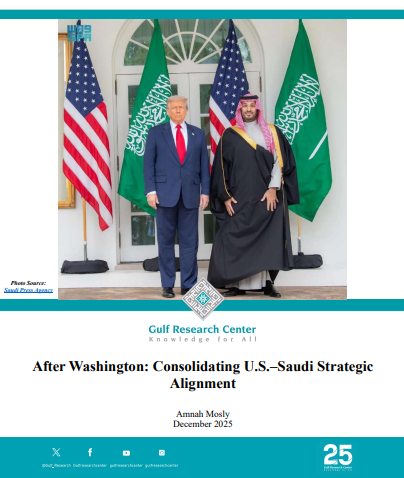
The visit of His Royal Highness Prince Mohammed bin Salman, Crown Prince and Prime Minister of the Kingdom of Saudi Arabia, to Washington, D.C., in November 2025 sought to produce outcomes that would solidify U.S.-Saudi strategic coordination. While it can be argued that Riyadh successfully expanded its access to defense, technology, and investment channels, the decisions taken during the visit still leave questions about Washington’s present and future role in Gulf security. The key to the visit therefore lies not in what was announced, but in the structure and follow-up mechanisms for the many deals that were concluded, which will determine their significance for the overall relationship.
The visit marked a notable elevation in the way HRH the Crown Prince is received in Washington. The ceremonial displays, which ranged from marching bands and flag-carrying horse riders to a military flyover, demonstrated President Trump’s intentions to strengthen the U.S. relationship with the Kingdom. In terms of bi-lateral ties, progress was indeed made in the fields of defense, technology, and investment.
The visit culminated in the signing of the U.S.–Saudi Strategic Defense Agreement (SDA), which provides a formal framework for defense cooperation following years of coordination. By establishing clearer procedures for joint planning, readiness, and interoperability, the agreement reflects an interest in predictable security arrangements rather than mere transactional exchanges. Alongside the SDA, the visit confirmed major defense procurement decisions, including forthcoming F-35 deliveries and the acquisition of nearly 300 American tanks. Despite remaining questions about the exact level of access to defense technology, U.S.-Saudi defense ties continue to form the core of the relationship.
Washington’s decision to formally designate Saudi Arabia a Major Non-NATO Ally (MNNA) signals a commitment from a major security partner at a time when regional threats have grown more complex, and the international system has become increasingly fragmented. Nevertheless, it falls short of fully mitigating concerns about U.S. policy in the region and should be viewed as representing only a first step in reducing the operational uncertainty that has in the past accompanied leadership transitions in Washington. While the SDA and MNNA designation signal the U.S. administration’s intent to retain a central role in regional affairs amid shifting global dynamics and intensifying geopolitical competition, greater clarity and definition of the commitment is still necessary.
A similar assessment applies to economic cooperation. The announcement of Saudi Arabia’s expansion of its U.S. investment commitment to nearly $1 trillion almost doubled the pledge made during the U.S. President’s earlier visit to Riyadh in May. For Riyadh, the intention is clear: to support diversification objectives, technology acquisition, and access to U.S. capital markets. For Washington, the investments translate into job creation, industrial expansion, and a strengthened economic pillar within the partnership. Yet, the sequence of investments and the overall timeline will still need to be outlined.
The same applies to the Joint Declaration on the Completion of Negotiations on Civil Nuclear Energy Cooperation and the AI Memorandum of Understanding, which aim to broaden cooperation in emerging technologies. The Joint Declaration establishes the legal basis for a multi-billion-dollar partnership and confirms the United States as the Kingdom’s preferred partner for civilian nuclear development, but the exact scope remains subject to further negotiation. Similarly, while the Critical Minerals Framework addresses supply chain resilience through coordinated investment, exploration, and processing strategies, its specifics still need to be determined and defined.
On the political and regional level, a degree of divergence remains. The issue of normalization with Israel continues to hinge on the position of the Crown Prince, who maintains that a long-term solution involving the establishment of a Palestinian state must be pursued before the Kingdom can consider such a step. By engaging in intensive debate on the matter, the visit reflected a confident and clear-eyed Kingdom that will not compromise on its assessment that a just resolution for Palestine through a two-state solution based on the 1967 borders with East Jerusalem as its capital is a prerequisite for wider and more lasting regional stability.
The visit further underscores that U.S.-Saudi ties will proceed on a dual tack. By delinking strategic defense capabilities from political concessions, the U.S. acknowledged that Saudi Arabia’s security requirements warrant priority in their own right, particularly given the current regional threat environment. For Washington, this reflects a reassessment of regional priorities, including the need to reinforce security ties with key allies amid escalating tensions and the absence of near-term prospects for Israeli normalization.
Yet, while the breadth of the agreements reflects strong strategic alignment, the focus must now be on implementation. Many of the outcomes, whether in defense, technology, or economic cooperation, were anticipated given the momentum of bilateral discussions over recent months. The signing of these frameworks represents an important step, but it is just the beginning. Translating these commitments into operational capability, industrial cooperation, and measurable economic outcomes is now essential to further enhancing the bilateral relationship.
Ensuring that each agreement is supported by clear follow-up mechanisms and joint oversight structures will be critical to avoiding fragmented outcomes. Without sustained coordination, there is a risk that bureaucratic delays, misaligned expectations, or political transitions could slow the conversion of commitments into practical results. The coming period must therefore focus on ensuring that the agreements reached in Washington translate into tangible gains that reinforce regional stability and support the Kingdom’s long-term strategic objectives.
If these steps are taken, the visit will be seen as marking a transition toward a more formalized and comprehensive U.S.–Saudi partnership. Through coordinated action across defense, technology, energy, and economic domains, the Kingdom is intent on anchoring the relationship in a more stable framework that reflects the current regional and global conditions. U.S.–Saudi ties are thus evolving with potentially significant long-term implications for Gulf stability and the broader regional order.
*Amnah Mosly is a Researcher at the Gulf Research Center (GRC)