Commentary & Analysis
Davos 2026 and the Middle-Power Response to Global Fragmentation
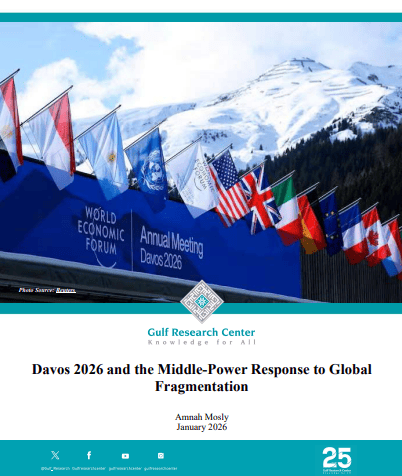
The World Economic Forum Annual Meeting, held in Davos, Switzerland, in January 2026, had a clear theme: The rules-based order is shifting amid persistent geopolitical tensions, strategic uncertainty, and accelerating global change. Intensified great-power competition, evolving alliance structures, and continued ambiguity surrounding international law have reinforced perceptions of a less predictable and less stable international environment. These dynamics have prompted a recalibration of external partnerships, particularly as middle powers increasingly find themselves navigating the pressures of great-power rivalry. The renewed emphasis on power-centric approaches to global governance, reflected in the expanded use of sanctions, the politicization of economic interdependence, and increasingly rigid bloc dynamics, has further exposed the vulnerabilities of the current international transition.
The consequences of this shift have been clear. Middle powers are being compelled to adapt to a more contested global landscape. Canada’s Prime Minister articulated this challenge directly, noting that “great powers have begun using economic integration as weapons, tariffs as leverage, financial infrastructure as coercion, [and] supply chains as vulnerabilities to be exploited.” He further warned that the multilateral institutions on which middle powers have traditionally relied, including the WTO, the UN, and the COP framework, are under increasing strain, leading many states to conclude that greater strategic autonomy is required in areas such as energy, food security, critical minerals, finance, and supply chains.
Against this backdrop, Canada has moved to diversify its international engagement, concluding new strategic partnerships, particularly with Qatar and the UAE. Canada has also expanded its cooperation with Gulf states in mediation and diplomacy and continues to contribute to conflictresolution efforts in the Middle East. This coincides with the GCC states’ growing role as political and economic power brokers at the international level. Canada’s long-standing experience in mediation and peacebuilding positions it as a potentially valuable partner in these efforts. While Canada’s response reflects a more institutionalized effort to reinforce strategic autonomy, Gulf states have adopted a comparatively flexible and interest-driven approach to navigating similar external pressures.
Rather than placing themselves at the center of contesting great-power roles, Gulf states have emphasized diplomatic engagement. This is evident in Saudi Arabia’s efforts to advance the Global Alliance for the Implementation of the Two-State Solution and to reduce regional tensions through dialogue with Iran, Qatar’s mediation in both regional and international crises, and the UAE’s focus on conflict de-escalation and economic diplomacy. The GCC’s diplomatic approach rests on the use of dialogue and effective multilateral institutions as essential tools for managing competition, mitigating conflict, and safeguarding economic and security interests within an increasingly fragmented international system.
In this sense, Gulf states continue to position themselves as reform-oriented actors seeking to preserve the relevance of multilateral institutions rather than allowing them to become instruments of dominance by any single state or bloc. This approach aligns with broader GCC diversification strategies in areas of direct national interest, sustaining long-standing security relationships while expanding economic, technological, and political engagement across Asia, Europe, and the Global South.
The GCC’s strategic partnership with the United States illustrates this evolving posture. While shared interests in areas such as energy stability, counterterrorism, and maritime security remain central, increased variability in U.S. foreign policy and the wider fragmentation of global governance have altered the framework within which the relationship operates. As a result, Gulf states are increasingly balancing reliance on U.S. security guarantees with greater emphasis on independent planning and regional engagement.
The Palestinian issue and the push for a two-state solution represent a key test case of this strategic autonomy. Saudi Arabia’s establishment of the Global Alliance for the Implementation of the TwoState Solution seeks to re-center Palestine on the international agenda and advance a just resolution consistent with the Arab Peace Initiative. This initiative, which has involved public criticism of Israeli actions and a firm stance on Palestinian statehood, contrasts with the more cautious and often Israel-centric approach adopted by the United States, underscoring the GCC’s willingness to pursue independent political strategies when core regional interests are at stake.
At the same time, Saudi Arabia, alongside Qatar and the UAE, has welcomed President Trump’s invitation to join the Board of Peace, a U.S.-led initiative aimed at stabilizing and rebuilding Gaza, as endorsed by United Nations Security Council Resolution 2803. The board’s mission aims to “consolidate a permanent ceasefire, support the reconstruction of Gaza, and advance a just and lasting peace based on the Palestinian people’s right to self-determination and statehood in accordance with international law, thereby paving the way for security and stability for all countries and peoples of the region,” according to a joint statement by the foreign ministries of Saudi Arabia, Türkiye, Egypt, Jordan, Indonesia, Pakistan, Qatar, and the UAE.
In this context, Saudi Arabia’s Foreign Minister, H.H. Prince Faisal bin Farhan, signed the Board of Peace Charter in the presence of President Trump, alongside leaders and representatives of several participating countries, during the Board’s launch ceremony held on the sidelines of the World Economic Forum 2026. The signing reflects the Kingdom’s support for the U.S.-led peace efforts and reaffirms its commitment to the Board of Peace’s mission as a transitional administration to end the conflict in Gaza, support reconstruction efforts, and advance a just and lasting peace in line with international law.
This dual-track engagement highlights the Gulf’s broader strategic approach: avoiding entrapment in great-power rivalry while maintaining engagement with all relevant actors to advance concrete national and regional interests. By diversifying partnerships, keeping open channels with competing powers, and prioritizing diplomacy as a central tool of statecraft, Gulf states are seeking to navigate an increasingly polarized international system without becoming constrained by rigid bloc politics.
*Amnah Mosly is a Researcher at the Gulf Research Center (GRC)