Commentary & Analysis
Somaliland, Recognition Politics, and Gulf Rivalries in the Horn of Africa
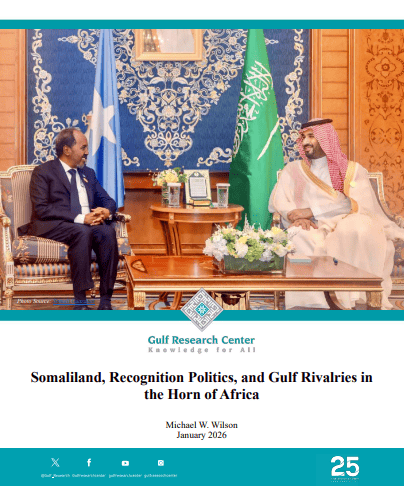
Following the civil war in 1991, Somaliland broke away from Somalia and declared itself an autonomous state. Since then, it has formed a government through subsequent democratic elections, adopted its own currency, and established a constitution independent from Somalia. Despite these efforts to establish sovereignty, it has failed to gain recognition from the international community, notably from Somalia, which still claims ownership over the territory.
Still, for over 30 years, Somaliland has sought diplomatic recognition, willing to give up almost anything in exchange. It engaged in discussions with Ethiopia to lease the DP World Berbera Port in exchange for potential future recognition. As a landlocked country that relies on Djibouti’s port for trade and handling of 90% of its imports and exports, leasing the Berbera Port would enable Ethiopia to diversify its markets and reduce trade costs by breaking its dependence on Djibouti.
In December 2025, Israel became the first country to recognise Somaliland’s independence in a move that was met with condemnation from several countries, including Saudi Arabia, Qatar, and members of the African Union, among others. Adamant to expand on the Abraham Accords, Israel officially recognized the Republic of Somaliland with the expectation of Somaliland joining the Accords. With this recognition, Israel broke Somaliland’s diplomatic isolation and established an ally in the Horn of Africa, laying the groundwork for a potential Israeli military base on the Bab al Mandeb Strait. In response, Somalia’s Defence Minister Hmed Fiqi alleged that Israel would forcibly displace Palestinians to Somaliland, a claim the breakaway territory has denied.
Israel’s recognition of Somaliland sits within a broader regional context marked by increasing competition, escalating conflict, and international threats to critical maritime corridors. These pressures arise from attacks that have plagued the Horn of Africa, notably from Houthi rebels. In this regard, access, partnerships, and military positions near the Bab al-Mandeb offer geostrategic advantages and leverage over a critical chokepoint. Through these initiatives, Israel appears to be positioning itself more firmly within the evolving Red Sea security landscape and strengthening its influence within it.
The Gulf states view Israel’s recognition of Somaliland with grave concern. Notably, Saudi Arabia has rallied its allies to support the government in Mogadishu. In January 2026, the Kingdom convened foreign ministers of the Organisation of Islamic Cooperation’s member states to condemn the mutual recognition between Israel and Somaliland. Saudi Arabia’s Vice Foreign Minister, H.E. Waleed Elkhereiji, affirmed the Kingdom’s rejection of “any attempts” to subvert Somalia’s unity and territorial integrity. Accordingly, Elkhereiji urged allies to adopt a unified position and unequivocally reject separatist factions in Somalia. This response reflects a broader Gulf concern that new military footholds and escalating rivalries around the Bab al-Mandeb could aggravate polarisation in the Red Sea and accelerate regional militarisation.
In the meantime, the UAE’s relations with Mogadishu have been contentious. Although the UAE has not recognised Somaliland, it has invested over 400 million USD in developing the Berbera Port. Mogadishu views this as an affront to its sovereignty and a strain on its relations with the UAE. In January 2026, the Somali government cancelled all agreements with the UAE, including shutting down its military bases and large infrastructure projects such as the ports of Berbera, Bosaso, and Kismayo, citing threats to its “sovereignty, national unity, and political independence.”
This friction will undoubtedly lead to a lengthy court battle, as questions will arise over Somalia’s jurisdiction and authority to control Somaliland’s assets. This tension may encourage the UAE to recognise Somaliland sooner than expected to protect its assets in the breakaway region, as Berbera’s proximity to the Bab el-Mandeb Strait makes it strategic for regional powers aiming to stabilise maritime trade routes.
With Somaliland gaining its first international recognition, maintaining Somali unity will be ever more challenging. Countries including Turkey and Qatar have made attempts to mediate accords between the two sides, renouncing Somaliland’s independence as was done during the Ankara Communique of 2013. The current developments will force countries to choose whether to support Somalia or follow in Israel’s footsteps. While most members of the African Union and OIC have chosen the former, the UAE, the United States, and Ethiopia appear to lean towards recognising Somaliland.
In the wider context, this demonstrates a growing alliance between African and Arab states on the global stage. The African Union’s position and the broader Arab stance, both of which emphasise that Somaliland is an integral part of Somalia, constitute a clear warning against unilateral recognition and underscore the risks that such moves contribute to further fragmentation of African states and the weakening of already fragile political systems. In a continent where several states face internal conflict, contested legitimacy, and campaigns to create autonomous nations, external recognition of breakaway regions could set a destabilising precedent. It also reflects a broader pattern of Africa-Arab coordination on shared political positions, including continued support for Somali territorial integrity and, in parallel, the unified stance of African states on the Palestinian cause, including South Africa and Ghana.
Israel’s recognition of Somalia marks an escalation of geopolitical issues in the Horn of Africa, which can threaten stability, and it reinforces how maritime insecurity in the Red Sea is shaping regional strategic decisions. By recognising Somaliland, Israel is pursuing a strategic presence near the Bab al Mandeb at a time when Houthi threats and wider regional instability continue to endanger critical trade routes. However, the move also carries with it serious regional risks, as it could weaken Somalia’s internationally recognised sovereignty, raise tensions in the Horn of Africa, and further polarise the Red Sea region, which is already moving toward greater militarisation.
By rejecting Somaliland’s bid for independence, African and Arab states demonstrate that unilateral recognition sets a destabilising precedent. In the near term, Somaliland’s push for international recognition in exchange for access to its critical assets forces regional actors to reconsider their calculus and weigh strategic gains against the long-term costs of fragmentation, insecurity, and escalating competition.
Michael W. Wilson is a Researcher at the Gulf Research Center (GRC)