
Commentary & Analysis
India-GCC Free Trade Agreement: A New Phase in Economic Cooperation and Implications for the Gulf
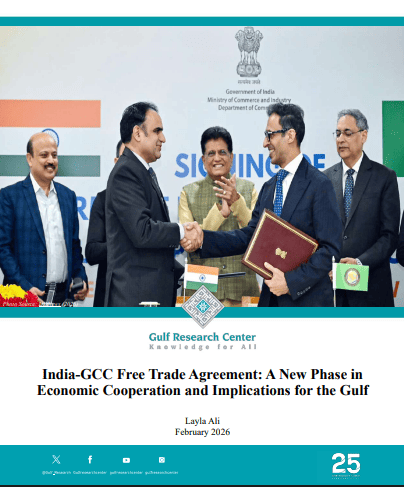
The signing of the Terms of Reference (ToR) between India and the six member states of the Gulf Cooperation Council (GCC) on February 5, 2026, represents an important procedural step in the evolution of India-GCC economic relations. The ToR sets the framework for the resumption of negotiations toward a Free Trade Agreement (FTA), following a prolonged pause of nearly two decades. This development reflects a shared interest in reassessing trade arrangements and exploring avenues for deeper economic cooperation, in line with shifting regional and global economic dynamics.
The ToR establishes the scope, structure, and modalities for renewed negotiations and signals a recalibrated approach by both sides. Earlier efforts to conclude an India-GCC FTA in 2006 and 2008 were suspended after the GCC opted to defer trade negotiations with external partners. The current resumption suggests a renewed convergence of priorities, informed by evolving trade patterns and strategic considerations. This move also comes against the backdrop of India’s recent trade agreements with the European Union on January 27, 2026, and the United States on February 2, 2026, as well as existing comprehensive agreements with individual GCC members, including the UAE (implemented in May 2022) and Oman (finalized in December 2025). Together, these developments provide a broader context and technical foundation for advancing discussions at the regional level.
From an economic perspective, trade between India and the GCC has expanded steadily in recent years. In 2024-25, bilateral trade reached $178.7 billion, up from $161.82 billion in the previous fiscal year. India’s exports to the GCC grew modestly by 1 percent to $57 billion, while imports increased by 15.33 percent to $121.7 billion. This pattern reflects India’s continued reliance on the Gulf for energy supplies, with crude oil and liquefied natural gas (LNG), particularly from Saudi Arabia and Qatar, accounting for a substantial share of imports.
Trade balances further illustrate the energy-driven nature of this relationship. In 2024-25, India recorded trade deficits of $26.76 billion with the UAE, $18.36 billion with Saudi Arabia, and $10.78 billion with Qatar. These figures highlight structural imbalances rooted in energy imports. An FTA could, over time, contribute to a more diversified trade profile by facilitating greater market access for Indian goods and services, while also supporting broader sectoral cooperation. For GCC states, an FTA with India aligns with ongoing economic transformation agendas, including Saudi Arabia’s Vision 2030 and similar diversification strategies across the region. Enhanced access to India’s large and expanding consumer market could support the growth of nonoil exports and emerging industries, reinforcing efforts to reduce dependence on hydrocarbons and expand value-added sectors.
An FTA could also encourage deeper investment linkages. GCC sovereign wealth funds are increasingly seeking diversified global investment opportunities, and India’s growth trajectory, infrastructure development, and expanding technology ecosystem make it a compelling destination. A structured trade framework could improve regulatory clarity and predictability, supporting two-way investment flows and long-term capital engagement.
Food security represents another area of potential convergence. India’s role as a major agricultural producer positions it as a reliable partner in meeting the GCC’s food import needs. Strengthening trade arrangements could enhance supply chain resilience and contribute to the Gulf’s broader food security strategies.
People-to-people ties remain a central pillar of India–GCC relations. Nearly half of the estimated 32 million non-resident Indians worldwide live and work in the Gulf, forming a substantial social and economic bridge between the two regions. Remittances play an important role in India’s economy, while Indian professionals and workers contribute across key sectors in GCC economies. An FTA framework could further support mobility for skilled professionals and reinforce human capital cooperation.
Beyond economics, the renewed FTA process also reflects wider geopolitical considerations. For India, deeper engagement with the GCC complements its “Look West” approach and supports diversified economic partnerships beyond its immediate region. For GCC states, strengthening ties with India fits within a broader strategy of expanding global partnerships and balancing relations across a more multipolar international system. The GCC’s recent decision to separate investment agreement discussions from FTA negotiations further illustrates a pragmatic effort to advance trade cooperation incrementally.
In conclusion, the resumption of India-GCC FTA negotiations reflects growing economic interdependence and an evolving strategic outlook on both sides. While negotiations are likely to face challenges, including regulatory alignment and trade balance considerations, the process offers opportunities to enhance trade diversification, investment cooperation, energy and food security, and people-to-people engagement. Taken together, these elements point toward a gradual deepening of economic partnership across the Indo-Gulf corridor.
Layla Ali is the Senior Research Associate at the Gulf Research Center (GRC).