

Commentary & Analysis
Anchoring the South: NATO’s Untapped Maritime Frontier
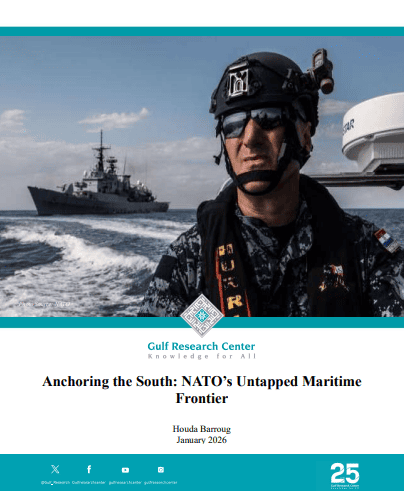
A core element of NATO’s rhetoric is its commitment to a “360-degree vision of security.” The concept emerged in the mid-2010s and has been continuously reiterated throughout the Alliance’s summits and statements, expanding NATO’s definition of and approach to its security threats. This new conception expands the Alliance’s security dimension on hybrid, emerging, and human-centric threats. It further complements the Alliance’s 2022-defined three core tasks of Deterrence and Defense, Crisis Prevention and Management, and Cooperative Security, by moving beyond the traditional realm to encompass the east, south, land, sea, air, cyber, space, human, and climate security challenges.
While the 360-degree framework is certainly ambitious in theory, NATO’s communiqués, force deployments, and overall decision-making continue to prioritize the traditional flanks. The Hague Summit in June 2025 served as a first reflection of how this comprehensive approach is more aspirational than operational, especially given the fact that leaders and partners from NATO’s southern neighborhood have not been included in much of the discussion. Such an exclusion points to a deeper blind spot than merely a matter of geographical oversight. It represents strategic misalignments and fundamental gaps in NATO’s ambitions and the investments required to address the constantly evolving challenges.
The Alliance’s 2024 commissioned report, titled “Supporting NATO’s Comprehensive and Deep Reflection Process on The Southern Neighborhood,” explicitly identifies and acknowledges these shortcomings, highlighting that the current political, operational, and institutional outreach mechanisms remain fragmented. As such, NATO’s current engagement approach demands a much-needed rethinking of the Alliance’s global strategy, and particularly the 360-degree vision of security.
Defining NATO’s Southern Neighborhood Strategy
NATO’s Southern Neighborhood should be understood as more than the Alliance’s Mediterranean Strip on Europe’s southern shore. It includes the broad, interconnected arc from Morocco to the Levant, including the Sahel and the Gulf. In its engagement with the region, NATO has been limited to regional cooperation frameworks: North African and Levantine countries participating in the Mediterranean Dialogue, and the Gulf countries engaged through the Istanbul Cooperation Initiative (ICI.)
While both the Mediterranean Dialogue and ICI have supported the Alliance’s presence in the respective regions, they serve as technocratic, auxiliary mechanisms rather than core components of NATO’s strategy. This arc is characterized by the various challenges outlined in NATO’s “360-degree vision of security,” held together by overlapping conflict systems, energy corridors, and maritime routes. This dense composition makes the spillovers of shocks from one sub-region (mainly the Southern Neighborhood) to another (Europe) inevitable.
The renewed and growing interest in boosting and increasing NATO’s engagement with the Southern Neighborhood was solidified in the Washington Summit with the appointment of Javier Colomina as NATO’s Special Representative for the Southern Neighborhood. To implement the broader “360-degree vision of security,” the 2024 Summit identified an action plan with three main pillars, not verbatim:
- Enhancing political dialogue and visibility to substantially increase communication with Southern members and foster a better understanding of common security threats, and correct NATO-related misconceptions. This will be critical to strengthen political ties.
- Practical cooperation and capacity building to help generate and implement specific, results-oriented initiatives that can successfully respond to regional partners' needs. The focus here is on defense institution building, counterterrorism, cyber security, and maritime security,
- Strategic awareness and monitoring to help improve NATO’s oversight, analysis, and early response mechanisms to potential security threats.
Under this new framework, NATO’s engagement has so far centered on official visits to Southern countries: Morocco, Oman, and Egypt, and talks with League of Arab States representatives in Geneva, such as ahead of the Hague Summit.
Yet, NATO has not institutionalized and operationalized this engagement, and as such, NATO’s role and overall action plan can be characterized as more symbolic than anything else. The existing gaps in NATO’s institutional design and political prioritization reflect the limited mandate and resources allocated for the arc. This is because the South is continuously seen as a crisis-response afterthought rather than a region necessitating proactive strategic engagement and investment. This institutional and operational baseline establishes the framework for a comprehensive evaluation of which capability domains can most efficiently support NATO's involvement in the South.
Competitive Influence and the Crowded Southern Arena
It is important to highlight that the existing structural weaknesses characterizing the Southern neighborhood are exploited by external actors, such as China and Russia, to weaken NATO’s outreach. This should therefore be seen as a direct challenge to NATO’s Southern engagement. While the NATO’s Southern engagement has traditionally relied on coalitionbuilding, China and Russia exploit the instability, undermine Western partnerships, and compete for influence, creating hybrid threats and dependencies.
On the economic front, China leverages the Belt and Road Initiative (BRI) in infrastructure, constructing and financing ports in Djibouti and Oman as well as creating long-term fiscal vulnerabilities through debt-traps. Russia focuses on resource extraction deals and employs an “instrumental” strategy that (1) disperses Western attention and resources, (2) bolsters authoritarian regimes, (3) disseminates disinformation regarding a "Collective West" oppressing the Global South, and (4) collaborates with other revisionist powers including Iran, China, and North Korea. This policy enhances access agreements, logistics hubs, and informal bases that can bolster Russian deployments throughout the broader Mediterranean and into neighboring maritime areas.
Both strategies reflect economic prioritization over capacity-building and deliberately underfund local marine capabilities, compelling partners to depend on external forces for the protection of their commercial lanes and coastal infrastructure. China’s approach further fosters debt ties.
Both countries also focus on filling the vacuums amidst Western withdrawals in Syria, Libya, the Sahel, Sudan, and Afghanistan, among others. In this realm, both China and Russia continue to work on expanding their political and military footprints. While the former increases its appeal through “consultative,” “non-interference” diplomacy, the latter maintains informal military bases across various countries in the region and seeks port access arrangements that would facilitate a more permanent naval presence. Both also solidify their presence through arms deals, maritime surveillance assets, coastal defense systems, and naval platforms, ensuring securing long-term security alliances.
Although neither China nor Russia is seeking dominance in the region, they successfully challenge NATO in complementary ways, particularly in the maritime domain. This significantly erodes NATO initiatives and image as the preferred partner, especially given its conditional engagement and emphasis on Western norms.
The argument here is that the focus should not be on complete abandonment of NATO’s normative framework: rather, it should be reinforced by coupling conditionality with concrete capacity-building initiatives that make further alignment with Beijing and/or Moscow less appealing.
In the context of the 360-dgree vision of security which allocates NATO’s limited resources across all potential danger vectors, the direct result is a lack of clear prioritization of the Alliance’s activities in the South. It reveals a deeper blind spot, and in particular NATO’s inability to prioritize a set of core missions in a region where it is already overextended. These misalignments arise thus from the absence of a prioritization framework. Because the Southern flank is at the intersection of some of the world’s most dynamic maritime routes, any regional instability triggers rapid expansion and repercussions on European energy supplies, trade, and overall key supply chains. This situation implies that maritime security is the most pressing strategic threat for both the north and south flanks, particularly for the EU and GCC.
NATO's distinctive naval assets and cohesive missile-defense capabilities provide it with an unparalleled advantage over any regional competitor; thus, focusing resources on safeguarding sea lanes, securing vital maritime chokepoints, and strengthening missile-defense positions presents the most effective strategy for stabilizing the Southern neighborhood. Prioritizing maritime security, along with missile defense, at the forefront of NATO's Southern agenda effectively aligns the Alliance's military capabilities with the fundamental weaknesses that contribute to regional instability.
Turkey and GCC States: Inside the Southern Equation
The role of both Türkiye and the GCC states should be closely examined in the context of the above discussion. Türkiye, as a NATO member, and the GCC states as NATO partnership countries represent the regionally most capable but also unpredictable allies. More crucially, both Türkiye and the GCC are crucial maritime actors situated along the Alliance's primary maritime communication routes in the Gulf/Red Sea, Eastern Mediterranean and Black Sea regions.
Ankara alternates between collaborating with Russia, and hedging against it, while certain GCC capitals intermittently engage in autonomous security agreements that veer from Alliance anticipations. Türkiye has been more influential in the region in ways that NATO has been unable to counter. Despite the Republic being part of the Alliance, its assertive foreign policy strategy in the Southern Neighborhood complicates and undermines NATO’s ability to foster unified engagement and project power. Ankara's partisan military operations and often contrasting security priorities often impede its allies' goals. This weakens the alliance and undermines collective responses to regional threats.
These frictions exert direct consequences on maritime transportation. Ankara’s operations in Syria, and its balancing act with Russia prioritized bilateral over alliance mechanisms, eventually sidelining NATO. The Republic’s PKK Focus and operations in northern Iraq also bypassed NATO coordination. Despite its prioritization of counterterrorism, Türkiye’s autonomy complicated the Alliance’s collective joint efforts to stabilize Iraq’s north and fight against ISIS. Moreover, Türkiye’s direct military involvement in Libya in 2020 clashed with France, and eventually halted NATO training missions and led to France’s withdrawal from Operation Sea Guardian.
Türkiye’s governance of the Turkish Straits, as stipulated by the Montreux Convention, along with its extensive coasts along the Black Sea and Eastern Mediterranean, and its advancing naval and unmanned systems capabilities render the Republic essential for a cohesive NATO maritime strategy in the South and the Black Sea. Ankara's strategic ambiguity, combining hedging between NATO and Russia while pursuing its own foreign policy that often contradicts NATO interests and efforts, leads to intra-alliance rifts that make the Alliance’s engagement fragmented and undermine potential partners’ trust. NATO should aim to institute a structured “Strategic Dialogue with Türkiye” that offers incentives for alignment and clarifies red-lines, creating a more effective, joint rapid-response mechanism for dispute resolution and solidifying the Republic’s position within a collaborative maritime-security framework.
As for the GCC member countries, Bahrain, Kuwait, Qatar, and the United Arab Emirates, although formally aligned through the ICI, continue to pursue strategic agendas that complement but also complicate NATO’s objectives. In practice, although Saudi Arabia and Oman participate in selected initiatives within the framework, they remain non-ICI members. The GCC nations are situated along the Strait of Hormuz, the Bab al-Mandeb, and the broader approaches of the Arabian Sea. Their security is significantly reliant on trade and energy transit in these regions, where NATO possesses a distinct superiority in naval capabilities and maritime security expertise.
The UAE's bombings in Libya along with Qatar’s and Türkiye’s supported mediation in Gaza exemplify significant regional intervention capacities that NATO lacks. This is not to suggest that NATO needs to emulate these unilateral interventions. Rather, it is to recognize the extent of regional capabilities and to advocate for enhanced operational coordination and burden-sharing where interests converge. Numerous GCC nations have collaborated more closely with U.S.- and U.K.-led initiatives, such as the International Maritime Security Construct, Combined Maritime Forces (CTF-152 and CTF-153,) and CENTCOM's Task Force 59 on unmanned and AI-enhanced naval systems. This indicates the GCC states’ capability and willingness to assist in maintaining the safety of the regional maritime routes.
Nevertheless, their normalization with Israel, increased Chinese investments in regional ports (Jebel Ali,) and armament agreements with Russia (despite ICI membership) establish hedging mechanisms that NATO cannot readily regulate. This dichotomy necessitates that NATO engage in diplomatic efforts to denounce activities that compromise Alliance objectives while concurrently pursuing constructive collaboration with GCC allies on mutual security challenges. This signifies a transition from a predominantly political ICI discourse to organized maritime security collaborations. These collaborations would encompass combined operations to safeguard chokepoints, mutual awareness of the marine zone, and synchronized protection of critical offshore and port facilities. This would diminish the attractiveness of depending on security assurances from China or Russia.
The GCC countries’ parallel outreach to Beijing and Moscow forces NATO out of strategic leadership and into reactive accommodation. This directly affects rule- and norm-making in key maritime routes crucial to Euro-Atlantic security. The outcome is a policy paralysis that exposes NATO’s lack of and inability to develop a clear strategy towards the Southern Neighborhood. A cohesive Southern strategy necessitates NATO to integrate political engagement that compels the GCC to address contentious policies with pragmatic collaboration that leverages their intervention capabilities for mutually beneficial security objectives, with maritime security and the protection of common sea routes for trade as the primary focus for such burden-sharing
Towards a Coherent Southern Strategy
NATO’s southern engagement needs to be reformed from symbolic gestures to strategic substance, primarily by prioritizing maritime security and safeguarding vital sea lines of communication linking the Mediterranean, Red Sea, and Gulf. The first initiative should be upgrading the Mediterranean Dialogue and ICI into high-level political platforms that will serve as the political framework for a NATO-led Southern maritime security mechanism.
Prior efforts to enhance these frameworks have been rejected: Mediterranean Dialogue participants are cautious about increased politicization associated with the Israel-Gaza conflict, and most GCC states favor bilateral agreements rather than multilateral platforms. In the absence of regional willingness, NATO could initiate a “Track-II” Euro-Mediterranean-Gulf forum that convenes think tanks, academic institutions, and industry leaders to generate political momentum prior to establishing formal higher-level platforms and to evaluate practical methods for marine collaboration, such as information exchange about situational awareness and safeguarding ports and energy infrastructure. This would signal an unprecedented level of seriousness on NATO’s end, focusing primarily on regular summits and both differentiated and joint partnerships packages that would address country- and region-specific needs and demands while providing them with a shared awareness of the South's marine deficiencies and requirements.
A more important initiative is operationalizing the Southern Neighborhood as a genuine strategic actor and defense planning priority by viewing vulnerabilities of Southern maritime infrastructure, chokepoints, and coastal stability as primary Alliance concerns instead of peripheral crisismanagement issues. NATO needs to replace episodic deployments by allocating standing maritime capabilities for a continuous Mediterranean-Red Sea presence that can deter adversarial naval operations, safeguard critical chokepoints, and assist allies in coastal defense while monitoring the marine sector. Southern threats scenarios should be approached as core NATO threats and integrated into core defense and deterrence strategies alongside eastern contingencies to ensure that planning for the Black Sea, Eastern Mediterranean, and Red Sea is conducted within a unified maritime domain.
Most critically, NATO needs to put in place a distinct, dedicated Southern command structure that is equal to Joint Force Commands Norfolk and Brunssum and which possesses an integrated maritime operations HQ tasked with coordinating and sustaining the Southern strategy. This will ensure that the region obtains regular resources instead of ad hoc reactive responses to emerging crises, and that the Alliance's force generation and capacity development programs must consistently include the maritime security requirements of the South.
Southern Neighborhood countries should be included throughout the process of building a potential coherent strategy, which is why the Türkiye 2027 summit offers a historic opportunity and window to explore the details, objectives, and mechanisms of this partnership. Failing to do so will cost the Alliance its credibility in the Southern region and global aspirational irrelevance by insufficiently allocating resources to the maritime sector of its comprehensive strategy, hence facilitating external competitors' exploitation of this oversight.
*Houda Barroug is a Researcher at the Gulf Research Center (GRC)