Commentary & Analysis
The Hormuz-Ras Laffan Crisis: Serious Impacts on Global Gas Markets
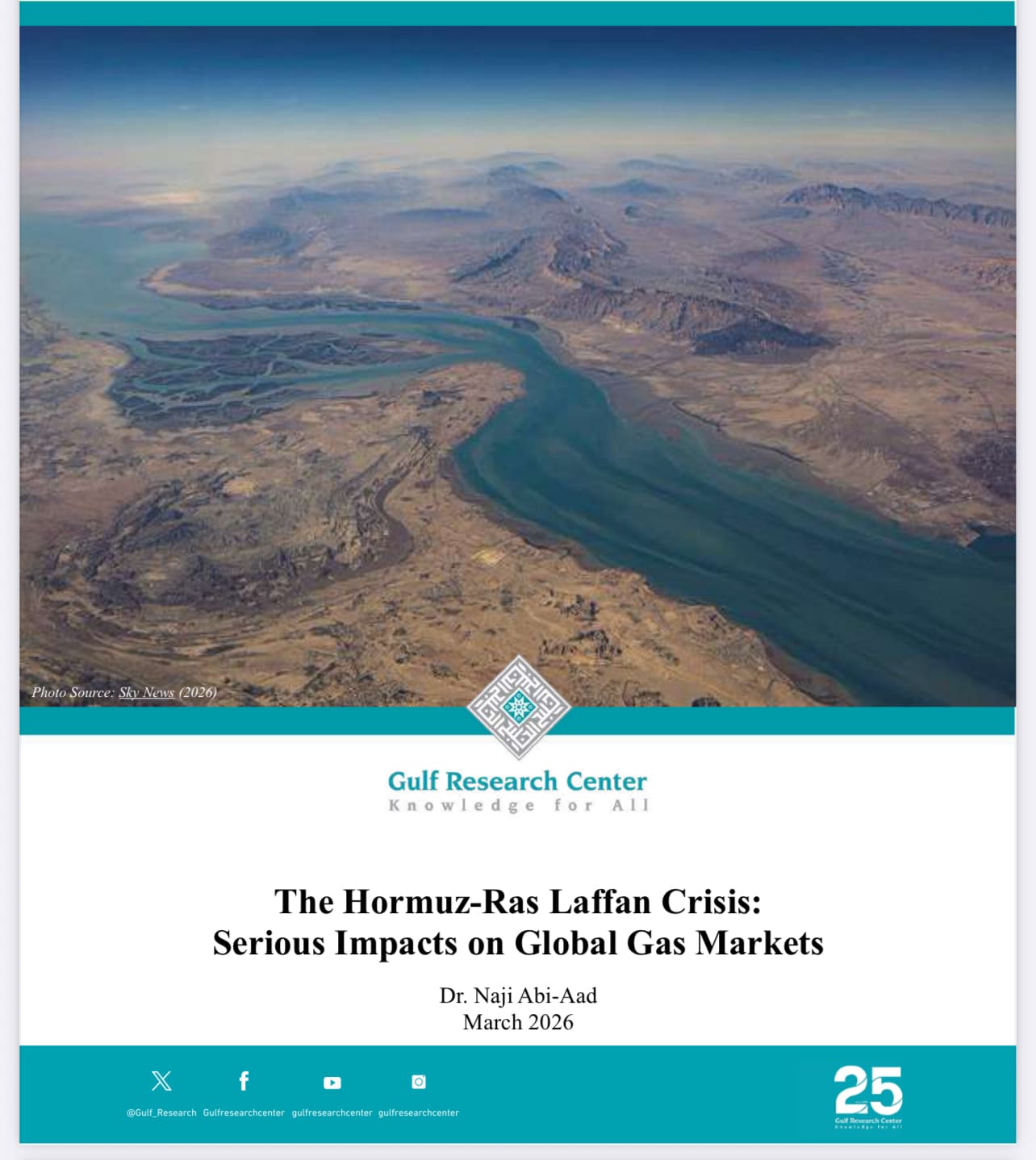
On the 2nd of March 2026, a senior commander from Iran’s Revolutionary Guards declared that the Strait of Hormuz had been closed and warned that any vessel attempting to transit the waterway would be targeted. Although the United States Central Command, which covers the whole Middle East, confirmed that the Strait was not closed, oil and gas tanker traffic in the Gulf region is already being seriously affected.
Located between Oman and Iran, the Strait of Hormuz functions as a vital artery for global oil and gas trade. While in 2025 roughly 13 million barrels of oil passed through Hormuz per day, representing about 31 percent of all seaborne crude flows, some 85 million tons of liquefied natural gas (LNG), or around 21 percent of the global LNG trade, were also channelled through the Strait.
On the same day, QatarEnergy, one of the world's largest LNG producers, officially halted its liquefied gas and associated liquids production following Iranian drone attacks on its Ras Laffan Industrial City, the world's largest LNG export facility. The state energy company declared force majeure, a legal clause that permits it to miss contracted deliveries without penalty due to circumstances beyond its control, though no structural damage to the facility has been reported.
The shutdown of Ras Laffan, from which around a fifth of global LNG is exported, together with the closure of the Strait of Hormuz are sending strong shockwaves across global energy and gas markets.
Actually, export of natural gas from the Gulf Arab countries is done exclusively in liquefied form as LNG, with no pipelines linking the region to outside markets. LNG from the Gulf is exported from Oman, the United Arab Emirates (Abu Dhabi), and mainly from Qatar. Oman, which supplies around 10.4 million tons of LNG annually, has its liquefied gas export plant located at Qalhat on the Arabian Sea, outside Hormuz, and is therefore not affected by the closure of the Strait.
Abu Dhabi, which was historically the first Gulf state to export LNG in 1977, exports around 6 million tons of liquefied gas per year from its plant at Das Island, a crucial industrial island in the Gulf, located 160 km northwest of the emirate, serving as a major hub for processing and liquefying gas and exporting LNG (in addition to crude oil, liquid petroleum gas (LPG), and sulphur). Most of Abu Dhabi’s LNG supplies are exported to Asian markets, India in particular.
Qatar has played a pivotal role in the LNG market, both regionally and globally. Its current annual capacity amounts to more than 77 million tons of LNG, or around 19 percent of the world’s total. In recent years, some 80 percent of Qatar’s LNG production has been exported to Asian markets, to China and India in particular. About 13 percent of the Peninsula’s LNG exports have been channelled into European markets, especially to Italy and the United Kingdom (UK), while the remaing 6 percent has been exported to regional markets, Kuwait and Dubai in particular.
In terms of proven reserves of natural gas, Qatar has the third largest reserves in the world, after Russia and Iran, with some 23,900 billion cubic meters, or around 12 percent of the world’s total. The reserves-to-production (RP) ratio for Qatar, a measure often used as an indication of near-term supply capabiliy, is the highest in the world with more than 144 years worth of stores. The proven reserves of natural gas in Qatar are alone sufficient, even if no more discoveries are made, to satisfy current worldwide gas demand for more than 6 years.
Notably, about 99 percent of Qatar’s proven gas reserves are in non-associated form with rich liquid content. This fact makes gas output in Qatar unrelated to its crude production, allowing for more economic development. Associated gas is produced alongside crude oil from oil reservoirs, often requiring separation and sometimes flared, whereas non-associated gas comes from reservoirs containing little or no oil and is produced directly for market. In fact, Qatari gas has been produced from reserves found in the North Field, the largest non-associated gas structure in the world, which was discovered in 1971 and is located fully offshore, 80 kilometers northeast of the Peninsula’s onshore land, and extends over an area of about 6,000 square kilometers.
Qatar and its huge gas industry benefits from aspects such as a very low cost of gas production, relatively low domestic demand, strong governmental support, a strategic geographical location in relative proximity to the key gas markets, a stable political system, a straightforward decision-making process, a liberal economic environment, and a wide openness to foreign investment including the world’s largest oil and gas companies.
When looking at the impacts of the Strait of Hormuz’s closure and the shutdown of Ras Laffan, much would depend on the duration of the closure and whether there is any extensive damage to the LNG facilities. In fact, potential damage to or blockage of key infrastructure there could lead to long-term supply constraints with serious enduring damaging impacts.
In the short-term, the restricted traffic through the Strait of Hormuz and attacks such as those on Ras Laffan have caused immediate, severe spikes in global gas prices, particularly affecting Asian and European markets. The benchmark European gas price, traded on the Dutch TTF hub, immediately rose by as much as 45 percent, the sharpest single-day rise since the start of the Russian-Ukrainian crisis in February 2022. UK natural gas prices also surged, with the NBP benchmark climbing sharply in tandem with continental markets. A sustained blockade and long closure could cause European wholesale gas prices to triple, while also causing significant shortages, forcing Asian buyers to compete for limited alternative supplies.
In addition to the massive price spikes, there are other key impacts on gas supply and markets as a result of what is happening. In fact, the global supply of LNG has been disrupted, with about 20 percent of the world's trade of liquefied gas, primarily from Qatar, being choked off. With the high exposure for Asian countries (China, India, Japan) that rely on the Gulf for LNG imports, regional shortages are expected to be seen there. While some countries may have stockpiles, a sustained closure would likely trigger severe energy market stress and potential industrial, as well as economic, disruption.
The shortage in Asian markets would increase competition for non-Middle Eastern LNG supplies, especially from the US, and would consequently inflate costs worldwide, similar to the 2022 energy crisis due to the Russian-Ukrainian conflict. In addition, shipping insurance and freight rates would surge, with spot daily LNG shipping rates potentially exceeding US$100,000.
One aggravating factor is the lack of alternative routes or gas supply buffers, with no alternative pipelines and shipping routes capable of handling at least a fraction of the missing LNG volumes and providing limited relief. Another exacerpating fact is the lack of adequate spare global capacity to fill the LNG supply gap.
It is true that US LNG producers are racing to fill the gap, with two of the largest producers there seeking to squeeze additional volumes of liquefied gas from their existing facilities and bring more capacity online as consumers around the globe brace for supply shortages. In addition, traders and buyers of US LNG are rerouting cargoes to capitalize on skyrocketing prices as customers battle for supplies. But the current US LNG capacity that can be diverted to fill the 85-million ton/year gap caused by the restrictions of Hormuz and the attack on Ras Laffan is not more than 30 million tons/year.
Another impact of the LNG supply gap would be for other available alternative energy sources to displace liquefied gas in many consuming nations. Coal would be the main benefitor in countries like China, India, and Germany. China is already boosting domestic coal production and consumption to offset high-priced, volatile LNG imports and ensure energy security. In India, local coal which still fuels 70 percent of the power sector, would most probably profit from the limited supplies of LNG and its high costs. In Germany, the domestic coal sector continues to play a significant role in securing energy supply despite long-term phase-out plans, frequently profiting from volatile LNG markets and supply bottlenecks.
Moreover, the present Hormuz-Ras Laffan crisis would badly affect the security reputation of Gulf gas (and oil) suppliers. That would push gas developers from the region to seriously explore the possibility of building alternative outlets for their gas, surpassing the Strait of Hormuz, through the construction of export gas pipelines linking the Gulf reserves to main consuming centers in Asia and Europe.
Gas developers in the Gulf would also aggressively seek and acquire gas liquefaction assets outside the area, especially in the US. Already, Qatar has been developing the Golden Pass, while Abu Dhabi recently acquired shares in the US NextDecade plant and in the Galp LNG unit in Mozambique, whereas Saudi Arabia bought stakes in MidOcean Energy LNG, secured supply deals with Commonwealth LNG, and signed MoUs with NextDecade and Sempra.
To conclude, the direct and indirect impacts of the Strait of Hormuz’s closure and the shutdown of Qatar’s LNG facilities at Ras Laffan on the global energy and gas markets became immediately visible, but they will become much more noticeable and deep-rooted with each passing day, and will depend on the duration of the closure and the degree of physical damage that they may incur.
Dr . Naji Abi-Aad is the Senior Advisor on Energy Studies at the Gulf Research Center (GRC).